J-11 Responsive Dragon
Chinese modernized variant of the Soviet Su-27 Flanker twin-engine combat aircraft. Key figures: top speed 2,500 km/h, range 3,530 km, service ceiling 18,500 m, max takeoff weight 33,000 kg, unit price $30M, built 442. In service with 1 air force as of 2026 — China (495).
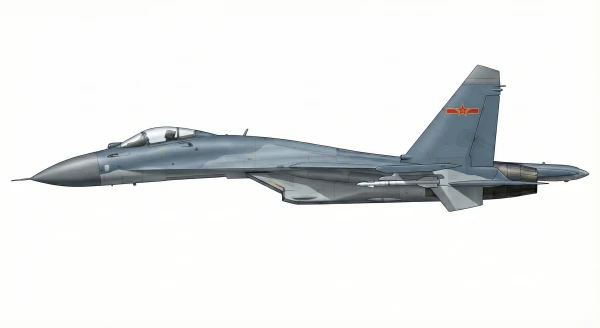
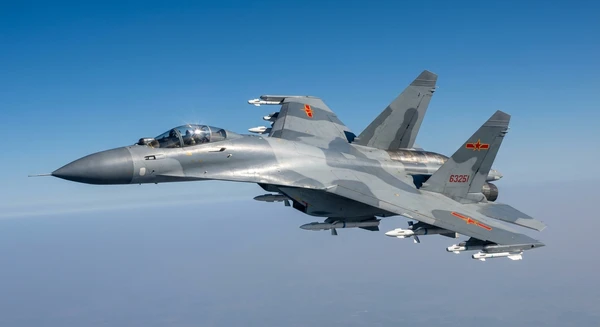
| Crew | 1 |
| Length | 21.9 m (71.9 ft) |
| Wingspan | 14.7 m (48.2 ft) |
| Height | 5.9 m (19.4 ft) |
| Wing area | 52.8 m² (568.8 sqft) |
| Empty weight | 16,380 kg (36,112 lbs) |
| Max. takeoff weight | 33,000 kg (72,752 lbs) |
| Powerplant | 2 × turbofans Shenyang WS-10A "Taihang" 13,460 kgf each |
| Ejection seat | Zvezda K-36DM |
| Maximum speed | 2500 km/h (Mach 2.5) |
| Operational range | 3,530 km (2,193 mi) |
| Service ceiling | 18,500 m (60,696 ft) |
| Climb rate | 300.0 m/s (984.3 ft/s) |

- Air-to-Air Long-Range PL-15
- Air-to-Air Medium-Range PL-12
- Air-to-Air Short-Range PL-10
- Air-to-Air Short-Range PL-9
- Air-to-Air Short-Range PL-8
- Air-to-Air Medium-Range Vympel R-77 RVV-AE (AA-12 Adder)
- Air-to-Air Long-Range Vympel R-27 / K-27 (AA-10 Alamo)
- Air-to-Air Short-Range Vympel R-73 (AA-11 Archer)
- Cluster Free-fall bombs
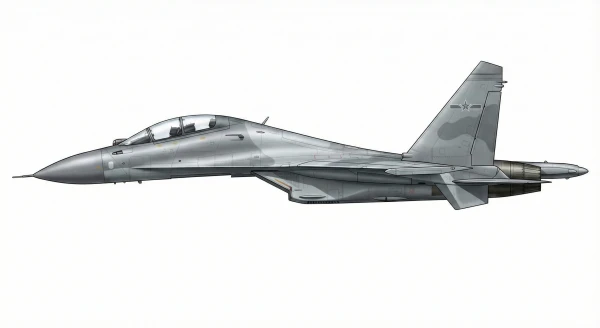
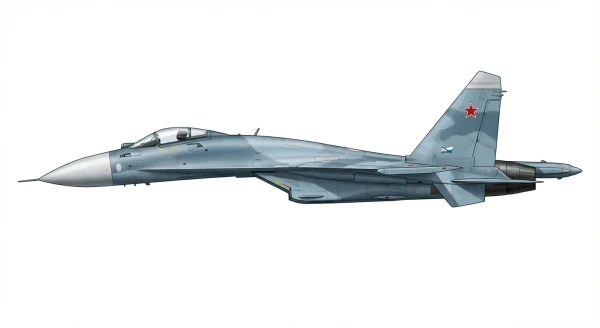
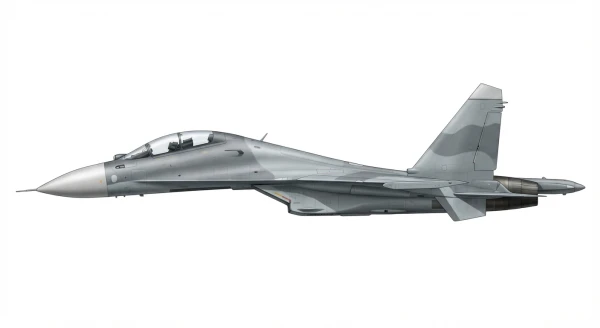
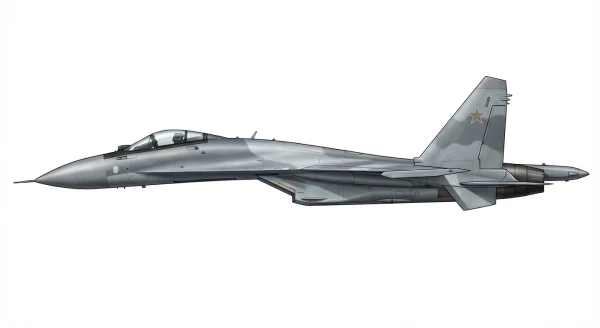
Description
The Shenyang J-11 emerged from China's strategic shift toward Soviet military hardware following the 1989 Tiananmen Square protests and a subsequent Western arms embargo. After acquiring Sukhoi Su-27 fighters, China entered into a US$1.2 billion agreement with Rosoboronexport in 1996, permitting the Shenyang Aircraft Corporation (SAC) to license-produce 200 Su-27UBKs using kits supplied by Russia's Komsomolsk-on-Amur Aircraft Plant (KnAPPO). The first two aircraft, designated J-11, were completed in December 1998, the same year as the type's first flight, but faced initial assembly problems that required Russian technical assistance. Production continued with increasing incorporation of local airframe parts, evolving into the J-11A variant around 2000. By 2004, China's development of the J-11B, a heavily indigenous version, violated the co-production agreement and reportedly concluded the official arrangement, though significant engineering challenges remained, particularly in maturing the domestic WS-10 turbofan engine as a replacement for the Russian powerplants.
Design
Derived from the Sukhoi Su-27 airframe, the J-11 series features a twin-engine, twin-tail design optimized for air superiority. Early J-11A models retained many Russian subsystems but introduced improved domestic avionics and cockpit displays. The subsequent J-11B variant represents a significant technological divergence, incorporating a lighter airframe through the greater use of composite materials and a suite of Chinese subsystems. These include a Type 1493 radar, a digital fly-by-wire control system, a glass cockpit, and indigenous hydraulic, fuel, environmental control, and molecular sieve oxygen generation systems. Later upgrades, such as the J-11BG, introduced further enhancements like an Active Electronically Scanned Array (AESA) radar, a helmet-mounted sight, and missile approach warning systems.
Armament
The J-11 is equipped for a range of air-to-air and air-to-ground missions, centered around a ten-hardpoint weapon carriage system. Standard internal armament consists of one 30 mm Gryazev-Shipunov GSh-30-1 cannon with 150 rounds. External pylons located under the fuselage, air intakes, and wings can carry a variety of munitions. Its air-to-air missile capabilities have expanded with successive variants, initially including the Russian Vympel R-27 and R-73, and later integrating Chinese missiles such as the PL-8, PL-9, and the beyond-visual-range PL-12. Upgraded models like the J-11B and J-11D are capable of deploying more advanced munitions, including the PL-10 and PL-15. For ground-attack roles, the aircraft can be armed with unguided rocket launchers and free-fall cluster bombs.
Operational History
In service with the People's Liberation Army Air Force (PLAAF) and Naval Air Force (PLANAF), the J-11 has been a key asset in China's air power projection. In March 2011, PLAAF J-11Bs participated in "Shaheen 1," a joint operational exercise in Pakistan with the Pakistan Air Force. The aircraft gained international attention on August 19, 2014, when a PLANAF J-11B intercepted a U.S. Navy P-8 Poseidon patrol aircraft over the South China Sea. The Pentagon described the encounter, which included close-proximity passes and a barrel roll over the P-8, as "unsafe" and "unprofessional," while China maintained its pilot acted professionally during surveillance by the U.S. aircraft. The J-11's service has also seen operational losses, including a J-11B crash during a training exercise in December 2017.
Variants
- J-11A: An upgraded variant of the baseline J-11 featuring greater domestic content, improved avionics, and modernized cockpit displays.
- J-11B: A Chinese-developed multirole variant featuring extensive domestic subsystems, including a new radar, a lighter airframe using composites, and the Shenyang WS-10 engine on later blocks.
- J-11BS: The tandem two-seat combat-capable trainer version of the J-11B variant.
- J-11BH: A naval version of the J-11B fighter adapted for operations with the People's Liberation Army Naval Air Force.
- J-11D: A proposed advanced variant featuring AESA radar, an IRST sensor, and greater use of composite materials, though the project was reportedly set aside.
Identified in 416 sorties in the official China-Taiwan Tensions activity reports between 2020 and 2023 — a floor, not a census: only sorties the source identified by type are counted, and how much it disclosed varies by year.
Frequently Asked Questions
What type of aircraft is the J-11 Responsive Dragon?
What is the maximum speed of the J-11 Responsive Dragon?
What is the range of the J-11 Responsive Dragon?
When did the J-11 Responsive Dragon first fly?
How many J-11 Responsive Dragon have been built?
Which countries operate the J-11 Responsive Dragon?
How much does a J-11 Responsive Dragon cost?
What is the service ceiling of the J-11 Responsive Dragon?
- AUG 52026 Updated Powerplant and thrust updated
- JUN 262026 Updated Bombs and missiles updated
- APR 72026 Updated Sources and cross-references refreshed
- APR 52026 Updated Ejection seat added
- FEB 112026 Updated Price added
- JAN 242026 Updated Thrust updated
- JUN 162025 Updated Specifications and description reviewed