J-16 Qianlong
Chinese multirole strike fighter, developed from the Shenyang J-11, used by the Chinese Air Force since 2015. Key figures: top speed 2,120 km/h, range 4,000 km, service ceiling 17,300 m, max takeoff weight 35,000 kg, built 365. In service with 1 air force as of 2026 — China (450).
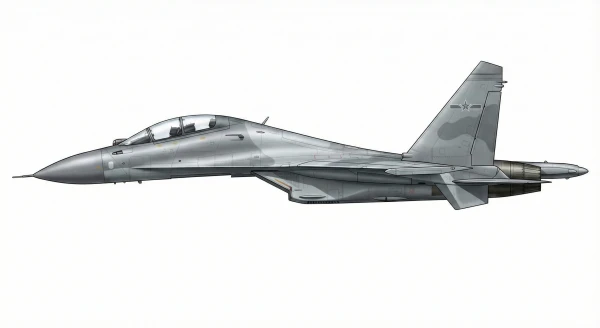
| Crew | 2 |
| Length | 21.9 m (71.9 ft) |
| Wingspan | 14.7 m (48.2 ft) |
| Height | 6.4 m (20.9 ft) |
| Wing area | 62 m² (667.4 sqft) |
| Empty weight | 17,700 kg (39,022 lbs) |
| Max. takeoff weight | 35,000 kg (77,162 lbs) |
| Powerplant | 2 × turbofans Shenyang WS-10B 13,766 kgf each |
| Ejection seat | Zvezda K-36DM |
| Maximum speed | 2120 km/h (Mach 2.12) |
| Operational range | 4,000 km (2,485 mi) |
| Service ceiling | 17,300 m (56,759 ft) |
| Climb rate | 230.0 m/s (754.6 ft/s) |

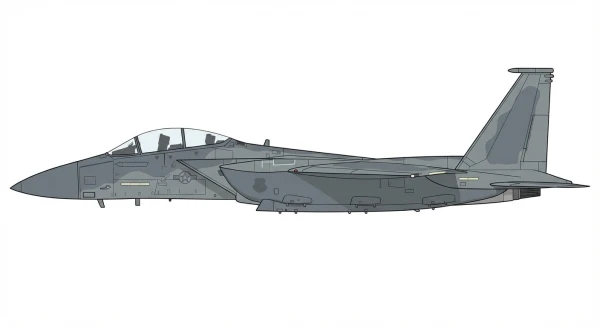
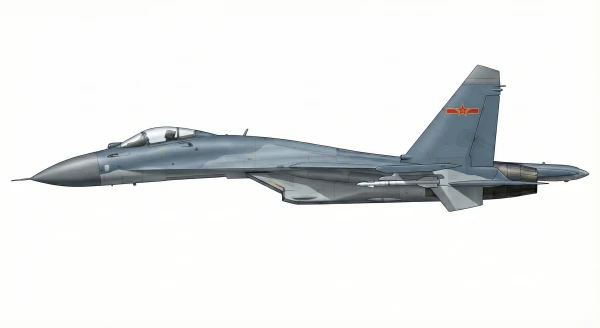
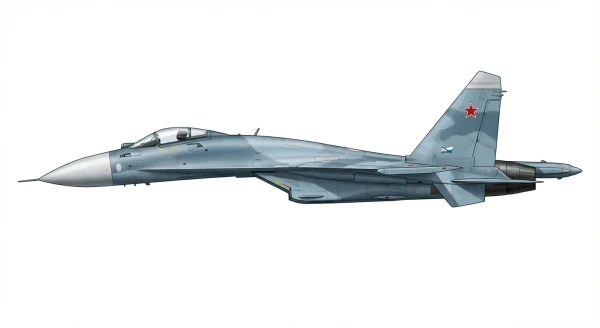
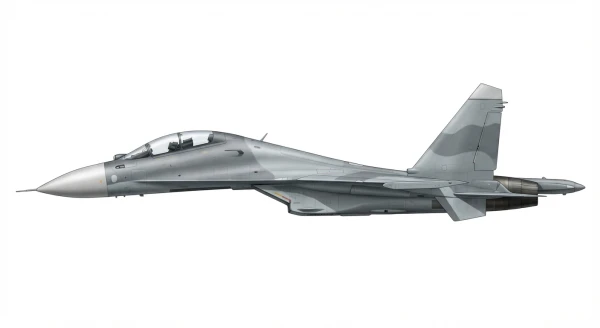
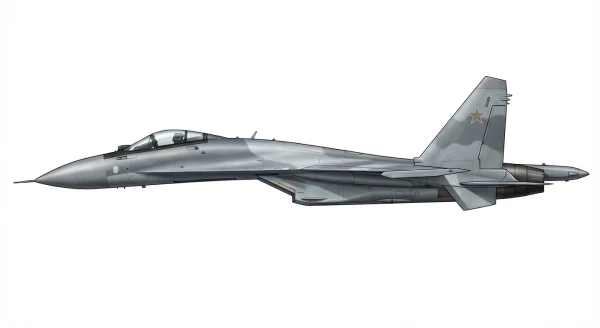
Description
The Shenyang J-16 was developed to address the growing obsolescence of the People's Liberation Army Air Force's (PLAAF) JH-7 fleet at the turn of the century. Building upon its experience with licensed production of the Russian Su-27, which became the Shenyang J-11, the Shenyang Aircraft Corporation derived the J-16 multirole strike fighter from the tandem-seat J-11BS model. Representing a strategic shift away from dependency on Russian technology, the program aimed to produce a superior indigenous derivative. The aircraft is believed to have made its first flight between 2011 and 2012, with the PLAAF receiving its first regiment in 2014. The J-16 officially entered service in 2015 and was publicly unveiled in 2017. By 2018, production had fully superseded that of the single-seat J-11B fighter.
Design
The J-16 is a tandem-seat, twin-engine, 4.5-generation strike fighter featuring significant technological advancements over its predecessors. Its airframe incorporates a greater amount of composite materials to reduce overall weight and is coated with radar-absorbent paint to lower its radar signature. It is powered by two Chinese Shenyang WS-10A afterburning turbofan engines. The advanced avionics suite is centered on an Active Electronically Scanned Array (AESA) radar and includes an Infrared Search and Track (IRST) system. The cockpit is equipped with a helmet-mounted display (HMD) to enhance pilot situational awareness. Furthermore, a variant is in development that reportedly replaces the co-pilot with an artificial intelligence algorithm, indicating a push towards advanced autonomous combat capabilities.
Armament
The J-16 is equipped for a wide range of missions with a versatile weapons payload carried on 12 external hardpoints. Its primary internal armament consists of a 30 mm GSh-30-1 cannon. For air-to-air combat, it can be armed with missiles such as the PL-9, PL-10, PL-12, PL-15, and the long-range PL-17. Its air-to-ground and anti-shipping capabilities are enabled by munitions including the KD-88 and AKF-98 air-to-surface missiles, YJ-83K and YJ-12 anti-ship missiles, various guided bombs like the LS-500J, and unguided rockets. The aircraft can also carry anti-radiation missiles for Suppression of Enemy Air Defenses (SEAD) missions, supported by equipment like the YINGS-III targeting pod.
Operational History
Since entering service, the J-16 has been actively deployed by the People's Liberation Army Air Force, most notably in operations over the South China Sea and in the Taiwan Strait, where it is frequently utilized, possibly due to its advanced electronic warfare capabilities. In May 2022, a J-16 intercepted a Royal Australian Air Force P-8 Poseidon in international airspace, releasing flares and chaff in close proximity to the surveillance aircraft. A year later, in May 2023, a J-16 conducted what was described by the U.S. as an "unnecessarily aggressive" maneuver against a USAF RC-135, flying directly in front of its nose. China has justified these actions as responses to provocative operations near its territory.
Variants
- J-16D: An electronic warfare variant designed for Suppression of Enemy Air Defenses (SEAD) missions, featuring prominent wingtip EW pods and an internal EW system that replaces the standard IRST and 30 mm cannon.
Identified in 1,329 sorties in the official China-Taiwan Tensions activity reports between 2020 and 2024 — a floor, not a census: only sorties the source identified by type are counted, and how much it disclosed varies by year.
Frequently Asked Questions
What type of aircraft is the J-16 Qianlong?
What is the maximum speed of the J-16 Qianlong?
What is the range of the J-16 Qianlong?
When did the J-16 Qianlong first fly?
How many J-16 Qianlong have been built?
Which countries operate the J-16 Qianlong?
What is the service ceiling of the J-16 Qianlong?
- AUG 122026 Updated Range corrected to the ferry range
- AUG 52026 Updated Powerplant and thrust updated
- APR 72026 Updated Sources and cross-references refreshed
- APR 52026 Updated Ejection seat added
- JAN 242026 Updated Thrust updated
- JUN 162025 Updated Specifications and description reviewed