JAS 39 Gripen
Summary
| Category | Combat Aircraft |
| Origin country | 🇸🇪 Sweden |
| Manufacturer | Saab |
| First flight | 9 December 1988 |
| Year introduced | 1996 |
| Number produced | 300 units |
| Average unit price | $85 million |
Technical specifications
| Version: JAS 39C | |
|---|---|
| Crew | 1 pilot |
| Operational range | 805 km (500 mi) |
| Maximum speed | 2100 km/h (1305 mph) |
| Wing area | 30 m² (322.9 sqft) |
| Wingspan | 8.4 m (27.6 ft) |
| Height | 4.5 m (14.8 ft) |
| Length | 14.9 m (48.9 ft) |
| Service ceiling | 15,240 m (50,000 ft) |
| Empty weight | 6,800 kg (14,991 lbs) |
| Max. takeoff weight | 14,000 kg (30,865 lbs) |
| Climb rate | 254.0 m/s (833.3 ft/s) |
| Powerplant | 1 x turbofan Volvo RM12 delivering 5,507 kgf each |
| Ejection seat | Martin-Baker Mk 10 |
Current operating countries
| Country | Units | ||
|---|---|---|---|

|
Sweden | 96 (+58) | |

|
South Africa | 25 | |

|
Hungary | 14 (+4) | |

|
Czechia | 14 | |

|
Brazil | 11 (+33) | |

|
Thailand | 11 (+12) | |

|
Colombia | 0 (+17) | |
All operators
Armament
Missiles payload:
- Air-to-Surface AGM-65 Maverick
- Air-to-Air Medium-Range AIM-120 AMRAAM
- Cruise Missiles KEPD 350 Taurus
- Air-to-Air Long-Range MBDA Meteor
- Air-to-Air Medium-Range MICA
- Air-to-Air Short-Range Raytheon AIM-9 Sidewinder
- Air-to-Surface RBS-15
- Air-to-Air Medium-Range Skyflash
- Air-to-Air Short-Range V3 Darter
Bombs payload:
- Cluster Daimler DWS-24
- Low-Drag Mk 82
- Laser-Guided Raytheon GBU-12
Recent events involving the JAS 39 Gripen
Description
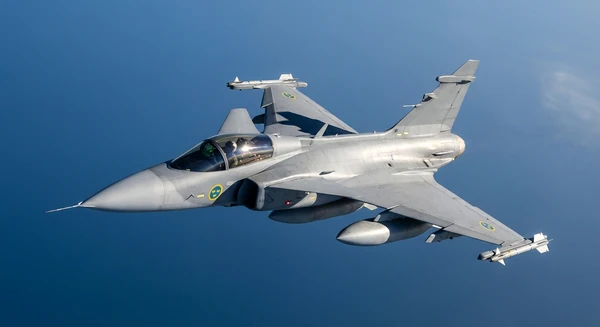
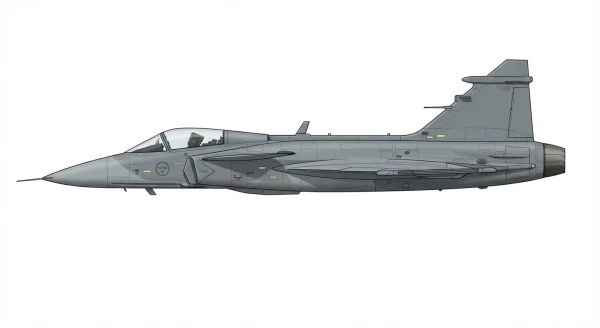
The Saab JAS 39 Gripen is a Swedish light single-engine multirole fighter aircraft designed and manufactured by Saab. The designation "JAS" stands for Jakt (air-to-air), Attack (air-to-surface), and Spaning (reconnaissance), reflecting Saab's "swing-role" philosophy: the ability to switch between mission types during a single sortie. Designed during the Cold War for dispersed operations from short road strips, the Gripen has evolved into one of the most cost-effective and widely exported Western fighters, with orders from over a dozen countries.
Development
In the late 1970s, Sweden sought to replace its aging Saab 35 Draken and Saab 37 Viggen with a single affordable multirole platform. The Swedish Air Force required a Mach 2-capable aircraft able to operate from 800 m road strips as part of the Bas 90 dispersed basing system — designed to maintain air defense capacity in the event of invasion. After evaluating several foreign designs including the F-16, F/A-18, and Mirage 2000, the government opted for a new domestic fighter.
In 1980, Industrigruppen JAS (IG JAS) was formed as a joint venture between Saab-Scania, Ericsson, Volvo Flygmotor, and other Swedish firms. The Riksdag approved the project in 1982, awarding contracts for five prototypes and 30 production aircraft. The first Gripen was rolled out on 26 April 1987, and made its maiden flight on 9 December 1988. The test program was marked by two high-profile crashes — in 1989 and 1993 — both caused by fly-by-wire flight control software issues and pilot-induced oscillation. These were resolved by 1995, though they generated significant negative publicity.
Sweden ordered 204 Gripens across three batches. The Batch I/II aircraft (JAS 39A/B) were followed by the upgraded Batch III (JAS 39C/D), delivered between 2002 and 2008, which added NATO compatibility, in-flight refueling, and improved avionics. In 2013, Sweden ordered 60 of the substantially redesigned JAS 39E, developed from the Gripen NG demonstrator that first flew in 2008. The Gripen E features a larger airframe, the more powerful General Electric F414G engine (replacing the Volvo RM12), 40% greater internal fuel, the Leonardo Raven ES-05 AESA radar, the Arexis electronic warfare suite, the Skyward-G IRST sensor, a wide-area touchscreen display, and two additional hardpoints. The first Gripen E flew on 15 June 2017, with initial deliveries to Sweden and Brazil starting in 2019. In May 2025, a Gripen E became the first fighter aircraft to be piloted by an artificial intelligence in beyond-visual-range combat demonstrations.
Design
The Gripen features a delta wing and canard configuration with relaxed stability and digital fly-by-wire flight controls. The canards provide positive lift at all speeds and, combined with the delta wing, give the aircraft excellent agility with the ability to fly at 70–80 degrees angle of attack while sustaining +9/−3 g loads. The aircraft was designed from the outset for minimal maintenance: a turnaround time of just ten minutes by a team of one technician and five conscripts — including re-arming, refueling, and inspection — before returning to flight.
Major systems including the RM12 engine and PS-05/A radar are modular for rapid replacement and low operating cost. According to a 2012 Jane's study, the Gripen had the lowest cost per flight hour among modern fighters at US$4,700, compared to US$7,000 for the F-16 — a key selling point in export competitions. The aircraft's open architecture makes it highly upgradeable, and operators receive access to source code and technical documentation, allowing independent integration of new systems.
The Gripen's avionics feature full sensor fusion across five MIL-STD-1553B data buses, integrating information from radar, IRST, electronic warfare, and datalink systems. The cockpit uses HOTAS controls, a wide-angle HUD, three multifunction color displays, and an optional Cobra helmet-mounted display. The PS-05/A pulse-Doppler radar can detect and track multiple targets at 120 km range. On the Gripen E, this is replaced by the Raven ES-05 AESA radar with greatly increased detection range and field of view.
Variants
- JAS 39A/B: Initial single-seat (A) and two-seat (B) versions for the Swedish Air Force. Basic multirole capabilities, now largely retired or upgraded to C/D standard.
- JAS 39C/D: NATO-compatible evolution with improved avionics, in-flight refueling, OBOGS, and expanded weapons compatibility. The C is single-seat, D is two-seat. The most widely deployed variant, serving with Sweden, Czech Republic, Hungary, South Africa, and Thailand.
- JAS 39E/F (Gripen NG): Major redesign with the F414G engine, AESA radar, Arexis EW suite, Skyward-G IRST, 10 hardpoints, and 16,500 kg max takeoff weight. The E is single-seat, F is two-seat. Ordered by Sweden, Brazil, Thailand, Colombia, and Peru. Designated F-39E/F in Brazilian service.
Armament
The Gripen carries one 27 mm Mauser BK-27 cannon with 120 rounds (single-seat models only) and has 8 hardpoints (10 on Gripen E) for up to 5,300 kg of external stores (7,200 kg on Gripen E). For air-to-air combat, it employs IRIS-T or AIM-9 Sidewinder short-range missiles and AIM-120 AMRAAM or MBDA Meteor beyond-visual-range missiles. Air-to-ground weapons include AGM-65 Maverick missiles, GBU-12 Paveway II laser-guided bombs, GBU-39 Small Diameter Bombs, and Taurus KEPD 350 cruise missiles. Anti-ship capability is provided by the RBS-15F missile. A distinctive Saab philosophy is weapons-source flexibility — customers can integrate munitions from US, European, Israeli, or other suppliers to suit their operational needs.
Export
The Gripen initially achieved moderate export success through leasing arrangements and offset deals. Its breakthrough on the new-build export market came with Brazil's selection of the Gripen E/F, and the aircraft has since gained significant momentum as a competitive alternative to the F-16 and F-35.
- Czech Republic: 14 Gripens C/D on lease since 2005, extended through 2029 with MS20 upgrades.
- Hungary: 14 Gripens C/D on lease-and-buy since 2006, with 4 additional Gripen C ordered in 2024.
- South Africa: 26 Gripens C/D ordered in 1999, delivered from 2008. Procurement was marred by bribery allegations involving BAE Systems.
- Thailand: 12 Gripens C/D delivered from 2011. In August 2025, Thailand signed for 3 Gripen E and 1 Gripen F to begin replacing its F-16 fleet.
- Brazil: 36 Gripen E/F ordered in 2014 (US$5.4 billion), with local assembly by Embraer in Gavião Peixoto. Negotiations underway for additional aircraft, targeting a fleet of 45–66 units. The first domestically produced airframe was presented in March 2026.
- Colombia: Selected the Gripen E/F in April 2025 to replace its Kfir fleet. Contract for 17 aircraft (15E + 2F) signed in November 2025 for €3.1 billion.
- Peru: 24 JAS 39E/F ordered in July 2025 to replace aging Mirage 2000s and MiG-29s.
- Ukraine: Letter of intent for up to 150 Gripen Es signed in October 2025.
- Canada: Re-evaluating its F-35 purchase as of 2025–2026, with the Gripen offered as an alternative featuring full technology transfer and domestic production. Originally planned to buy 88 F-35s, only 16 are under firm order as of February 2026.
Operational History
The Gripen entered Swedish Air Force service on 9 June 1996. Its first combat deployment came during NATO operations over Libya in 2011 (Opération Unified Protector), when eight Swedish Gripens flew over 650 reconnaissance sorties and nearly 2,000 flight hours, delivering some 2,000 intelligence reports to NATO — though they did not carry out strike missions.
Gripens have regularly participated in NATO Baltic Air Policing missions, protecting airspace over the Baltic states, as well as international exercises including Red Flag Alaska (2006), where they scored ten simulated kills against F-16s, Typhoons, and F-15s with no losses on the first day.
In July 2025, Royal Thai Air Force Gripens were reportedly deployed in combat for the first time, striking Cambodian positions during the 2025 Cambodia–Thailand border conflict — marking the type's first air-to-ground combat use.