AH-1 Cobra vs Mi-24 Hind
AH-1 Cobra vs Mi-24 Hind at a glance — top speed 277 vs 330 km/h, range 570 vs 450 km, max takeoff weight 8,391 vs 11,500 kg, built 1,116 vs 2,648 units.
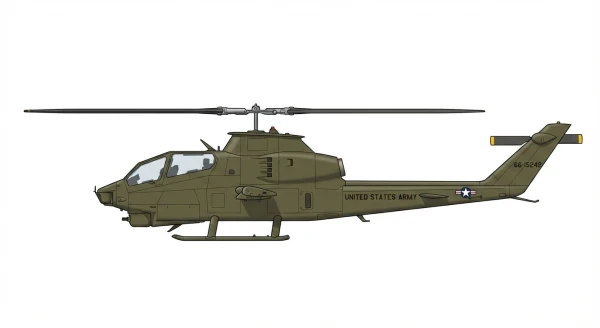
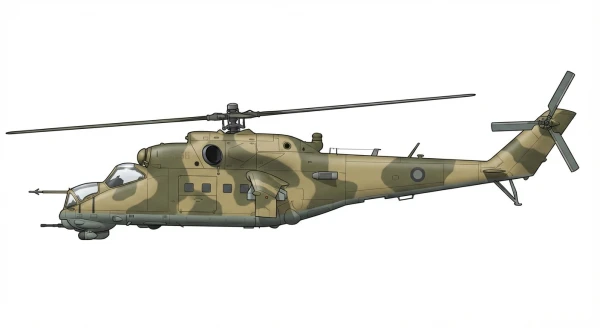
| AH-1 Cobra | Mi-24 Hind | |
|---|---|---|
| Origin country | 🇺🇸 United States | 🇷🇺 Ex-USSR |
| Category | Military Helicopters | Military Helicopters |
| Manufacturer | Bell | Mil |
| First flight | 7 September 1965 | 19 September 1969 |
| Year introduced | 1967 | 1972 |
| Number produced | 1116 units | 2648 units |
| Average unit price | $13 million | $12 million |
| Wingspan | 13.4 m | 6.5 m |
| Height | 4.4 m | 5.5 m |
| Length | 17.8 m | 21.4 m |
| Maximum speed | 277 km/h | 330 km/h |
| Operational range | 570 km | 450 km |
| Service ceiling | 6,096 m | 5,120 m |
| Max. takeoff weight | 8,391 kg | 11,500 kg |
| Empty weight | 5,579 kg | 7,792 kg |
| Total thrust | 2 x 1,342 kW | 2 x 1,641 kW |
Detailed Comparison
The Bell AH-1 Cobra was born from a U.S. Army requirement for a dedicated, slender gunship to escort utility helicopters in Vietnam, stripping away transport weight to maximize agility and ordnance delivery. Conversely, the Mil Mi-24 Hind emerged from Soviet Cold War doctrine as a flying infantry fighting vehicle (IFV), combining a heavy weapons platform with an eight-man troop compartment to drop shock troops directly onto European battlefields.
Development and Design
The AH-1 pioneered the tandem-seat, stepped-cockpit configuration that became the global standard for attack helicopters. By repurposing the UH-1 Huey's dynamic components into a 91-centimeter-wide fuselage, Bell reduced the aircraft's frontal radar and visual signature, prioritizing survivability through evasion. Mil took a brute-force route with the Mi-24. Weighing nearly double the early Cobras, the Hind incorporates heavy titanium armor around its cockpit and critical systems. The inclusion of a rear cabin for an infantry squad compromised aerodynamic efficiency and increased its target profile, but allowed Soviet commanders to integrate heavy fire support and airborne mechanized infantry into a single airframe. The Hind relies on stub wings not just for weapon hardpoints, but to generate up to 25% of its lift in forward flight.
Specifications and Performances
The Mi-24 operates in a heavier weight class, with a maximum takeoff weight of 11,500 kg compared to the Cobra's 8,391 kg. To move this mass, the Hind utilizes twin Isotov TV3-117 engines pushing it to a maximum speed of 330 km/h, outpacing the Cobra’s 277 km/h. This straight-line speed comes at the cost of hover performance and agility. The Cobra, utilizing twin General Electric T700 turboshafts in its later variants, achieves superior maneuverability and a higher service ceiling (6,096 m versus the Hind’s 5,120 m). The AH-1's lighter frame translates to better climb rates and responsiveness in confined environments, whereas the Mi-24 flies more like a fixed-wing attack aircraft, frequently requiring running takeoffs when heavily loaded.
Deployment and usage
The AH-1 validated the dedicated attack helicopter concept in Vietnam and later destroyed hundreds of Iraqi armored vehicles during the 1991 Gulf War. U.S. Marine Corps AH-1W and AH-1Z variants integrated TOW and Hellfire missiles, excelling in close air support where precision and loiter time were required. The Mi-24's combat record revealed distinct limitations in its doctrine:
- During the Soviet-Afghan War, the Hind's heavy armor deflected small arms, but its massive profile and sluggish hover performance made it highly vulnerable to Stinger MANPADS.
- In Chechnya and later Ukraine, the troop-carrying capability was largely abandoned; commanders refused to risk an infantry squad inside an airframe intentionally drawing enemy anti-aircraft fire.
Consequently, operators mostly employ the Hind as a heavy strike aircraft, conducting high-speed unguided rocket runs rather than hovering engagements.
Conclusion
The AH-1 Cobra has the definitive edge in anti-armor campaigns and precision close air support in contested terrain. Its high agility, smaller visual signature, and dedicated sensor suites allow it to exploit cover and deliver guided munitions efficiently from a hover. The Mi-24 Hind is superior in low-intensity conflicts or border security against unarmored insurgents, where high-speed strafing runs and the capacity to rapidly insert a specialized extraction team dictate mission success. Ultimately, the Cobra’s pure-attack design proved more viable long-term; modern militaries abandoned the Hind’s hybrid "flying IFV" concept, acknowledging that mixing transport and attack missions in a single airframe compromises both roles.