AH-64 Apache vs EC665 Tiger
AH-64 Apache vs EC665 Tiger at a glance — top speed 293 vs 315 km/h, range 480 vs 800 km, max takeoff weight 10,107 vs 6,100 kg, built 2,400 vs 180 units.
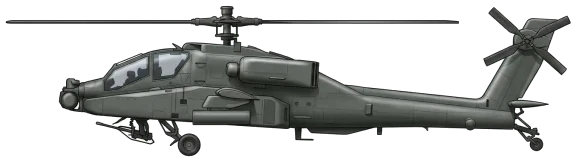
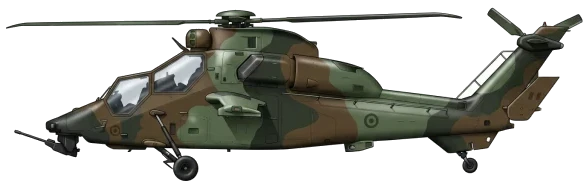
| AH-64 Apache | EC665 Tiger | |
|---|---|---|
| Origin country | 🇺🇸 United States | 🇩🇪 Germany🇫🇷 France |
| Category | Military Helicopters | Military Helicopters |
| Manufacturer | Boeing | Eurocopter |
| First flight | 30 September 1975 | 27 April 1991 |
| Year introduced | 1984 | 2002 |
| Number produced | 2400 units | 180 units |
| Average unit price | $33 million | $36 million |
| Wingspan | 14.6 m | 4.5 m |
| Height | 5.0 m | 3.8 m |
| Length | 17.7 m | 15.8 m |
| Maximum speed | 293 km/h | 315 km/h |
| Operational range | 480 km | 800 km |
| Service ceiling | 5,670 m | 2,000 m |
| Max. takeoff weight | 10,107 kg | 6,100 kg |
| Empty weight | 5,352 kg | 4,200 kg |
| Total thrust | 2 x 1,208 kW | 2 x 958 kW |
Detailed Comparison
The AH-64 Apache and EC665 Tiger originate from different strategic doctrines and eras. The Apache, a product of the Cold War, was conceived as a heavily armed and armored tank-killer, resulting in a robust, combat-proven platform with over 2,400 units built. The Tiger, a later Franco-German project, was designed as a lighter, more agile, and modular multi-role helicopter, emphasizing reduced observability and lower operational costs, with around 180 units produced. This fundamental difference in philosophy—survivability through armor versus agility and stealth—defines their respective capabilities.
Development and Design
The Apache's design prioritizes crew survivability and overwhelming firepower. Developed to replace the AH-1 Cobra, it features a tandem cockpit, extensive armor, and redundant systems. Its continuous evolution, from the original AH-64A to the AH-64D Longbow with its mast-mounted fire-control radar, and the network-centric AH-64E Guardian, has kept the platform at the forefront of attack helicopter technology. In contrast, the Tiger's development focused on creating a common European platform. Its airframe makes extensive use of composite materials, reducing weight and radar cross-section. Its design is inherently modular, leading to distinct national variants like the French HAP/HAD and the German KHT, each optimized for different mission sets, from armed reconnaissance to anti-tank warfare.
Specifications and Performances
A comparison of performance metrics reveals their divergent design priorities. The Apache is significantly heavier, with a maximum takeoff weight of 10,107 kg compared to the Tiger's 6,100 kg, reflecting its greater payload and armor. This mass contributes to a lower maximum speed (265 km/h) and shorter range (485 km). The lighter Tiger is faster (280 km/h) and boasts a much greater ferry range of 800 km. However, the Apache's more powerful General Electric T700 engines give it a superior service ceiling of 5,670 m, a critical advantage in high-altitude theaters like Afghanistan, whereas the Tiger is limited to 2,000 m.
Deployment and usage
The Apache's operational history is extensive and unparalleled. It proved its anti-armor capabilities during the 1991 Gulf War and has since served as a primary close air support and armed reconnaissance asset in Iraq, Afghanistan, and numerous other conflicts. Its widespread adoption by US allies has solidified its status as the benchmark for modern attack helicopters. The Tiger has also been combat-deployed in Afghanistan, Libya, and Mali, where it has performed effectively in attack and support roles. However, its operational record is less extensive, and some operators, notably Australia, have reported significant maintenance and availability issues with their ARH variant.
Conclusion
The AH-64 Apache remains the definitive heavy attack helicopter, defined by its survivability, firepower, and a combat record spanning decades. Its continual upgrades ensure its relevance in a network-centric battlespace. The EC665 Tiger is a capable and agile multi-role platform that reflects a more modern European design philosophy favoring modularity and reduced signature over heavy armor. While effective, it has not achieved the production scale or the level of operational maturity demonstrated by the Apache. The choice between the two platforms is a choice between a proven, heavily armed specialist and a lighter, more flexible multi-role asset.
-
 United States
822
United States
822
-
 Israel
48
Israel
48
-
 United Kingdom
47
United Kingdom
47
- All 19 operators →


