AV-8B Harrier II vs F-35 Lightning II
AV-8B Harrier II vs F-35 Lightning II at a glance — top speed 1,070 vs 1,960 km/h, range 3,300 vs 2,800 km, max takeoff weight 14,100 vs 27,216 kg, built 337 vs 965 units.
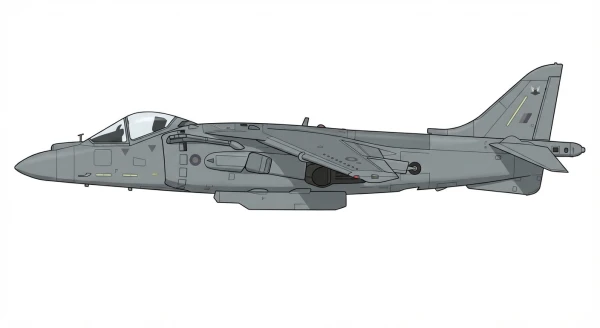
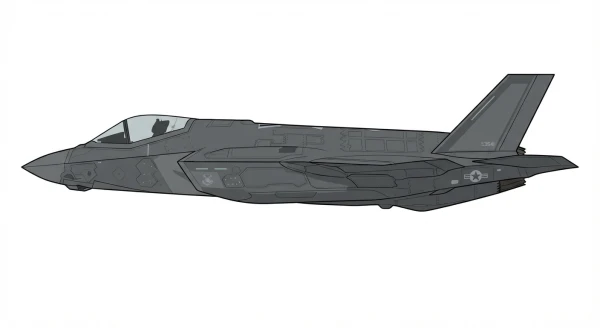
| AV-8B Harrier II | F-35 Lightning II | |
|---|---|---|
| Origin country | 🇬🇧 United Kingdom🇺🇸 United States | 🇺🇸 United States |
| Category | Combat Aircraft | Combat Aircraft |
| Manufacturer | McDonnell Douglas | Lockheed Martin |
| First flight | 6 January 1971 | 15 December 2006 |
| Year introduced | 1983 | 2013 |
| Number produced | 337 units | 965 units |
| Average unit price | $26 million | $103 million |
| Wing area | 22.6 m² | 43.0 m² |
| Wingspan | 9.3 m | 11.0 m |
| Height | 3.6 m | 4.4 m |
| Length | 14.1 m | 15.6 m |
| Maximum speed | 1070 km/h | 1960 km/h |
| Operational range | 3,300 km | 2,800 km |
| Service ceiling | 15,240 m | 15,000 m |
| Max. takeoff weight | 14,100 kg | 27,216 kg |
| Empty weight | 6,340 kg | 14,651 kg |
| Total thrust | 1 x 10,500 kgf | 1 x 19,500 kgf |
Detailed Comparison
The F-35 Lightning II and the AV-8B Harrier II represent two distinct generations of V/STOL-capable combat aircraft, with the former designed as a stealthy, multirole successor to the latter's specialized ground-attack mission. While both are single-engine, single-seat jets operated by the U.S. Marine Corps from amphibious assault ships, the F-35B integrates its short takeoff and vertical landing (STOVL) capability into a far more advanced and versatile airframe defined by low observability and data fusion, a stark contrast to the Harrier's singular focus on V/STOL performance for close air support.
Development and Design
The AV-8B Harrier II was an evolutionary development, a U.S.-led enhancement of the original British Harrier. Its design is entirely dictated by its Rolls-Royce Pegasus engine with four swiveling nozzles, enabling it to vector thrust for vertical flight. This V/STOL capability was its primary innovation and tactical purpose. In contrast, the F-35 originated from the Joint Strike Fighter (JSF) program, which aimed to create a common, next-generation platform for multiple services. Its design philosophy is centered on stealth, achieved through its shaping and composite materials, and sensor fusion. Systems like the AN/APG-81 AESA radar, Distributed Aperture System (DAS), and EOTS are integrated to provide unparalleled situational awareness, a capability far beyond the Harrier's upgraded but conventional avionics. The F-35B’s STOVL system, while complex, is an added capability to a multirole stealth design, not its sole defining feature.
Specifications and Performances
A performance comparison reveals the generational gap. The F-35 is a supersonic aircraft with a maximum speed of 1,930 km/h, whereas the Harrier is strictly subsonic at 1,070 km/h. The F-35 is also a much larger and heavier aircraft, with a max takeoff weight of 27,216 kg compared to the Harrier’s 14,100 kg. This allows the F-35 to carry a significantly larger payload, including up to 18,000 pounds of ordnance. Crucially, the F-35 can carry weapons like the AIM-120 AMRAAM internally to maintain its stealth profile, a key survivability advantage the Harrier lacks. The F-35’s F135 engine produces significantly more thrust (up to 18,144 kgf with afterburner) than the Harrier’s Pegasus engine (10,500 kgf), underpinning its superior speed, payload, and overall performance.
Deployment and usage
The AV-8B's operational history, from the Gulf War to Afghanistan, confirmed its value as a flexible close air support (CAS) platform. Its ability to operate from austere forward bases and ships placed it close to the fight, providing responsive fire support for ground troops. Its role was almost exclusively air-to-ground. The F-35B inherits this STOVL mission but expands the operational envelope exponentially. It is designed to penetrate and survive in heavily defended airspace where a Harrier would be highly vulnerable. Its role is not just to attack targets but to act as a networked intelligence, surveillance, and reconnaissance (ISR) node, using its advanced sensors to gather and share data with other assets, thereby enhancing the lethality of the entire force.
Conclusion
The AV-8B Harrier II was a successful and innovative aircraft that perfected the concept of a dedicated V/STOL ground-attack jet. It provided the U.S. Marine Corps with a unique and valuable capability for decades. The F-35B is not merely a replacement but a fundamental paradigm shift. It trades the Harrier's specialized simplicity for a complex, multi-domain system that combines STOVL flexibility with the core tenets of 5th-generation air power: stealth, sensor fusion, and network-centric warfare. While the Harrier brought the airfield to the fight, the F-35 is designed to dominate the battlespace from that same forward position.