Boeing 707 vs KC-135 Stratotanker
Boeing 707 vs KC-135 Stratotanker at a glance — top speed 1,010 vs 933 km/h, range 5,400 vs 17,727 km, max takeoff weight 151,318 vs 146,283 kg, built 865 vs 803 units.
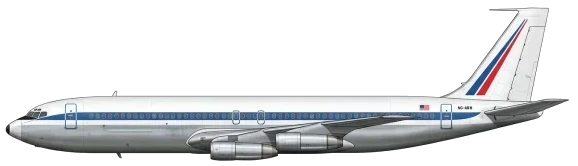
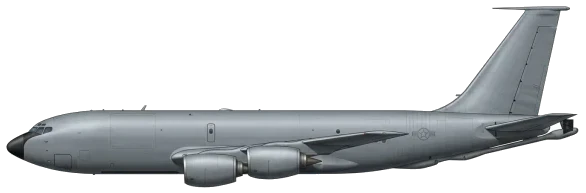
| Boeing 707 | KC-135 Stratotanker | |
|---|---|---|
| Origin country | 🇺🇸 United States | 🇺🇸 United States |
| Category | Military Special Mission Aircraft | Military Special Mission Aircraft |
| Manufacturer | Boeing | Boeing |
| First flight | 15 July 1954 | 31 August 1956 |
| Year introduced | 1958 | 1957 |
| Number produced | 865 units | 803 units |
| Average unit price | $35 million | $39 million |
| Wing area | -- m² | 226.0 m² |
| Wingspan | 44.5 m | 39.9 m |
| Height | 13.0 m | 12.7 m |
| Length | 46.4 m | 41.5 m |
| Maximum speed | 1010 km/h | 933 km/h |
| Operational range | 5,400 km | 17,727 km |
| Service ceiling | 13,000 m | 15,240 m |
| Max. takeoff weight | 151,318 kg | 146,283 kg |
| Empty weight | 66,406 kg | 44,663 kg |
| Total thrust | 4 x 8,618 kgf | 4 x 9,813 kgf |
Detailed Comparison
The Boeing 707 and KC-135 Stratotanker derive from the same Boeing 367-80 prototype but were developed for fundamentally different purposes. The 707 was primarily a commercial airliner later adapted for specialized military roles, whereas the KC-135 was conceived from the outset as a dedicated military aerial refueler. This core distinction influenced their design, operational employment, and long-term evolution. While the 707 pioneered the commercial Jet Age, the KC-135 became a cornerstone of strategic air power projection for the United States and its allies.
Development and Design
The development paths of the two aircraft diverged early. The KC-135 was the first to be ordered by the USAF, featuring a fuselage optimized for its primary role of carrying jet fuel, resulting in a narrower and shorter airframe than its commercial counterpart. Its defining feature is the flying boom refueling system, an integral design element for high-speed fuel transfer to strategic bombers. Conversely, the 707's design was driven by commercial airline requirements, leading to a wider fuselage for passenger seating and the development of stretched "Intercontinental" variants for transoceanic routes. Aerodynamically, both shared the 35-degree swept wing and the need for a yaw damper to correct "Dutch roll." Engine evolution also differed; while early 707s used JT3C turbojets, the definitive upgrade was to JT3D turbofans. The KC-135's most critical upgrade was the re-engining of legacy airframes to create the KC-135R variant, equipped with powerful and efficient CFM56 (F108) turbofans.
Specifications and Performances
A comparison of the later variants highlights their role-specific optimization. The KC-135R possesses superior engine performance, with each of its four F108 engines producing 9,813 kgf of thrust compared to the 8,618 kgf from the 707's JT3D engines. This gives the KC-135R a significant advantage in climb rate (24.89 m/s) and a higher service ceiling of 15,240 m, critical for refueling modern high-altitude aircraft. The 707-320C, designed for heavy cargo, has a slightly higher Maximum Takeoff Weight (151,318 kg vs. 146,283 kg), reflecting its mission to carry dense freight or a full passenger load. Physically, the KC-135 is more compact, with a length of 41.53 m and wingspan of 39.88 m, compared to the larger 707-320's dimensions (46.36 m length, 44.47 m wingspan).
Deployment and usage
The operational histories of the two aircraft reflect their design intent. The KC-135 has been a frontline asset in nearly every US military conflict since the Vietnam War, serving as a critical force multiplier that extends the range and on-station time of tactical and strategic aircraft. Its airframe also proved adaptable for highly specialized intelligence, reconnaissance, and command post missions, such as the RC-135 and EC-135 series. The 707's military service was primarily as a platform of opportunity. Its large, stable airframe was ideal for conversion into high-value assets requiring significant internal volume for mission systems, most notably the E-3 Sentry (AWACS) and E-8 Joint STARS (JSTARS). These were not frontline combat-support aircraft in the same way as the KC-135, but rather strategic enablers.
Conclusion
The KC-135 Stratotanker and Boeing 707 represent two successful but divergent applications of a common technological ancestor. The KC-135 is a testament to a purpose-built military design, whose continuous modernization has kept it operationally indispensable for over 60 years. The 707, while a commercial icon, entered military service as an adaptable and cost-effective solution for hosting complex, high-end mission systems. The Stratotanker's legacy is that of a ubiquitous and essential tool for projecting air power, while the military 707's legacy is that of a versatile platform for strategic command, control, and surveillance missions.


