EA-18G Growler vs F/A-18 E/F Super Hornet
EA-18G Growler vs F/A-18 E/F Super Hornet at a glance — top speed 1,900 vs 1,915 km/h, range 2,346 vs 2,346 km, max takeoff weight 29,964 vs 29,900 kg, built 165 vs 632 units.
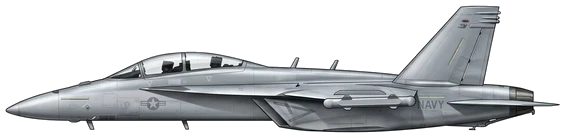
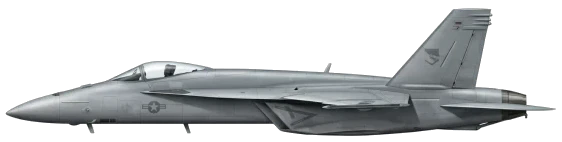
| EA-18G Growler | F/A-18 E/F Super Hornet | |
|---|---|---|
| Origin country | 🇺🇸 United States | 🇺🇸 United States |
| Category | Military Special Mission Aircraft | Combat Aircraft |
| Manufacturer | Boeing | Boeing |
| First flight | 15 August 2006 | 29 November 1995 |
| Year introduced | 2009 | 2001 |
| Number produced | 165 units | 632 units |
| Average unit price | $125 million | $70 million |
| Wing area | 46.5 m² | 46.5 m² |
| Wingspan | 13.6 m | 13.6 m |
| Height | 4.9 m | 4.9 m |
| Length | 18.3 m | 18.3 m |
| Maximum speed | 1900 km/h | 1915 km/h |
| Operational range | 2,346 km | 2,346 km |
| Service ceiling | 15,000 m | 15,940 m |
| Max. takeoff weight | 29,964 kg | 29,900 kg |
| Empty weight | 15,011 kg | 14,550 kg |
| Total thrust | 2 x 9,979 kgf | 2 x 9,979 kgf |
Detailed Comparison
The Boeing F/A-18E/F Super Hornet and its electronic warfare derivative, the EA-18G Growler, form the backbone of modern United States Navy carrier air wings. While the Super Hornet was developed in the 1990s as a stopgap measure following the A-12 Avenger II cancellation—ultimately replacing the F-14 Tomcat and A-6 Intruder—the Growler was purpose-built a decade later to retire the aging EA-6B Prowler. Sharing 90% airframe commonality, they execute separate doctrinal mandates: the F/A-18E/F delivers kinetic mass, while the EA-18G dictates electromagnetic spectrum control.
Development and Design
The Super Hornet program prioritized low-risk procurement over absolute performance. Boeing enlarged the legacy Hornet by 20%, expanded wing area by 25%, and increased internal fuel by 33% to correct the severe combat radius deficit of the F/A-18C/D. Engine inlets were redesigned into rectangular caret shapes to reduce radar cross-section. The Growler utilizes the two-seat F/A-18F airframe but removes the M61A2 20mm cannon to house airborne electronic attack (AEA) avionics. Aerodynamically, the Growler required localized modifications—wing fold hinge fairings, wing fences, and aileron tripper strips—to counteract pitch instability introduced by the heavy ALQ-99 tactical jamming pods. A primary Growler modification is the Interference Cancellation (INCANS) system, allowing UHF voice communication during active jamming, a capability absent in the Prowler.
Specifications and Performances
Both platforms rely on twin General Electric F414-GE-400 turbofans generating 19,958 kgf combined thrust. Airframe commonality mandates identical dimensions (18.31 m length, 13.62 m wingspan), but their mass distribution differs.
- The Growler's empty weight (15,011 kg) exceeds the Super Hornet's (14,550 kg) due to internal EW systems.
- While both share a 29,900-29,964 kg MTOW and listed 2,346 km ferry range, the Growler incurs higher drag penalties from ALQ-99/ALQ-249 pods and wingtip ALQ-218 receivers.
- Super Hornets retain a marginal kinetic edge with a 228 m/s climb rate and higher operational ceiling (15,940 m vs 15,000 m).
Both aircraft share the AN/APG-79 AESA radar, but the Growler's computing architecture is heavily biased toward emitter geolocation and tactical data linkage via TTNT.
Deployment and usage
The Super Hornet entered combat in 2002 during Operation Southern Watch and executed close air support and strike missions in Iraq and Afghanistan. It recorded a kinetic air-to-air victory in 2017, destroying a Syrian Su-22. The Growler debuted in 2011 during Operation Odyssey Dawn in Libya, suppressing regime air defenses. During the 2023–2024 Operation Prosperity Guardian, the platforms operated symbiotically. Super Hornets conducted interception and strike sorties against Houthi munitions, while a Growler destroyed an Mi-24 helicopter on the ground using an AGM-88E AARGM, and later downed a drone. Australia purchased 12 Growlers and 24 F/A-18Fs, becoming the sole export user and establishing regional electronic attack parity in the Indo-Pacific.
Conclusion
The Super Hornet possesses an edge in traditional fleet defense, deep strike, and counter-air scenarios due to its internal cannon, higher kinetic envelope, and broader ordnance integration. However, the EA-18G Growler is the strictly superior asset in contested airspace. Against modern integrated air defense systems, kinetic strike is irrelevant without spectrum dominance. The Growler’s ability to blind threat radars, geolocate emitters for standoff strikes, and deploy the ALQ-249 Next-Generation Jammer makes it the pacing asset for penetrating denied environments. A carrier strike group can fight without F/A-18E/Fs by substituting F-35Cs, but it cannot survive peer combat without the EA-18G.


