F-14 Tomcat vs F/A-18 Hornet
F-14 Tomcat vs F/A-18 Hornet at a glance — top speed 2,485 vs 1,915 km/h, range 3,000 vs 2,017 km, max takeoff weight 33,724 vs 23,541 kg, built 712 vs 1,480 units.
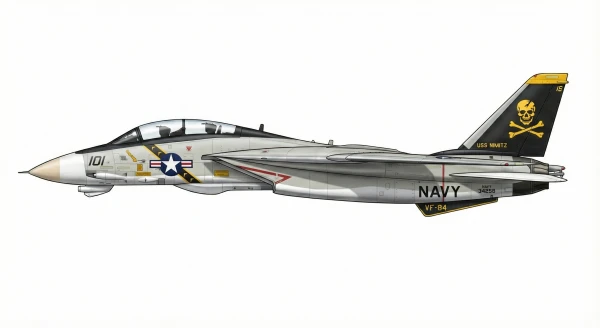
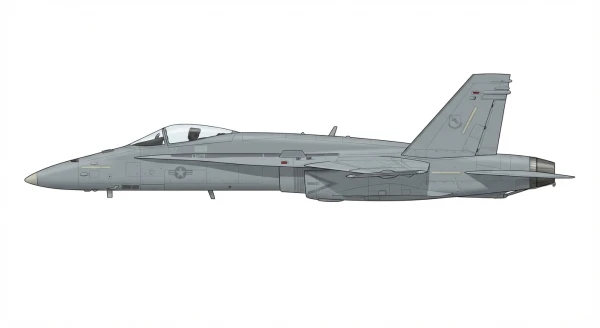
| F-14 Tomcat | F/A-18 Hornet | |
|---|---|---|
| Origin country | 🇺🇸 United States | 🇺🇸 United States |
| Category | Combat Aircraft | Combat Aircraft |
| Manufacturer | Grumman | McDonnell Douglas |
| First flight | 21 December 1970 | 18 November 1978 |
| Year introduced | 1972 | 1983 |
| Number produced | 712 units | 1480 units |
| Average unit price | $38 million | $29 million |
| Wing area | 52.5 m² | 38.0 m² |
| Wingspan | 19.6 m | 12.3 m |
| Height | 4.9 m | 4.7 m |
| Length | 19.1 m | 17.1 m |
| Maximum speed | 2485 km/h | 1915 km/h |
| Operational range | 3,000 km | 2,017 km |
| Service ceiling | 17,069 m | 15,000 m |
| Max. takeoff weight | 33,724 kg | 23,541 kg |
| Empty weight | 18,191 kg | 10,433 kg |
| Total thrust | 2 x 12,224 kgf | 2 x 8,051 kgf |
Detailed Comparison
The F-14 Tomcat and F/A-18 Hornet originated from different operational requirements for the U.S. Navy. The Tomcat was conceived as a specialized long-range fleet defense interceptor, a mission profile reflected in its $38 million unit cost and its advanced, long-range weapon system. In contrast, the F/A-18 was developed from the YF-17 as a more affordable ($29 million) and versatile multirole aircraft, intended to replace older attack platforms like the A-7 Corsair II while complementing the F-14.
Development and Design
The F-14's design was dictated by the need to loiter for extended periods and then engage targets at high speed. This led to its most distinct feature: variable-sweep wings, which automatically adjusted to optimize lift and reduce drag across different flight regimes. Its design centered on the powerful Hughes AWG-9 radar, capable of tracking 24 targets and engaging six simultaneously. Conversely, the F/A-18 was designed for versatility and reliability in carrier operations. Its fixed, trapezoidal wings with large leading-edge extensions (LEX) and a digital fly-by-wire system provided high agility. The design also emphasized ease of maintenance, a crucial factor for sustained carrier deployments.
Specifications and Performances
A key performance discriminator was the F-14’s beyond-visual-range (BVR) capability. Its AWG-9 radar paired with the AIM-54 Phoenix missile gave it an engagement range of 160 km, far exceeding that of its contemporaries. The Tomcat also possessed a higher maximum speed of 2,485 km/h compared to the Hornet's 1,915 km/h. However, the F-14A model's performance was critically undermined by its Pratt & Whitney TF30 engines, which were unreliable and prone to failure in high angle-of-attack maneuvers, hindering its effectiveness in dogfights. The F/A-18's General Electric F404 engines were noted for their reliability, and while the aircraft was slower, its aerodynamic design made it a formidable opponent in close-range combat. This engine deficiency in the Tomcat was only rectified late in its service life with the introduction of the General Electric F110 in the F-14B/D variants.
Deployment and usage
The two aircraft's operational histories reflect their design philosophies. The F-14 primarily served as a two-seat interceptor, though later variants ("Bombcat") added significant air-to-ground capabilities. Its use was largely confined to the U.S. Navy and a single export customer, Iran. The F/A-18, true to its "F/A" designation, was deployed from the outset in both fighter and attack roles. It has a more extensive and varied combat record, participating in numerous conflicts from the 1980s onward. Its versatility and lower operating costs led to widespread adoption by the U.S. Navy and Marine Corps, as well as several allied air forces. Ultimately, the F/A-18's evolution into the F/A-18E/F Super Hornet led to it replacing the F-14.
Conclusion
The F-14 Tomcat was a pinnacle of specialized Cold War-era design, offering unmatched long-range fleet defense capabilities at the cost of complexity, high price, and initial engine unreliability. The F/A-18 Hornet represented a strategic shift toward multi-mission platforms, emphasizing reliability, adaptability, and cost-effectiveness. While the Tomcat was a superior BVR interceptor for much of its career, the Hornet's multirole flexibility and operational dependability proved to be a more sustainable and versatile model for modern naval aviation, ensuring its lineage would continue long after the Tomcat's retirement.