F-15 Eagle vs F-15EX Eagle II
F-15 Eagle vs F-15EX Eagle II at a glance — top speed 2,655 vs 2,655 km/h, range 3,971 vs 3,889 km, max takeoff weight 30,844 vs 36,741 kg, built 1,198 vs 154 units.
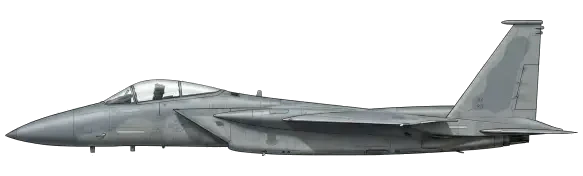
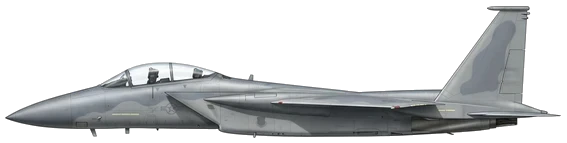
| F-15 Eagle | F-15EX Eagle II | |
|---|---|---|
| Origin country | 🇺🇸 United States | 🇺🇸 United States |
| Category | Combat Aircraft | Combat Aircraft |
| Manufacturer | McDonnell Douglas | Boeing |
| First flight | 27 July 1972 | 2 February 2021 |
| Year introduced | 1976 | 2024 |
| Number produced | 1198 units | 154 units |
| Average unit price | $29 million | $90 million |
| Wing area | 56.5 m² | 56.5 m² |
| Wingspan | 13.1 m | 13.1 m |
| Height | 5.6 m | 5.7 m |
| Length | 19.4 m | 19.4 m |
| Maximum speed | 2655 km/h | 2655 km/h |
| Operational range | 3,971 km | 3,889 km |
| Service ceiling | 19,812 m | 18,000 m |
| Max. takeoff weight | 30,844 kg | 36,741 kg |
| Empty weight | 12,701 kg | 16,103 kg |
| Total thrust | 2 x 10,782 kgf | 2 x 129 kN |
Detailed Comparison
The original F-15 Eagle was engineered in the late 1960s for air superiority to counter the Soviet MiG-25, based on energy-maneuverability theory. The F-15EX Eagle II abandons the original "not a pound for air-to-ground" mandate, emerging as a 4.5-generation heavy-payload multirole fighter. While the airframe silhouette remains identical, the internal architecture and tactical employment of the two platforms share almost nothing.
Development and Design
The legacy F-15 prioritized thrust, energy retention, and a high-visibility cockpit over multirole utility. McDonnell Douglas utilized a semi-monocoque titanium and aluminum structure, constrained by mechanical flight controls. The F-15EX stems from a Boeing effort funded by export clients Saudi Arabia and Qatar. By replacing the mechanical linkages with a digital fly-by-wire system, Boeing unlocked outboard wing stations 1 and 9. The EX integrates an open mission systems architecture built around the ADCP II processor, replacing the proprietary avionics silos of the F-15C to accelerate future software integrations.
Specifications and Performances
The structural reinforcement required for a 20,000-hour airframe life and multirole capability imposes a weight penalty. The F-15EX's empty weight of 16,103 kg is 3,402 kg heavier than the legacy Eagle. To compensate, the EX employs twin General Electric F110-GE-129 engines, pushing the Maximum Takeoff Weight to 36,741 kg—a 5,897 kg increase over the legacy F-15.
Key technological substitutions include:
- The APG-82(V)1 AESA radar, replacing the mechanically scanned APG-63
- The ALQ-250 EPAWSS for digital electronic warfare, replacing the ALQ-135/128
- A digital flight control system increasing the standard air-to-air loadout from 8 to 12 missiles
Both airframes maintain a Mach 2.5 maximum speed, but the EX trades the F-15C's unrefueled aerodynamic agility for raw payload capacity.
Deployment and usage
Israeli F-15s destroyed 41 Syrian aircraft in 1982, and USAF F-15s secured 36 of 39 US air-to-air kills in the 1991 Gulf War. The legacy F-15 operated as a frontline penetration fighter. Doctrine for the F-15EX shifts away from contested airspace penetration. The USAF utilizes the EX for homeland defense, replacing Air National Guard F-15Cs, and as a standoff weapons magazine. Operating safely behind stealth assets like the F-35, the EX is tasked with launching outsized munitions, including the AIM-260 JATM and AGM-158 JASSM, which cannot fit inside fifth-generation internal weapons bays.
Conclusion
The F-15EX is the more effective platform for modern, integrated air campaigns, while the legacy F-15 retains an edge only in close-range, unladen dogfighting where its lighter airframe yields better energy retention. Procurement of the EX indicates that stealth platforms possess insufficient payload depth for a protracted peer conflict. The F-15EX acts as a heavy-lift node, surviving via EPAWSS jamming and standoff range rather than kinematic evasion or low observability. For pure air superiority in contested airspace, the F-22 remains necessary, but for sustained fires and payload mass, the F-15EX provides the exact capacity required by current USAF doctrine.


-
 Saudi Arabia
83
Saudi Arabia
83
-
 Qatar
48
Qatar
48
-
 United States
22
United States
22
- All 4 operators →