F-15 Eagle vs F-22 Raptor
F-15 Eagle vs F-22 Raptor at a glance — top speed 2,655 vs 2,414 km/h, range 3,971 vs 3,000 km, max takeoff weight 30,844 vs 38,000 kg, built 1,198 vs 195 units.
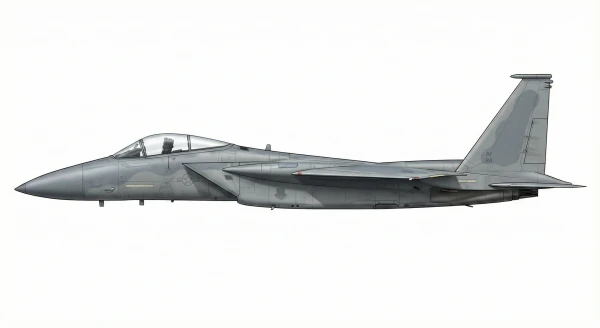
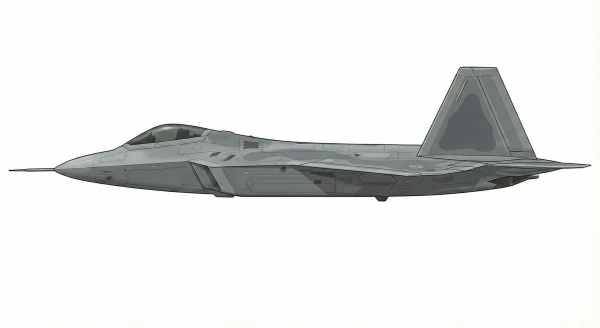
| F-15 Eagle | F-22 Raptor | |
|---|---|---|
| Origin country | 🇺🇸 United States | 🇺🇸 United States |
| Category | Combat Aircraft | Combat Aircraft |
| Manufacturer | McDonnell Douglas | Lockheed Martin |
| First flight | 27 July 1972 | 7 September 1997 |
| Year introduced | 1976 | 2005 |
| Number produced | 1198 units | 195 units |
| Average unit price | $29 million | $150 million |
| Wing area | 56.5 m² | 78.0 m² |
| Wingspan | 13.1 m | 13.6 m |
| Height | 5.6 m | 5.1 m |
| Length | 19.4 m | 18.9 m |
| Maximum speed | 2655 km/h | 2414 km/h |
| Operational range | 3,971 km | 3,000 km |
| Service ceiling | 19,812 m | 19,812 m |
| Max. takeoff weight | 30,844 kg | 38,000 kg |
| Empty weight | 12,701 kg | 19,700 kg |
| Total thrust | 2 x 10,782 kgf | 2 x 15,876 kgf |
Detailed Comparison
Conceived in the wake of the Vietnam War, the F-15 Eagle was engineered to reverse U.S. disadvantages in close-range dogfighting through raw thrust and energy-maneuverability theory. The F-22 Raptor, born from the 1981 Advanced Tactical Fighter program, shifted air superiority doctrine toward low-observable stealth, sensor fusion, and beyond-visual-range dominance to counter advanced Soviet surface-to-air missiles.
Development and Design
The F-15 architecture prioritizes wing area (56.5 m²) and thrust to achieve a near 1:1 thrust-to-weight ratio. McDonnell Douglas built the Eagle using 37.3% aluminum and 25.8% titanium, favoring durability and high sortie generation. Lockheed Martin designed the F-22 around a highly classified stealth profile, trading external payload capacity for a reduced radar cross-section. The Raptor relies on radar-absorbent materials and internal weapons bays, necessitating complex, time-intensive maintenance protocols. The Obey Amendment legally barred the F-22 from export, capping production at 195 airframes. The F-15, exported to nations like Israel and Japan, reached 1,198 units. At $29.0 million per unit historically, the F-15 provided mass that the $150.0 million F-22 could not sustain.
Specifications and Performances
The F-15 maintains a kinematic edge in maximum sprint speed, reaching Mach 2.5 (2,655 km/h) compared to the F-22's Mach 2.2 (2,414 km/h). The Raptor's twin Pratt & Whitney F119 engines deliver 31,752 kgf of thrust and enable supercruise—sustained supersonic flight without afterburners. This allows the F-22 to transit to engagements rapidly while conserving fuel. The F-22 operates with a higher maximum takeoff weight of 38,000 kg versus the F-15's 30,844 kg. Payload dictates tactics: the F-15 mounts weaponry on external pylons, maximizing munitions load at the cost of drag and radar visibility, whereas the F-22 restricts its baseline air-to-air loadout to six AIM-120s and two AIM-9s stored internally.
Deployment and usage
The F-15 holds a verified 104-to-0 air-to-air combat record, established by the Israeli Air Force in the 1982 Lebanon War and the USAF during the 1991 Gulf War, where Eagles scored 36 of 39 U.S. aerial victories. The F-22's combat application is different. Initially deployed in 2005, its primary combat usage occurred in 2014 over Syria during Operation Inherent Resolve. Instead of dogfighting, the USAF utilized the F-22 as a forward sensor and command node. Pilots used its AN/APG-77 radar to map the airspace and pass targeting tracks to older 4th-generation aircraft. The Raptor fleet has struggled with lower readiness rates, compounded by early groundings due to oxygen supply (OBOGS) malfunctions.
Conclusion
The F-22 holds the advantage in highly contested airspace defended by modern integrated air defense systems. Its low observability allows it to identify and destroy threats before being targeted. The F-15 retains the edge in permissive environments and extended air patrols where stealth is unnecessary and payload mass is required.
Specifically, the split in operational utility is rigid:
- The F-22 is required for penetrating anti-access/area denial (A2/AD) networks and conducting first-look/first-shoot engagements.
- The F-15 is required for homeland defense, long-duration combat air patrols, and acting as a high-capacity missile truck once the airspace is sanitized.
For volume of fire and cost-per-flight-hour, the F-15 remains the practical asset. When operating against peer-state adversaries with modern radar networks, the F-22 is the only viable option.