F-22 Raptor vs F/A-18 Hornet
F-22 Raptor vs F/A-18 Hornet at a glance — top speed 2,414 vs 1,915 km/h, range 3,220 vs 2,017 km, max takeoff weight 38,000 vs 23,541 kg, built 195 vs 1,480 units.
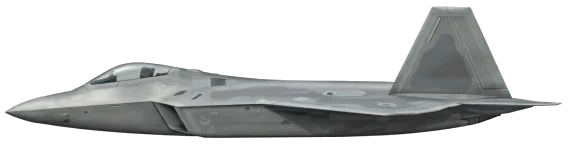
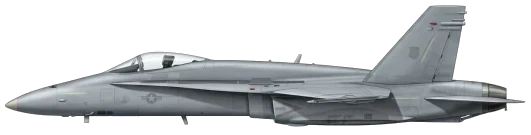
| F-22 Raptor | F/A-18 Hornet | |
|---|---|---|
| Origin country | 🇺🇸 United States | 🇺🇸 United States |
| Category | Combat Aircraft | Combat Aircraft |
| Manufacturer | Lockheed Martin | McDonnell Douglas |
| First flight | 7 September 1997 | 18 November 1978 |
| Year introduced | 2003 | 1983 |
| Number produced | 195 units | 1480 units |
| Average unit price | $150 million | $29 million |
| Wing area | 78.0 m² | 38.0 m² |
| Wingspan | 13.6 m | 12.3 m |
| Height | 5.1 m | 4.7 m |
| Length | 18.9 m | 17.1 m |
| Maximum speed | 2414 km/h | 1915 km/h |
| Operational range | 3,220 km | 2,017 km |
| Service ceiling | 19,812 m | 15,000 m |
| Max. takeoff weight | 38,000 kg | 23,541 kg |
| Empty weight | 19,700 kg | 10,433 kg |
| Total thrust | 2 x 15,876 kgf | 2 x 8,051 kgf |
Detailed Comparison
Designed to penetrate dense air defense networks, the Lockheed Martin F-22 Raptor is a specialized, low-observable air superiority platform. Conversely, the McDonnell Douglas F/A-18 Hornet trades stealth for a carrier-capable, multirole airframe optimized for high sortie generation. Where the F-22 relies on kinematic dominance to kill beyond visual range, the Hornet leverages high angle-of-attack maneuverability and broad ordnance integration.
Development and Design
The F-22 emerged from the Advanced Tactical Fighter program, prioritizing low radar cross-section and supercruise. Lockheed Martin engineered the airframe with internal weapons bays and titanium-composite structures. This specialization drove the unit cost to $150.0 million, capping production at 195 airframes. The Hornet originated from a Navy mandate to replace A-4 and F-4 fleets using the Northrop YF-17 prototype. McDonnell Douglas redesigned it for carrier operations with robust landing gear, folding wings, and a digital multiplexing avionics bus. At $29.0 million per unit, the Hornet was built for mass production, delivering 1,480 units. It introduced multifunction displays allowing single-seat pilots to execute air-to-air and strike profiles sequentially.
Specifications and Performances
The kinematic gap dictates tactical employment. Driven by Pratt & Whitney F119-PW-100 turbofans generating 31,752 kgf of thrust against a 38,000 kg maximum takeoff weight, the F-22 reaches 2,414 km/h and a 19,812-meter ceiling. This thrust enables supercruise—sustained supersonic flight without afterburners. The F/A-18 is slower (1,915 km/h) and altitude-limited (15,000 meters), with F404 engines yielding 12,700 kgf against a 23,541 kg maximum takeoff weight. The Hornet offsets lower energy retention with large leading-edge extensions for nose-pointing at low airspeeds. Weapon carriage diverges structurally:
- The F-22 restricts primary loads to internal bays (typically six AIM-120s and two AIM-9s, or two 1,000-lb JDAMs) to maintain its stealth profile.
- The F/A-18 utilizes nine external hardpoints to haul up to 13,700 pounds of ordnance, ranging from AGM-88 HARMs to Harpoon anti-ship missiles.
Deployment and usage
The Hornet logged decades of combat data starting with 1986 strikes on Libya. During the 1991 Gulf War, F/A-18s shot down Iraqi MiGs and bombed ground targets on the same mission. Its maintenance reliability drove export sales to Australia, Canada, Spain, and Finland. The F-22 saw no combat until 2014 over Syria, acting primarily as a kinetic node and airspace manager during Operation Inherent Resolve. Federal law barred F-22 exports to protect low-observable data, leaving the USAF as the sole operator. Early Raptor deployments faced hypoxia-like incidents traced to the on-board oxygen generation system, requiring mechanical retrofits.
Conclusion
The F-22 dictates terms in contested, anti-access/area-denial airspace. Against adversaries equipped with modern surface-to-air missiles, the Raptor’s low-observability and kinematic advantage make it the strict requirement for first-strike air dominance. The F/A-18 is highly vulnerable in that specific arena. However, for sustained combat generation in semi-permissive airspace, the F/A-18 is the required platform. At a fraction of the procurement cost, the Hornet executes close air support, anti-shipping, and SEAD missions the F-22 cannot physically perform due to internal payload volume constraints and a lack of diverse ordnance integration.