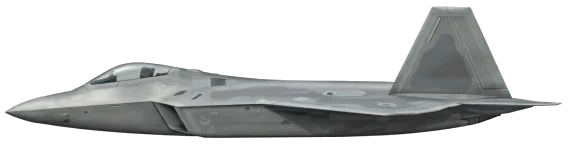
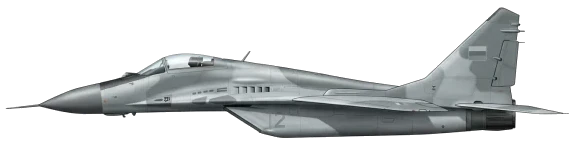
F-22 Raptor vs MiG-29 Fulcrum
F-22 Raptor vs MiG-29 Fulcrum at a glance — top speed 2,414 vs 2,450 km/h, range 3,220 vs 2,100 km, max takeoff weight 38,000 vs 18,000 kg, built 195 vs 1,600 units.
F-22 Raptor MiG-29 Fulcrum
Origin country
🇺🇸 United States 🇷🇺 Ex-USSR
Category
Combat Aircraft Combat Aircraft
Manufacturer
Lockheed Martin
Mikoyan
First flight
7 September 1997
6 October 1977
Year introduced
2003
1983
Number produced
195 units
1600 units
Average unit price
$150 million
$25 million
Wing area
78.0 m² 38.0 m²
Wingspan
13.6 m 11.4 m
Height
5.1 m 4.7 m
Length
18.9 m 17.3 m
Maximum speed
2414 km/h 2450 km/h
Operational range
3,220 km 2,100 km
Service ceiling
19,812 m 18,000 m
Max. takeoff weight
38,000 kg 18,000 kg
Empty weight
19,700 kg 11,000 kg
Total thrust
2 x 15,876 kgf
2 x 8,319 kgf
Detailed Comparison The $150 million Lockheed Martin F-22 Raptor and the $25 million Mikoyan MiG-29 Fulcrum were built to secure air superiority, executing this mission through opposed engineering vectors. The F-22 relies on very-low-observable (VLO) stealth, sustained supersonic kinematics, and beyond-visual-range (BVR) sensor fusion to destroy threats before detection. The MiG-29 was engineered as a frontline point-defense interceptor, optimized for within-visual-range (WVR) agility, rapid sortie generation from austere airstrips, and numerical saturation.
Development and Design
The MiG-29 emerged from the Soviet requirement for a lightweight tactical fighter to counter the F-15 and F-16 . Mikoyan optimized the airframe for high angle-of-attack maneuvers, integrating a helmet-mounted sight (HMS) slaved to the R-73 infrared missile. This mechanical and sensor integration provided a direct WVR advantage upon its 1983 introduction. The F-22 originated from the 1981 Advanced Tactical Fighter (ATF) program to penetrate integrated air defense systems. Lockheed Martin prioritized radar cross-section (RCS) reduction and supercruise capability (sustained flight above Mach 1.5 without afterburners), forcing internal weapons carriage. This design choice limits the F-22 's payload volume compared to external carriage but ensures it survives in highly contested airspace.
Specifications and Performances
A kinematic comparison reveals the F-22 's dominance in energy management and endurance. The Raptor carries a maximum takeoff weight of 38,000 kg compared to the Fulcrum ’s 24,000 kg, yet its twin Pratt & Whitney F119 engines produce 31,752 kgf of thrust, granting a higher thrust-to-weight ratio even with internal weapons and fuel.
The MiG-29 is limited by a 1,430 km range, restricting it to local air defense, while the F-22 reaches 3,000 km, enabling theater-wide projection.
The MiG’s Klimov RD-33 engines require frequent overhauls and historically leave a visible exhaust trail, compromising visual stealth.
The F-22 ’s AN/APG-77 AESA radar detects targets at over 200 kilometers, whereas the MiG-29 ’s baseline N-019 mechanically scanned radar struggles with look-down/shoot-down modes and multi-target tracking.
Deployment and usage
The MiG-29 has seen widespread combat deployment but suffers a bleak BVR loss record. During Operation Desert Storm (1991) and Operation Allied Force (1999), Iraqi and Serbian MiG-29s were consistently destroyed by US F-15s and F-16s before entering their WVR engagement envelopes. The airframe’s lack of modern datalinks and autonomous situational awareness proved fatal against networked western forces. The F-22 achieved initial operational capability in 2005 but lacked peer adversaries. Its combat debut occurred in 2014 over Syria during Operation Inherent Resolve , functioning as a kinetic striker using GBU-32 JDAMs and as an airborne command node, utilizing its sensors to deconflict airspace rather than dogfighting.
Conclusion
The F-22 Raptor holds the absolute edge in modern, peer-to-peer air superiority engagements. Its combination of VLO stealth and BVR lethality renders the MiG-29 's WVR agility geographically irrelevant; a Fulcrum will be tracked, targeted, and destroyed by an AIM-120D long before its pilot detects the Raptor. The MiG-29 retains value only in low-budget, localized point-defense for developing nations. In contested, multi-domain environments, the F-22 's sensor fusion dictates the terms of the engagement.
Largest operators · in service
Largest operators · in service
Change comparison
-- Select an aircraft --
206 JetRanger
208 Caravan
210 Centurion
421 Golden Eagle
429 GlobalRanger
441 Conquest II
500 Citation I
505 Jet Ranger X
A-1 Skyraider
A-10 Thunderbolt II
A-3 Skywarrior
A-37 Dragonfly
A-4 Skyhawk
A-40 Mermaid
A-5 Vigilante
A-50 Mainstay
A-6 Intruder
A-7 Corsair II
A1-CM Furia
A129 Mangusta
A400M Atlas
A900
AC-130
AH-1 Cobra
AH-1W Super Cobra
AH-1Z Viper
AH-2 Rooivalk
AH-6 Little Bird
AH-64 Apache
AMCA
AMX
AN-BK-1 Horlytsia
AQ-400 Scythe
AQM-34 Lightning Bug
AS 202 Bravo
AS332 Super Puma
AS565 Panther
ASN-209 Silver Eagle
AT-3 Tsu Chiang
ATL-2 Atlantique
ATR-42
ATR-72
AV-8B Harrier II
AW.660 Argosy
AW101
AW109
AW119
AW139
AW149
AW159
AW169
AW249 Fenice
AW609
Aarok
Ababil-3
Aermacchi M-345
Aermacchi S-211
Aerosonde
Aerostar
Air Tractor AT-500
Airbus A310 MRTT
Airbus A319 CJ
Airbus A321
Airbus A330
Airbus A330 MRTT
Airbus A350
Ajeet
Alarus CH2000
Alizé
Alpha Jet
An-12 Cub
An-124 Condor
An-14 Clod
An-140
An-148
An-178
An-196 Liutyi
An-2 Colt
An-22 Cock
An-225 Cossack
An-24 Coke
An-26 Curl
An-28 Cash
An-30 Clank
An-32 Cline
An-71 Madcap
An-72/74 Coaler
Ansat
Arava
Archytas
Atlas Cheetah
Atlas Oryx
Azarakhsh
B-1A
B-1B Lancer
B-2 Spirit
B-21 Raider
B-29 Superfortress
B-36 Peacemaker
B-45 Tornado
B-47 Stratojet
B-52 Stratofortress
B-57 Canberra
B-58 Hustler
B-66 Destroyer
BAE Tempest
BAe 146
BD-700 Global Express
BN-2B Defender
BQM-167 Skeeter
BQM-74 Chukar
BZK-005 Giant Eagle
Bayraktar Akıncı
Bayraktar Kızılelma
Bayraktar TB2
Bayraktar TB3
Be-12 Tchaïka Mail
Be-200
Be-6 Madge
Beechcraft 1900 Beechliner
Beechcraft 390 Premier I
Beechcraft Baron
Beechcraft Bonanza
Bell 214
Bell 407
Bell 412
Bell 430
Bell 47
Bird-Eye
Black Hornet
Blackburn Beverley
Bober
Boeing 707
Boeing 727
Boeing 737
Boeing 747
Boeing 757
Boeing 767
Br.1150 Atlantic
Bristol Belvedere
Bristol Sycamore
Buccaneer
Burraq
C-101 Aviojet
C-123 Provider
C-130 Hercules
C-140 JetStar
C-141 Starlifter
C-160 Transall
C-17 Globemaster III
C-2 Greyhound
C-212 Aviocar
C-23 Sherpa
C-27J Spartan
C-295 Persuader
C-32
C-390 Millennium
C-5 Galaxy
CF-100 Canuck
CF-105 Arrow
CH-3 Rainbow
CH-4 Rainbow
CH-46 Sea Knight
CH-47 Chinook
CH-5 Rainbow
CH-53 Sea Stallion
CH-54 Tarhe
CH-7 Rainbow
CH-92 Rainbow
CH-95 Rainbow
CL-215 Scooper
CL-41 Tutor
CL-415 Super Scooper
CL-600 Challenger
CM 170 Magister
CN-235
CP-107 Argus
CT/4 Airtrainer
Calidus B250
Canadair CL-289
Canberra
Cessna 340
Cessna 402
Cessna 404 Titan
Cirrus SR-20
Cirrus SR22
Commander 500
Crécerelle
DA42 Twin Star
DH.100 Vampire
DH.106 Comet
DH.110 Sea Vixen
DH.112 Venom
DHC-1 Chipmunk
DHC-2 Beaver
DHC-3 Otter
DHC-4 Caribou
DHC-5 Buffalo
DHC-6 Twin Otter
DHC-7 Dash 7
DHC-8 Dash 8
Denel Seeker
Dhruv
Diamond DA62
Djinn
Do 128
Do 228
Do 27
Do 328
Douglas DC-3
E-1 Tracer
E-2 Hawkeye
E-3 Sentry AWACS
E-4 NOAC
E-6 Mercury TACAMO
E-7 Wedgetail
E-8 Joint STARS
EA-18G Growler
EA-37B Compass Call
EA-6B Prowler
EC-130 Commando Solo
EC-130H Compass Call
EC-135 / EC-18 ARIA
EC665 Tiger
EF-111 Raven
EMB 110
EMB 120 Brasilia
EMB 121 Xingu
EMB 312 Tucano
EMB-314 Super Tucano
EMT Luna
ERJ 135
Eitan (Heron TP)
Elbit Skylark
Eleron-3
English Electric Lightning
Enstrom 480
Enstrom F-28
Eurodrone
F-100 Super Sabre
F-101 Voodoo
F-102 Delta Dagger
F-104 Starfighter
F-105 Thunderchief
F-106 Delta Dart
F-111 Aardvark
F-117 Nighthawk
F-14 Tomcat
F-15 Eagle
F-15E Strike Eagle
F-15EX Eagle II
F-15I Ra'am
F-16 Fighting Falcon
F-16I Sufa
F-16V Viper
F-22 Raptor
F-35 Lightning II
F-4 Phantom II
F-47
F-5 Freedom Fighter
F-5E Tiger II
F-8 Crusader
F-80 Shooting Star
F-84 Thunderjet
F-84F Thunderstreak
F-86 Sabre
F-CK-1 Ching-Kuo
F/A-18 E/F Super Hornet
F/A-18 Hornet
F11F Tiger
F27 Friendship
F28 Fellowship
F406 Caravan II
F4D Skyray
F9F Panther
FA-50 Fighting Eagle
FJ-4 Fury
FP-1
FQ-42 Vengeance
FQ-44 Fury
FT5 Łoś
Fairchild Metroliner
Fairey Gannet
Falcon 10
Falcon 20
Falcon 2000
Falcon 50
Falcon 7X
Falcon 8X
Falcon 900
FlyEye
Fokker 50
Folland Gnat
Forpost
Fotros
Fuji T-1
Fuji T-3
Fuji T-5
Fuji T-7
G-2 Galeb
G.222
G.91 Gina
GAF Nomad
GEC-Marconi Phoenix
GJ-11 Sharp Sword
GNAT-750
Garpiya-A1
Geran-5
Gerbera
GippsAero GA8 Airvan
GlobalEye
Gloster Javelin
Gloster Meteor
Grob G-115
Grob G-120
Guimbal Cabri G2
Gulfstream G100
Gulfstream G550
Gulfstream G650
Gulfstream II
Gulfstream III
Gulfstream IV
Gulfstream V
H-19 Chickasaw
H-21 Shawnee
H-34 Choctaw
H-37 Mojave
H-5
H-6
H120 / EC120 Colibri
H125M / AS550 Fennec
H135M / EC365
H145M / EC645
H155 / EC155 Dauphin 2
H160M Guépard
H175
H215M / AS532 Cougar
H225M / EC725 Caracal
HF-24 Marut
HH-3 Jolly Green Giant
HH-52 Seaguard
HH-60 Pave Hawk
HJT-16 Kiran
HPT-32 Deepak
HS 748
HTT-40
Harfang
Harrier
Hawk
Hawker 400
Hawker 800
Hawker Hunter
Hermes 450
Hermes 900
Hürjet
Hürkus
I-22 Iryda
IA 58 Pucará
IA-63 Pampa
IAI Harop
IAI Harpy
IAI Heron
IAI Scout
IAI Searcher
IAR-823
IAR-93 / J-22 Orao
IAR-99 Șoim
Il-10 Beast
Il-112
Il-114
Il-14 Crate
Il-18 Coot
Il-2 Sturmovik
Il-20 Coot-A
Il-276 SVTS
Il-28 Beagle
Il-38 May
Il-62 Classic
Il-76 Candid
Il-78 Midas
Il-80
Il-86 Camber
Il-96
Iomax Archangel
Italmas
J-10 Vigorous Dragon
J-11 Responsive Dragon
J-12
J-15 Flying Shark
J-16 Qianlong
J-20 Kraguj
J-20 Mighty Dragon
J-21 Jastreb
J-29 Tunnan
J-32 Lansen
J-35 Draken
J-36
J-5 Fresco
J-50
J-6 Farmer
J-7 Fishcan
J-8 Finback
JA 37 Viggen
JAS 39 Gripen
JF-17 Thunder
JH-7 Flounder
JL-10
JL-8
JL-9
Jaguar
Jasoos II
Jet Provost
Jetstream 31
Jetstream 41
KAAN
KC-10 Extender
KC-130 Hercules
KC-135 Stratotanker
KC-46 Pegasus
KC-767
KF-21 Boramae
KJ-200 Moth
KJ-2000 Mainring
KJ-500
KQ-200
KT-1 Woongbi
KT-100
KUB-BLA
KUH-1 Surion
KUS-FS
KZO
Ka-22 Hoop
Ka-226 Hoodlum-C
Ka-25 Hormone
Ka-26
Ka-27 Helix
Ka-29 Helix-B
Ka-31
Ka-50 Hokum "Black Shark"
Ka-52 Alligator Hokum-B
Ka-60 Kasatka
Kaman-22
Karayel
Kargu
Karrar
Kawasaki C-1
Kawasaki C-2
Kawasaki P-1
Kawasaki T-4
Kfir
King Air 350
King Air 90
Korsar
Kowsar
Kronshtadt Orion
L-159 ALCA
L-29 Delfin
L-39 Albatros
L-70 Vinka
L-90 Redigo
La-7 Fin
Lakshya
Lasta-95
Learjet 35
Learjet 45
Leleka-100
Leonardo Falco
Let L-410
M-18 Dromader
M-346 Master
M-4 Bison
M-50 Bounder
M-55 Mystic
M28 Skytruck
MB-326K
MB-339
MBB Bo 105
MD-450 Ouragan
MD-500
MD-900
MFI-15 Safari
MH-53J Pave Low III
MQ-1 Predator
MQ-1C Gray Eagle
MQ-20 Avenger
MQ-25 Stingray
MQ-28 Ghost Bat
MQ-4 Triton
MQ-8 Fire Scout
MQ-9 Reaper
MQ-9B SkyGuardian
MQM-107 Streaker
MS 733 Alcyon
MV-75 Cheyenne II
McDonnell Douglas DC-10
Meraj-521
Mi-1 Hare
Mi-10
Mi-14 Haze
Mi-17 Hip-H
Mi-2 Hoplite
Mi-24 Hind
Mi-26 Halo
Mi-28 Havoc
Mi-34 Hermit
Mi-35M
Mi-38
Mi-4 Hound
Mi-6 Hook
Mi-8 Hip
MiG-15 Fagot
MiG-17 Fresco
MiG-19 Farmer
MiG-21 Fishbed
MiG-23 Flogger
MiG-25 Foxbat
MiG-27 Flogger
MiG-29 Fulcrum
MiG-29K Fulcrum-D
MiG-31 Foxhound
MiG-35
MiG-9 Fargo
Mirage 2000
Mirage 4000
Mirage F1
Mirage F2 / F3
Mirage G
Mirage I / MD-550 Mystère Delta
Mirage III / 5 / 50
Mirage IV
Mitsubishi F-1 / T-2
Mitsubishi F-2
Mohajer-10
Mohajer-4
Mohajer-6
Mudry CAP 10
Mudry CAP 232
Mystère IV
NAMC YS-11
NCSIST Albatross
NH90 / Caiman
Nagastra-1
Nanchang CJ-6
Nesher
Nimrod
Nishant
Noratlas
Nord 3400
O-2 Skymaster
OA-1K Skyraider II / AT-802U
OH-1 Ninja
OH-58 Kiowa
OH-6 Cayuse
OV-1 Mohawk
OV-10 Bronco
Orbiter
Orlan-10
Orlan-30
P-2 Neptune
P-3 Orion
P-8 Poseidon
P.166
P180 Avanti
PA-31 Navajo
PA-32 Cherokee Six
PA-34 Seneca
PA-44 Seminole
PC-12 Eagle
PC-6 Porter
PC-7 Turbo Trainer
PD-2
PZL-130 Orlik
Pacific Aerospace P750
Palianytsia
Pe-2 Buck
Pegasus II
Phenom 100
Pilatus PC-21
Pilatus PC-24
Pilatus PC-9
Pipistrel Virus SW80
Po-2 Mule
Prachand
Q-5 / A-5 Fantan
QH-50 DASH
Quest Kodiak
R-4
R-99 Erieye
RC-135 Rivet Joint
RQ-101 Night Intruder
RQ-11 Raven
RQ-16 T-Hawk
RQ-170 Sentinel
RQ-180
RQ-2 Pioneer
RQ-20 Puma
RQ-21 Blackjack
RQ-4 Global Hawk
RQ-5 Hunter
RQ-7 Shadow
RUAG Ranger
Rafale
Robinson R22
Robinson R44 Raven
S-100 Camcopter
S-2 Tracker
S-3 Viking
S-70 Okhotnik
S-76 Spirit
S-92 Superhawk
S330 / S333
SA 315B Lama
SA315 Alouette II
SA316 Alouette III
SA321 Super Frelon
SA330 Puma
SA340 Gazelle
SAAB 105
SH-2 Seasprite
SH-3 Sea King
SH-5
SH-60 Seahawk
SIAI-Marchetti SF-260
SIAI-Marchetti SM.1019
SIRTAP
SO 4050 Vautour
SR-71 Blackbird
SW-4 Puszczyk
Saab 340 AEW&C
Saegheh
Saeqeh
Safran Patroller
Samad
Saro Skeeter
ScanEagle
Scottish Aviation Bulldog
Sea Harrier
Sea Hawk
Shackleton
Shahed 129
Shahed 131
Shahed 136
Shahed 238
Shahed-101
Shahed-107
Shahed-149 Gaza
Shahed-171 Simorgh
Shahpar
Shahpar-II
Shenyang J-35
ShinMaywa US-2
Short 330
Short 360
Short Skyvan
Skeldar V-200
Socata TBM
Sokil-300
Soko G-4 Super Galeb
Sokol Altius
Sperwer
Strikemaster
Su-11 Fishpot
Su-15 Flagon
Su-17 Fitter
Su-24 Fencer
Su-25 Frogfoot
Su-27 Flanker
Su-30 Flanker-C
Su-33 Flanker-D
Su-34 Fullback
Su-35 Flanker-E
Su-37 Super Flanker
Su-47 "Berkut" Firkin
Su-57 Felon
Su-7 Fitter
Su-75 Checkmate
Su-9 / Su-11 Fishpot
Super Etendard
Super Mystère B2
Supermarine Scimitar
Switchblade 300
Switchblade 600
T-2 Buckeye
T-23 Uirapuru
T-25 Universal
T-28 Trojan
T-33 Shooting Star
T-34 Mentor
T-35 Pillan
T-37 Tweet
T-38 Talon
T-39 Sabreliner
T-41 Mescalero
T-45 Goshawk
T-5 Brave Eagle
T-50 Golden Eagle
T-6 Texan II
T-67 Firefly
T-7 Red Hawk
T-CH-1 Chung Hsing
T129 ATAK
TAI Aksungur
TAI Anka
TAI Anka-3
TB-001 Twin-tailed Scorpion
TB-30 Epsilon
TH-55 Osage
TS-11 Iskra
TS-8 Bies
Tadiran Mastiff
Taranis
Tecnam P2002
Tecnam P2006T
Tejas
Tornado
Tsaigumi
Tu-104 Camel
Tu-123 Yastreb
Tu-126 Moss
Tu-128 Fiddler
Tu-134 Crusty
Tu-141 Strizh
Tu-142
Tu-143 Reys
Tu-144 Charger
Tu-154 Careless
Tu-16 Badger
Tu-160 Blackjack
Tu-2 Bat
Tu-214
Tu-22 Blinder
Tu-22M / Tu-26 Backfire
Tu-4 Bull
Tu-95 Bear
Twin Pioneer
Typhoon
U-2 Dragon Lady
UA Dynamics Punisher
UH-1 Iroquois "Huey"
UH-1N Twin Huey
UH-1Y Venom
UH-60 Black Hawk
UH-72 Lakota
UJ-22 Airborne
UJ-25 Skyline
UTVA-75
V-12 Homer
V-22 Osprey
V-BAT
VC-25 "Air Force One"
VH-60 White Hawk
Valiant
Victor
Vulcan
Vulcanair P68
W-3 Sokol
WJ-700
WZ-7 Soaring Dragon
WZ-8
Warmate
Wasp III
Watchkeeper WK450
Wessex
Westland Lynx
Westland Scout
Westland Wasp
Westland Whirlwind
Wing Loong I
Wing Loong II
Wing Loong-10
Wulung
X-31 EFM Vector
X-47B
XQ-58 Valkyrie
Y-12
Y-20
Y-7
Y-8
Y-9
YF-23 Black Widow II
YFQ-48 Talon Blue
Yabhon United 40
Yak-11 Moose
Yak-130 Mitten
Yak-141 Freestyle
Yak-15 Feather
Yak-152
Yak-18 Max
Yak-24 Horse
Yak-25 Flashlight
Yak-28 Brewer / Firebar
Yak-36 Freehand
Yak-38 Forger
Yak-40 Codling
Yak-42 Clobber
Yak-52
Yak-9 Frank
Z-10
Z-11
Z-18
Z-19
Z-20
Z-8
Z-9 Haitun
ZALA Lancet
ZDK-03 Karakoram Eagle
Zlin Z 42
Zlin Z 43
nEUROn
Étendard IVM
vs
-- Select an aircraft --
206 JetRanger
208 Caravan
210 Centurion
421 Golden Eagle
429 GlobalRanger
441 Conquest II
500 Citation I
505 Jet Ranger X
A-1 Skyraider
A-10 Thunderbolt II
A-3 Skywarrior
A-37 Dragonfly
A-4 Skyhawk
A-40 Mermaid
A-5 Vigilante
A-50 Mainstay
A-6 Intruder
A-7 Corsair II
A1-CM Furia
A129 Mangusta
A400M Atlas
A900
AC-130
AH-1 Cobra
AH-1W Super Cobra
AH-1Z Viper
AH-2 Rooivalk
AH-6 Little Bird
AH-64 Apache
AMCA
AMX
AN-BK-1 Horlytsia
AQ-400 Scythe
AQM-34 Lightning Bug
AS 202 Bravo
AS332 Super Puma
AS565 Panther
ASN-209 Silver Eagle
AT-3 Tsu Chiang
ATL-2 Atlantique
ATR-42
ATR-72
AV-8B Harrier II
AW.660 Argosy
AW101
AW109
AW119
AW139
AW149
AW159
AW169
AW249 Fenice
AW609
Aarok
Ababil-3
Aermacchi M-345
Aermacchi S-211
Aerosonde
Aerostar
Air Tractor AT-500
Airbus A310 MRTT
Airbus A319 CJ
Airbus A321
Airbus A330
Airbus A330 MRTT
Airbus A350
Ajeet
Alarus CH2000
Alizé
Alpha Jet
An-12 Cub
An-124 Condor
An-14 Clod
An-140
An-148
An-178
An-196 Liutyi
An-2 Colt
An-22 Cock
An-225 Cossack
An-24 Coke
An-26 Curl
An-28 Cash
An-30 Clank
An-32 Cline
An-71 Madcap
An-72/74 Coaler
Ansat
Arava
Archytas
Atlas Cheetah
Atlas Oryx
Azarakhsh
B-1A
B-1B Lancer
B-2 Spirit
B-21 Raider
B-29 Superfortress
B-36 Peacemaker
B-45 Tornado
B-47 Stratojet
B-52 Stratofortress
B-57 Canberra
B-58 Hustler
B-66 Destroyer
BAE Tempest
BAe 146
BD-700 Global Express
BN-2B Defender
BQM-167 Skeeter
BQM-74 Chukar
BZK-005 Giant Eagle
Bayraktar Akıncı
Bayraktar Kızılelma
Bayraktar TB2
Bayraktar TB3
Be-12 Tchaïka Mail
Be-200
Be-6 Madge
Beechcraft 1900 Beechliner
Beechcraft 390 Premier I
Beechcraft Baron
Beechcraft Bonanza
Bell 214
Bell 407
Bell 412
Bell 430
Bell 47
Bird-Eye
Black Hornet
Blackburn Beverley
Bober
Boeing 707
Boeing 727
Boeing 737
Boeing 747
Boeing 757
Boeing 767
Br.1150 Atlantic
Bristol Belvedere
Bristol Sycamore
Buccaneer
Burraq
C-101 Aviojet
C-123 Provider
C-130 Hercules
C-140 JetStar
C-141 Starlifter
C-160 Transall
C-17 Globemaster III
C-2 Greyhound
C-212 Aviocar
C-23 Sherpa
C-27J Spartan
C-295 Persuader
C-32
C-390 Millennium
C-5 Galaxy
CF-100 Canuck
CF-105 Arrow
CH-3 Rainbow
CH-4 Rainbow
CH-46 Sea Knight
CH-47 Chinook
CH-5 Rainbow
CH-53 Sea Stallion
CH-54 Tarhe
CH-7 Rainbow
CH-92 Rainbow
CH-95 Rainbow
CL-215 Scooper
CL-41 Tutor
CL-415 Super Scooper
CL-600 Challenger
CM 170 Magister
CN-235
CP-107 Argus
CT/4 Airtrainer
Calidus B250
Canadair CL-289
Canberra
Cessna 340
Cessna 402
Cessna 404 Titan
Cirrus SR-20
Cirrus SR22
Commander 500
Crécerelle
DA42 Twin Star
DH.100 Vampire
DH.106 Comet
DH.110 Sea Vixen
DH.112 Venom
DHC-1 Chipmunk
DHC-2 Beaver
DHC-3 Otter
DHC-4 Caribou
DHC-5 Buffalo
DHC-6 Twin Otter
DHC-7 Dash 7
DHC-8 Dash 8
Denel Seeker
Dhruv
Diamond DA62
Djinn
Do 128
Do 228
Do 27
Do 328
Douglas DC-3
E-1 Tracer
E-2 Hawkeye
E-3 Sentry AWACS
E-4 NOAC
E-6 Mercury TACAMO
E-7 Wedgetail
E-8 Joint STARS
EA-18G Growler
EA-37B Compass Call
EA-6B Prowler
EC-130 Commando Solo
EC-130H Compass Call
EC-135 / EC-18 ARIA
EC665 Tiger
EF-111 Raven
EMB 110
EMB 120 Brasilia
EMB 121 Xingu
EMB 312 Tucano
EMB-314 Super Tucano
EMT Luna
ERJ 135
Eitan (Heron TP)
Elbit Skylark
Eleron-3
English Electric Lightning
Enstrom 480
Enstrom F-28
Eurodrone
F-100 Super Sabre
F-101 Voodoo
F-102 Delta Dagger
F-104 Starfighter
F-105 Thunderchief
F-106 Delta Dart
F-111 Aardvark
F-117 Nighthawk
F-14 Tomcat
F-15 Eagle
F-15E Strike Eagle
F-15EX Eagle II
F-15I Ra'am
F-16 Fighting Falcon
F-16I Sufa
F-16V Viper
F-22 Raptor
F-35 Lightning II
F-4 Phantom II
F-47
F-5 Freedom Fighter
F-5E Tiger II
F-8 Crusader
F-80 Shooting Star
F-84 Thunderjet
F-84F Thunderstreak
F-86 Sabre
F-CK-1 Ching-Kuo
F/A-18 E/F Super Hornet
F/A-18 Hornet
F11F Tiger
F27 Friendship
F28 Fellowship
F406 Caravan II
F4D Skyray
F9F Panther
FA-50 Fighting Eagle
FJ-4 Fury
FP-1
FQ-42 Vengeance
FQ-44 Fury
FT5 Łoś
Fairchild Metroliner
Fairey Gannet
Falcon 10
Falcon 20
Falcon 2000
Falcon 50
Falcon 7X
Falcon 8X
Falcon 900
FlyEye
Fokker 50
Folland Gnat
Forpost
Fotros
Fuji T-1
Fuji T-3
Fuji T-5
Fuji T-7
G-2 Galeb
G.222
G.91 Gina
GAF Nomad
GEC-Marconi Phoenix
GJ-11 Sharp Sword
GNAT-750
Garpiya-A1
Geran-5
Gerbera
GippsAero GA8 Airvan
GlobalEye
Gloster Javelin
Gloster Meteor
Grob G-115
Grob G-120
Guimbal Cabri G2
Gulfstream G100
Gulfstream G550
Gulfstream G650
Gulfstream II
Gulfstream III
Gulfstream IV
Gulfstream V
H-19 Chickasaw
H-21 Shawnee
H-34 Choctaw
H-37 Mojave
H-5
H-6
H120 / EC120 Colibri
H125M / AS550 Fennec
H135M / EC365
H145M / EC645
H155 / EC155 Dauphin 2
H160M Guépard
H175
H215M / AS532 Cougar
H225M / EC725 Caracal
HF-24 Marut
HH-3 Jolly Green Giant
HH-52 Seaguard
HH-60 Pave Hawk
HJT-16 Kiran
HPT-32 Deepak
HS 748
HTT-40
Harfang
Harrier
Hawk
Hawker 400
Hawker 800
Hawker Hunter
Hermes 450
Hermes 900
Hürjet
Hürkus
I-22 Iryda
IA 58 Pucará
IA-63 Pampa
IAI Harop
IAI Harpy
IAI Heron
IAI Scout
IAI Searcher
IAR-823
IAR-93 / J-22 Orao
IAR-99 Șoim
Il-10 Beast
Il-112
Il-114
Il-14 Crate
Il-18 Coot
Il-2 Sturmovik
Il-20 Coot-A
Il-276 SVTS
Il-28 Beagle
Il-38 May
Il-62 Classic
Il-76 Candid
Il-78 Midas
Il-80
Il-86 Camber
Il-96
Iomax Archangel
Italmas
J-10 Vigorous Dragon
J-11 Responsive Dragon
J-12
J-15 Flying Shark
J-16 Qianlong
J-20 Kraguj
J-20 Mighty Dragon
J-21 Jastreb
J-29 Tunnan
J-32 Lansen
J-35 Draken
J-36
J-5 Fresco
J-50
J-6 Farmer
J-7 Fishcan
J-8 Finback
JA 37 Viggen
JAS 39 Gripen
JF-17 Thunder
JH-7 Flounder
JL-10
JL-8
JL-9
Jaguar
Jasoos II
Jet Provost
Jetstream 31
Jetstream 41
KAAN
KC-10 Extender
KC-130 Hercules
KC-135 Stratotanker
KC-46 Pegasus
KC-767
KF-21 Boramae
KJ-200 Moth
KJ-2000 Mainring
KJ-500
KQ-200
KT-1 Woongbi
KT-100
KUB-BLA
KUH-1 Surion
KUS-FS
KZO
Ka-22 Hoop
Ka-226 Hoodlum-C
Ka-25 Hormone
Ka-26
Ka-27 Helix
Ka-29 Helix-B
Ka-31
Ka-50 Hokum "Black Shark"
Ka-52 Alligator Hokum-B
Ka-60 Kasatka
Kaman-22
Karayel
Kargu
Karrar
Kawasaki C-1
Kawasaki C-2
Kawasaki P-1
Kawasaki T-4
Kfir
King Air 350
King Air 90
Korsar
Kowsar
Kronshtadt Orion
L-159 ALCA
L-29 Delfin
L-39 Albatros
L-70 Vinka
L-90 Redigo
La-7 Fin
Lakshya
Lasta-95
Learjet 35
Learjet 45
Leleka-100
Leonardo Falco
Let L-410
M-18 Dromader
M-346 Master
M-4 Bison
M-50 Bounder
M-55 Mystic
M28 Skytruck
MB-326K
MB-339
MBB Bo 105
MD-450 Ouragan
MD-500
MD-900
MFI-15 Safari
MH-53J Pave Low III
MQ-1 Predator
MQ-1C Gray Eagle
MQ-20 Avenger
MQ-25 Stingray
MQ-28 Ghost Bat
MQ-4 Triton
MQ-8 Fire Scout
MQ-9 Reaper
MQ-9B SkyGuardian
MQM-107 Streaker
MS 733 Alcyon
MV-75 Cheyenne II
McDonnell Douglas DC-10
Meraj-521
Mi-1 Hare
Mi-10
Mi-14 Haze
Mi-17 Hip-H
Mi-2 Hoplite
Mi-24 Hind
Mi-26 Halo
Mi-28 Havoc
Mi-34 Hermit
Mi-35M
Mi-38
Mi-4 Hound
Mi-6 Hook
Mi-8 Hip
MiG-15 Fagot
MiG-17 Fresco
MiG-19 Farmer
MiG-21 Fishbed
MiG-23 Flogger
MiG-25 Foxbat
MiG-27 Flogger
MiG-29 Fulcrum
MiG-29K Fulcrum-D
MiG-31 Foxhound
MiG-35
MiG-9 Fargo
Mirage 2000
Mirage 4000
Mirage F1
Mirage F2 / F3
Mirage G
Mirage I / MD-550 Mystère Delta
Mirage III / 5 / 50
Mirage IV
Mitsubishi F-1 / T-2
Mitsubishi F-2
Mohajer-10
Mohajer-4
Mohajer-6
Mudry CAP 10
Mudry CAP 232
Mystère IV
NAMC YS-11
NCSIST Albatross
NH90 / Caiman
Nagastra-1
Nanchang CJ-6
Nesher
Nimrod
Nishant
Noratlas
Nord 3400
O-2 Skymaster
OA-1K Skyraider II / AT-802U
OH-1 Ninja
OH-58 Kiowa
OH-6 Cayuse
OV-1 Mohawk
OV-10 Bronco
Orbiter
Orlan-10
Orlan-30
P-2 Neptune
P-3 Orion
P-8 Poseidon
P.166
P180 Avanti
PA-31 Navajo
PA-32 Cherokee Six
PA-34 Seneca
PA-44 Seminole
PC-12 Eagle
PC-6 Porter
PC-7 Turbo Trainer
PD-2
PZL-130 Orlik
Pacific Aerospace P750
Palianytsia
Pe-2 Buck
Pegasus II
Phenom 100
Pilatus PC-21
Pilatus PC-24
Pilatus PC-9
Pipistrel Virus SW80
Po-2 Mule
Prachand
Q-5 / A-5 Fantan
QH-50 DASH
Quest Kodiak
R-4
R-99 Erieye
RC-135 Rivet Joint
RQ-101 Night Intruder
RQ-11 Raven
RQ-16 T-Hawk
RQ-170 Sentinel
RQ-180
RQ-2 Pioneer
RQ-20 Puma
RQ-21 Blackjack
RQ-4 Global Hawk
RQ-5 Hunter
RQ-7 Shadow
RUAG Ranger
Rafale
Robinson R22
Robinson R44 Raven
S-100 Camcopter
S-2 Tracker
S-3 Viking
S-70 Okhotnik
S-76 Spirit
S-92 Superhawk
S330 / S333
SA 315B Lama
SA315 Alouette II
SA316 Alouette III
SA321 Super Frelon
SA330 Puma
SA340 Gazelle
SAAB 105
SH-2 Seasprite
SH-3 Sea King
SH-5
SH-60 Seahawk
SIAI-Marchetti SF-260
SIAI-Marchetti SM.1019
SIRTAP
SO 4050 Vautour
SR-71 Blackbird
SW-4 Puszczyk
Saab 340 AEW&C
Saegheh
Saeqeh
Safran Patroller
Samad
Saro Skeeter
ScanEagle
Scottish Aviation Bulldog
Sea Harrier
Sea Hawk
Shackleton
Shahed 129
Shahed 131
Shahed 136
Shahed 238
Shahed-101
Shahed-107
Shahed-149 Gaza
Shahed-171 Simorgh
Shahpar
Shahpar-II
Shenyang J-35
ShinMaywa US-2
Short 330
Short 360
Short Skyvan
Skeldar V-200
Socata TBM
Sokil-300
Soko G-4 Super Galeb
Sokol Altius
Sperwer
Strikemaster
Su-11 Fishpot
Su-15 Flagon
Su-17 Fitter
Su-24 Fencer
Su-25 Frogfoot
Su-27 Flanker
Su-30 Flanker-C
Su-33 Flanker-D
Su-34 Fullback
Su-35 Flanker-E
Su-37 Super Flanker
Su-47 "Berkut" Firkin
Su-57 Felon
Su-7 Fitter
Su-75 Checkmate
Su-9 / Su-11 Fishpot
Super Etendard
Super Mystère B2
Supermarine Scimitar
Switchblade 300
Switchblade 600
T-2 Buckeye
T-23 Uirapuru
T-25 Universal
T-28 Trojan
T-33 Shooting Star
T-34 Mentor
T-35 Pillan
T-37 Tweet
T-38 Talon
T-39 Sabreliner
T-41 Mescalero
T-45 Goshawk
T-5 Brave Eagle
T-50 Golden Eagle
T-6 Texan II
T-67 Firefly
T-7 Red Hawk
T-CH-1 Chung Hsing
T129 ATAK
TAI Aksungur
TAI Anka
TAI Anka-3
TB-001 Twin-tailed Scorpion
TB-30 Epsilon
TH-55 Osage
TS-11 Iskra
TS-8 Bies
Tadiran Mastiff
Taranis
Tecnam P2002
Tecnam P2006T
Tejas
Tornado
Tsaigumi
Tu-104 Camel
Tu-123 Yastreb
Tu-126 Moss
Tu-128 Fiddler
Tu-134 Crusty
Tu-141 Strizh
Tu-142
Tu-143 Reys
Tu-144 Charger
Tu-154 Careless
Tu-16 Badger
Tu-160 Blackjack
Tu-2 Bat
Tu-214
Tu-22 Blinder
Tu-22M / Tu-26 Backfire
Tu-4 Bull
Tu-95 Bear
Twin Pioneer
Typhoon
U-2 Dragon Lady
UA Dynamics Punisher
UH-1 Iroquois "Huey"
UH-1N Twin Huey
UH-1Y Venom
UH-60 Black Hawk
UH-72 Lakota
UJ-22 Airborne
UJ-25 Skyline
UTVA-75
V-12 Homer
V-22 Osprey
V-BAT
VC-25 "Air Force One"
VH-60 White Hawk
Valiant
Victor
Vulcan
Vulcanair P68
W-3 Sokol
WJ-700
WZ-7 Soaring Dragon
WZ-8
Warmate
Wasp III
Watchkeeper WK450
Wessex
Westland Lynx
Westland Scout
Westland Wasp
Westland Whirlwind
Wing Loong I
Wing Loong II
Wing Loong-10
Wulung
X-31 EFM Vector
X-47B
XQ-58 Valkyrie
Y-12
Y-20
Y-7
Y-8
Y-9
YF-23 Black Widow II
YFQ-48 Talon Blue
Yabhon United 40
Yak-11 Moose
Yak-130 Mitten
Yak-141 Freestyle
Yak-15 Feather
Yak-152
Yak-18 Max
Yak-24 Horse
Yak-25 Flashlight
Yak-28 Brewer / Firebar
Yak-36 Freehand
Yak-38 Forger
Yak-40 Codling
Yak-42 Clobber
Yak-52
Yak-9 Frank
Z-10
Z-11
Z-18
Z-19
Z-20
Z-8
Z-9 Haitun
ZALA Lancet
ZDK-03 Karakoram Eagle
Zlin Z 42
Zlin Z 43
nEUROn
Étendard IVM
Which is faster, the F-22 Raptor or MiG-29 Fulcrum?
The MiG-29 Fulcrum is faster with a maximum speed of 2,450 km/h compared to the F-22 Raptor's 2,414 km/h, a difference of 36 km/h.
Which has longer range, the F-22 Raptor or MiG-29 Fulcrum?
The F-22 Raptor has a longer range at 3,220 km compared to the MiG-29 Fulcrum's 2,100 km.
Which can fly higher, the F-22 Raptor or MiG-29 Fulcrum?
The F-22 Raptor has a higher service ceiling at 19,812 meters (65,000 ft) compared to the MiG-29 Fulcrum's 18,000 meters (59,055 ft).
Which is heavier, the F-22 Raptor or MiG-29 Fulcrum?
The F-22 Raptor has a higher maximum takeoff weight at 38,000 kg compared to the MiG-29 Fulcrum's 18,000 kg.
Which is larger, the F-22 Raptor or MiG-29 Fulcrum?
The F-22 Raptor is longer at 18.9 meters compared to the MiG-29 Fulcrum's 17.3 meters.
Which is more expensive, the F-22 Raptor or MiG-29 Fulcrum?
The F-22 Raptor is more expensive at approximately $150 million per unit compared to the MiG-29 Fulcrum at $25 million.
Which entered service first, the F-22 Raptor or MiG-29 Fulcrum?
The MiG-29 Fulcrum entered service first in 1983, 20 years before the F-22 Raptor which entered service in 2003.
Which has been built in greater numbers, the F-22 Raptor or MiG-29 Fulcrum?
The MiG-29 Fulcrum has been produced in greater numbers with 1,600 units compared to 195 units of the F-22 Raptor.