F-5 Freedom Fighter vs F-5E Tiger II
F-5 Freedom Fighter vs F-5E Tiger II at a glance — top speed 1,700 vs 1,700 km/h, range 2,806 vs 3,723 km, max takeoff weight 11,187 vs 11,187 kg, built 1,204 vs 1,399 units.
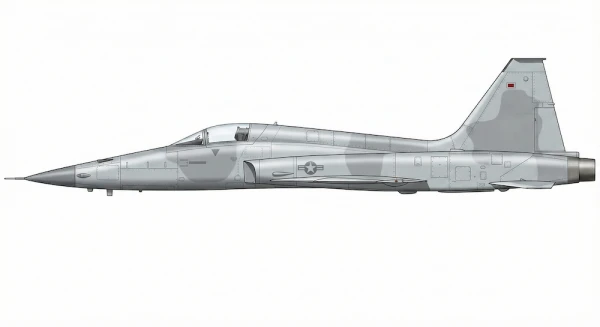
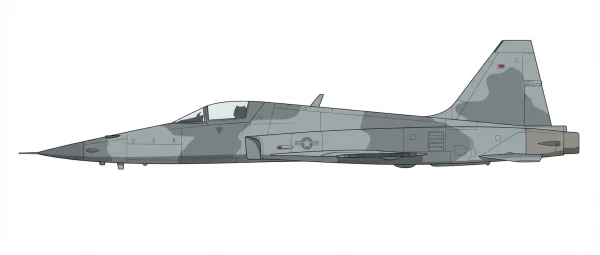
| F-5 Freedom Fighter | F-5E Tiger II | |
|---|---|---|
| Origin country | 🇺🇸 United States | 🇺🇸 United States |
| Category | Combat Aircraft | Combat Aircraft |
| Manufacturer | Northrop | Northrop |
| First flight | 30 July 1959 | 11 August 1972 |
| Year introduced | 1965 | 1976 |
| Number produced | 1204 units | 1399 units |
| Average unit price | $2 million | $2.1 million |
| Wing area | 17.3 m² | 17.3 m² |
| Wingspan | 8.1 m | 8.1 m |
| Height | 4.1 m | 4.1 m |
| Length | 14.5 m | 14.5 m |
| Maximum speed | 1700 km/h | 1700 km/h |
| Operational range | 2,806 km | 3,723 km |
| Service ceiling | 15,789 m | 15,789 m |
| Max. takeoff weight | 11,187 kg | 11,187 kg |
| Empty weight | 4,349 kg | 4,349 kg |
| Total thrust | 2 x 3,176 kgf | 2 x 3,176 kgf |
Detailed Comparison
The Northrop F-5 Freedom Fighter established the design philosophy of a lightweight, low-cost, and highly maneuverable combat aircraft, which was significantly refined in its successor, the F-5E Tiger II. While sharing a common airframe, the F-5E represented a substantial leap in capability, primarily through the integration of more powerful engines, improved aerodynamics, and the standard inclusion of an air-to-air radar, a system absent in the original F-5A.
Development and Design
The F-5 family originated from Northrop's private N-156 project in the late 1950s, prioritizing affordability and performance by pairing a small, aerodynamic airframe with two compact General Electric J85 turbojets. The initial F-5A/B Freedom Fighter variants embodied this minimalist approach, designed for ease of maintenance and operation by allied nations. The F-5E Tiger II, first flown in 1972, was a direct evolution intended to counter more advanced Soviet aircraft. Its design incorporated uprated J85-GE-21 engines, a larger wing area with leading-edge extensions for enhanced turn rates, and increased fuel capacity to address the range limitations of its predecessor. Crucially, the F-5E was designed from the outset with an integrated radar, such as the AN/APQ-153, providing an all-weather intercept capability that the F-5A lacked.
Specifications and Performances
While the basic dimensions of the F-5A and F-5E are nearly identical, the F-5E's performance envelope is superior. The Tiger II's J85-GE-21 engines provide a significant increase in afterburning thrust over the F-5A's original powerplants. This results in improved acceleration and a higher rate of climb (175 m/s). The aerodynamic refinements, including the modified wing, grant the F-5E superior sustained turn performance and better handling at high angles of attack. Furthermore, the F-5E's ordnance capacity of 7,000 lbs (3,200 kg) and its compatibility with a wider range of munitions, such as the AGM-65 Maverick and (in upgraded versions) the AIM-120 AMRAAM, make it a more potent multi-role platform.
Deployment and usage
Both aircraft were widely exported and saw extensive service. The F-5A was combat-evaluated in Vietnam under the Skoshi Tiger program, proving effective in a ground-attack role. However, its most prominent US use was as an "aggressor" aircraft for dissimilar air combat training, where its size and agility mimicked the Soviet MiG-21. The F-5E expanded on this role, becoming the principal adversary aircraft for the USAF and US Navy for decades. In foreign service, the Tiger II saw significant combat, including the Iran-Iraq War and the Ogaden War, where its enhanced performance and radar made it a more credible air superiority asset than the original Freedom Fighter. Its adaptability is highlighted by numerous national modernization programs that continue to keep it in service.
Conclusion
The F-5A/B Freedom Fighter successfully established a market for a simple, agile, and affordable supersonic fighter. However, its combat potential was constrained by its basic avionics and modest engine power. The F-5E Tiger II rectified these shortcomings, maturing the design into a far more capable and versatile multi-role combat aircraft. By integrating more powerful engines, a radar, and improved aerodynamics, the Tiger II became a more effective platform for both air-to-air and air-to-ground missions, cementing its legacy as one of the most enduring and widely operated light fighters of the Cold War era.