F-5E Tiger II vs J-7 Fishcan
F-5E Tiger II vs J-7 Fishcan at a glance — top speed 1,700 vs 2,200 km/h, range 3,723 vs 2,200 km, max takeoff weight 11,187 vs 9,100 kg, built 1,399 vs 2,400 units.
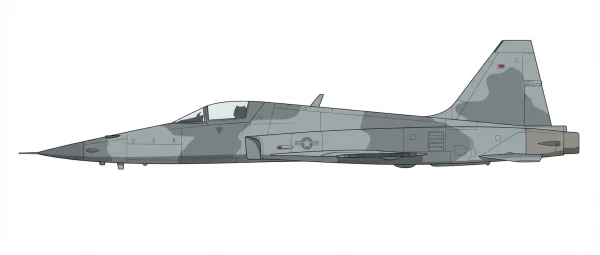
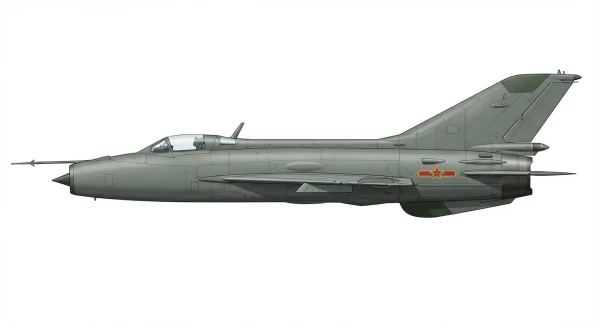
| F-5E Tiger II | J-7 Fishcan | |
|---|---|---|
| Origin country | 🇺🇸 United States | 🇨🇳 China |
| Category | Combat Aircraft | Combat Aircraft |
| Manufacturer | Northrop | Chengdu |
| First flight | 11 August 1972 | 17 January 1966 |
| Year introduced | 1976 | 1966 |
| Number produced | 1399 units | 2400 units |
| Average unit price | $2.1 million | $2 million |
| Wing area | 17.3 m² | 24.9 m² |
| Wingspan | 8.1 m | 8.3 m |
| Height | 4.1 m | 4.1 m |
| Length | 14.5 m | 14.0 m |
| Maximum speed | 1700 km/h | 2200 km/h |
| Operational range | 3,723 km | 2,200 km |
| Service ceiling | 15,789 m | 17,500 m |
| Max. takeoff weight | 11,187 kg | 9,100 kg |
| Empty weight | 4,349 kg | 5,292 kg |
| Total thrust | 2 x 3,176 kgf | 1 x 6,598 kgf |
Detailed Comparison
The Northrop F-5E Tiger II and the Chengdu J-7 Fishcan emerged as two of the most widely exported light fighters of the Cold War, catering to nations requiring cost-effective air defense. While the F-5E was designed specifically as a highly agile, multi-role platform for U.S. allies, the J-7 is a Chinese license-produced derivative of the Soviet MiG-21, emphasizing speed and interception over versatility. Both achieved massive production numbers—approximately 1,400 for the Tiger II and 2,400 for the Fishcan—competing directly in the global arms market for budget-conscious air forces.
Development and Design
The F-5E Tiger II, evolved from the Freedom Fighter, prioritized operational simplicity and modular maintenance. Its twin-engine configuration using General Electric J85s provided reliability and redundancy, while the aerodynamic design focused on subsonic and transonic agility. Uniquely, its modular construction allowed for component swapping, drastically reducing logistical footprints. Conversely, the J-7 adheres strictly to the Soviet interception doctrine. It utilizes a single-engine, tailed delta-wing configuration with a nose air intake, optimized for high-altitude, high-speed dashes. While the F-5E integrated functional radar capabilities for its class early on, early J-7 variants suffered from cramped cockpits and primitive avionics, necessitating extensive upgrades—such as the double-delta wing J-7E—to remain relevant in modern environments.
Specifications and Performances
The aerodynamic differences dictate distinct performance profiles. The J-7 possesses superior kinematic performance in the vertical regime, with a service ceiling of 17,500 m and a climb rate of 195 m/s, compared to the F-5E’s 15,789 m and 175 m/s. The J-7 also achieves a significantly higher maximum speed of 2,200 km/h (Mach 2+), eclipsing the F-5E's 1,700 km/h.
However, the F-5E offers superior utility as a weapons platform. With a Maximum Takeoff Weight of 11,187 kg, it supports a heavier payload (up to 7,000 lbs) compared to the J-7's 9,100 kg limit. The F-5E's twin 20mm M39A2 cannons and compatibility with precision munitions like the AGM-65 Maverick contrast sharply with the J-7's reliance on a single 30mm cannon and unguided rockets. Furthermore, the F-5E's wingtip rails for AIM-9 Sidewinders allow for rapid engagement, whereas the J-7's hardpoints are more limited.
Deployment and Usage
Northrop designed the F-5E to fit into diverse logistical ecosystems, leading to its adoption by over 30 nations. It saw combat in the Iran-Iraq War and Vietnam, but notably found a niche as an "Aggressor" aircraft for the USAF due to its visual and performance similarity to the MiG-21. The J-7 served primarily as the PLAAF’s backbone for decades, tasked with territorial defense. While widely exported to nations like Pakistan (as the F-7), its combat record is less distinguished than the Soviet MiG-21 it was based on. The J-7 remains a point-defense interceptor, whereas the F-5E functions effectively in ground attack and multi-role sorties.
Conclusion
Ultimately, the F-5E Tiger II represents a more balanced, pilot-friendly platform capable of sustained multi-role operations, justified by its higher unit cost of $3.0 million. The J-7 Fishcan, at $2.0 million, offers raw speed and high-altitude capability but is operationally limited by its short range, small payload, and older avionics architecture. While the J-7 relies on raw kinematic power for interception, the F-5E relies on versatility and sustainment, making it the superior tactical asset for air forces requiring more than simple airspace denial.