F/A-18 Hornet vs F/A-18 E/F Super Hornet
F/A-18 Hornet vs F/A-18 E/F Super Hornet at a glance — top speed 1,915 vs 1,915 km/h, range 2,017 vs 2,346 km, max takeoff weight 23,541 vs 29,900 kg, built 1,480 vs 632 units.
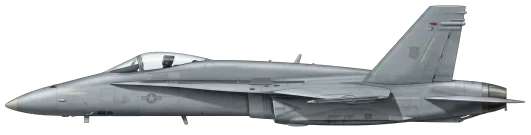
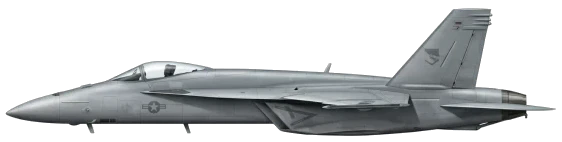
| F/A-18 Hornet | F/A-18 E/F Super Hornet | |
|---|---|---|
| Origin country | 🇺🇸 United States | 🇺🇸 United States |
| Category | Combat Aircraft | Combat Aircraft |
| Manufacturer | McDonnell Douglas | Boeing |
| First flight | 18 November 1978 | 29 November 1995 |
| Year introduced | 1983 | 2001 |
| Number produced | 1480 units | 632 units |
| Average unit price | $29 million | $70 million |
| Wing area | 38.0 m² | 46.5 m² |
| Wingspan | 12.3 m | 13.6 m |
| Height | 4.7 m | 4.9 m |
| Length | 17.1 m | 18.3 m |
| Maximum speed | 1915 km/h | 1915 km/h |
| Operational range | 2,017 km | 2,346 km |
| Service ceiling | 15,000 m | 15,940 m |
| Max. takeoff weight | 23,541 kg | 29,900 kg |
| Empty weight | 10,433 kg | 14,550 kg |
| Total thrust | 2 x 8,051 kgf | 2 x 9,979 kgf |
Detailed Comparison
The F/A-18 Hornet and the derivative F/A-18E/F Super Hornet represent a direct evolutionary line, with the latter being a substantially larger and more capable aircraft designed to correct the operational deficiencies, primarily in range and payload, of the original. While sharing a common design heritage and designation, they are distinct airframes developed in different strategic contexts. The legacy Hornet was a pioneering 1970s multirole platform, whereas the Super Hornet was a 1990s solution to maintain carrier aviation relevance amid budget cuts and the cancellation of more ambitious programs.
Development and Design
The F/A-18 Hornet was born from a 1970s US Navy requirement for a versatile, lower-cost fighter to replace multiple aging aircraft. Navalized from the YF-17 prototype by McDonnell Douglas, its design prioritized multirole capability from the outset. Key innovations included a pioneering digital fly-by-wire system, extensive use of multifunction displays to enable single-pilot fighter/attack switching, and engines designed for remarkable reliability and ease of maintenance. Its development established the core Hornet airframe characteristics: exceptional high angle-of-attack performance facilitated by its large leading-edge extensions (LEX).
The F/A-18E/F Super Hornet, while appearing similar, is a near-total redesign. Developed in the 1990s as a pragmatic, lower-risk alternative to clean-sheet designs like the canceled A-12 Avenger, it is approximately 20% larger. The design addressed the legacy Hornet's limited combat radius with 33% more internal fuel. Aerodynamic changes include enlarged, squared-off engine inlets for its more powerful F414 engines and larger LEXs. Critically, the Super Hornet incorporates radar cross-section reduction features, a key survivability improvement over its predecessor.
Specifications and Performances
The performance differences are a direct result of the Super Hornet’s increased scale. It boasts a higher maximum takeoff weight (29,900 kg vs. 23,541 kg) and can carry a heavier payload (17,750 lb vs. 13,700 lb) on two additional hardpoints. This increased capacity, combined with a 41% greater mission range, allows the Super Hornet to project power further and with more ordnance. Its General Electric F414 engines produce significantly more thrust than the Hornet’s F404s, compensating for the increased weight, although its climb rate is slightly lower (228 m/s vs. 250 m/s). While both aircraft share a similar maximum speed of Mach 1.8, the Super Hornet's ability to bring more fuel and weapons to the fight is its defining advantage. Later blocks also introduced the advanced AN/APG-79 AESA radar, a significant sensor upgrade over the Hornet’s AN/APG-73.
Deployment and usage
The legacy Hornet proved its multirole capability during the 1991 Gulf War, setting records for availability while destroying enemy fighters and striking ground targets on the same missions. It has served as a primary combat aircraft for the U.S. Marine Corps and numerous international partners. The Super Hornet entered service a decade later, becoming the backbone of the U.S. Navy carrier air wing. It has been used extensively in major conflicts for roles including strike, close air support, and Suppression of Enemy Air Defenses (SEAD). A key operational distinction is the Super Hornet’s ability to serve as a tactical airborne tanker using a "buddy store" refueling system, a crucial capability that extends the reach of the entire carrier air wing.
Conclusion
The F/A-18 Hornet was a landmark aircraft that successfully integrated fighter and attack roles into a single, agile airframe. The F/A-18E/F Super Hornet is a pragmatic and powerful evolution, trading some of the original's kinematic performance for substantial improvements in range, payload, and survivability. It is not merely an upgrade but a distinct, more formidable weapons system that adapted the Hornet's successful formula to meet the demands of 21st-century carrier operations, ensuring the platform's continued central role in naval aviation.


