UH-1 Iroquois "Huey" vs UH-60 Black Hawk
UH-1 Iroquois "Huey" vs UH-60 Black Hawk at a glance — top speed 222 vs 294 km/h, range 510 vs 2,221 km, max takeoff weight 4,309 vs 10,659 kg, built 16,000 vs 5,000 units.
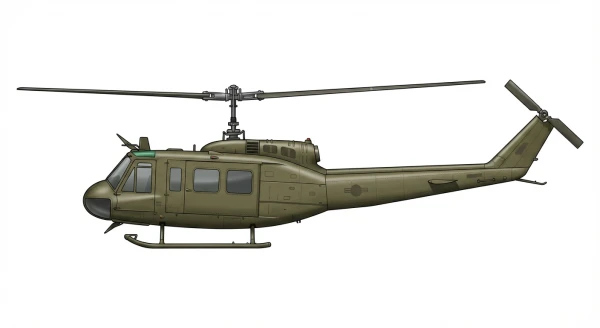
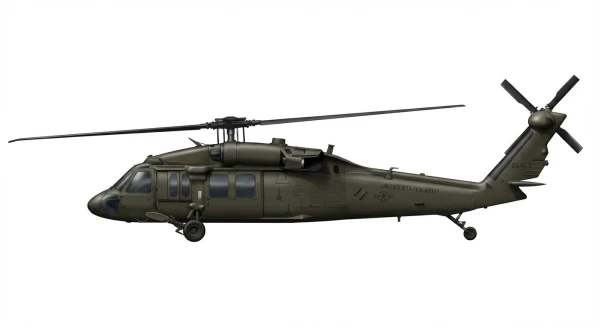
| UH-1 Iroquois "Huey" | UH-60 Black Hawk | |
|---|---|---|
| Origin country | 🇺🇸 United States | 🇺🇸 United States |
| Category | Military Helicopters | Military Helicopters |
| Manufacturer | Bell | Sikorsky |
| First flight | 22 October 1956 | 29 November 1974 |
| Year introduced | 1959 | 1979 |
| Number produced | 16000 units | 5000 units |
| Average unit price | $1.3 million | $21 million |
| Wingspan | 14.6 m | 16.4 m |
| Height | 4.5 m | 4.9 m |
| Length | 12.7 m | 19.5 m |
| Maximum speed | 222 km/h | 294 km/h |
| Operational range | 510 km | 2,221 km |
| Service ceiling | 5,910 m | 5,791 m |
| Max. takeoff weight | 4,309 kg | 10,659 kg |
| Empty weight | 2,087 kg | 4,819 kg |
| Total thrust | 1 x 820 kW | 2 x 1,208 kW |
Detailed Comparison
The Bell UH-1 Iroquois and Sikorsky UH-60 Black Hawk define the evolution of U.S. Army rotary-wing aviation from the Vietnam War to the modern era. While the Huey pioneered the concept of air mobility with its single-turbine simplicity, the Black Hawk introduced the durability, survivability, and twin-engine redundancy required for high-threat environments in the late 20th century.
Development and Design
The UH-1 was the first turbine-powered helicopter produced for the U.S. military, utilizing a single Lycoming T53 engine and a distinct twin-blade teetering rotor system. Its metal airframe prioritized ease of maintenance, modularity, and rapid reconfiguration for medevac or transport roles. Conversely, the UH-60 was engineered to replace the Huey with a focus on survivability following Vietnam War lessons. It features a twin-engine layout (General Electric T700s), a four-bladed fully articulated rotor, and a monocoque fuselage incorporating composites and titanium. The Black Hawk introduced critical crashworthiness standards, including a retractable landing gear system designed to absorb impact energy to protect the crew.
Specifications and Performances
The generational gap is evident in payload and power capabilities. The UH-60 possesses a Maximum Takeoff Weight (MTOW) of 10,659 kg, more than double the UH-1's 4,309 kg capacity. This allows the Black Hawk to carry 11 fully equipped troops or significantly heavier external loads compared to the Huey. In terms of kinetics, the Black Hawk achieves a maximum speed of 294 km/h, outpacing the Huey's 222 km/h. While the Huey relies on a single 820 kW powerplant, the UH-60 utilizes two engines producing vastly superior combined power, offering the redundancy necessary for maritime and hot-and-high operations that the single-engine Huey lacks.
Deployment and Usage
The UH-1 operationalized the concept of "air mobility" in Vietnam, flying approximately 7 million sorties. It served as a "slick" troop transport, a medical evacuation platform, and a gunship armed with manually aimed machine guns and unguided rockets. The UH-60 has served as the primary tactical transport from the invasion of Grenada through operations in Iraq and Afghanistan. Unlike the standard Huey, specialized variants of the Black Hawk (such as the MH-60) integrate advanced avionics and precision weaponry, including AGM-114 Hellfire missiles and laser-guided rockets, allowing it to undertake complex night raids and special operations that exceed the UH-1's technological envelope.
Conclusion
The UH-1 Iroquois remains a testament to the effectiveness of simple, rugged design, maintaining relevance in global export markets due to its low cost ($1.3 million vs. $21.0 million) and ease of maintenance. However, the UH-60 Black Hawk represents a necessary evolution in survivability and power projection. For modern military operations requiring speed, ballistic tolerance, and heavy lift in contested airspace, the Black Hawk is the superior platform, providing a level of crew protection and mission versatility that the legacy Huey design cannot match.