Mi-8 Hip vs UH-1 Iroquois "Huey"
Mi-8 Hip vs UH-1 Iroquois "Huey" at a glance — top speed 250 vs 222 km/h, range 495 vs 510 km, max takeoff weight 12,000 vs 4,309 kg, built 17,000 vs 16,000 units.
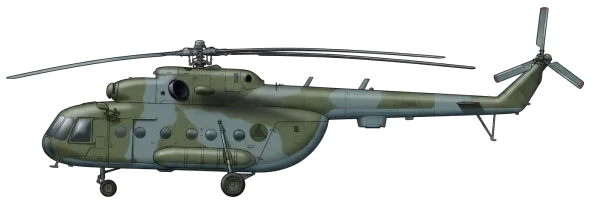
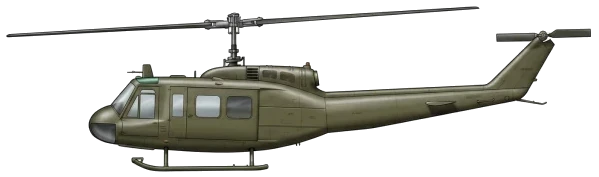
| Mi-8 Hip | UH-1 Iroquois "Huey" | |
|---|---|---|
| Origin country | 🇷🇺 Ex-USSR | 🇺🇸 United States |
| Category | Military Helicopters | Military Helicopters |
| Manufacturer | Mil | Bell |
| First flight | 24 June 1961 | 22 October 1956 |
| Year introduced | 1967 | 1959 |
| Number produced | 17000 units | 16000 units |
| Average unit price | $4 million | $1.3 million |
| Wingspan | 21.3 m | 14.6 m |
| Height | 5.7 m | 4.5 m |
| Length | 25.2 m | 12.7 m |
| Maximum speed | 250 km/h | 222 km/h |
| Operational range | 495 km | 510 km |
| Service ceiling | 4,500 m | 5,910 m |
| Max. takeoff weight | 12,000 kg | 4,309 kg |
| Empty weight | 7,160 kg | 2,087 kg |
| Total thrust | 2 x 1,119 kW | 1 x 820 kW |
Detailed Comparison
The Mil Mi-8 Hip and the Bell UH-1 Iroquois are the defining rotary-wing platforms of the Cold War, serving as the primary utility helicopters for the Eastern and Western blocs respectively. While sharing a common timeline—entering service within a decade of each other—they occupy different tactical weight classes: the UH-1 is a light-to-medium utility aircraft optimized for air mobility, whereas the Mi-8 is a heavy-duty medium transport designed for high-volume logistics and rugged durability.
Development and Design
Bell developed the UH-1 to meet a 1952 US Army requirement for medical evacuation and utility, pioneering the use of a turbine engine in US military helicopters. Its design features a distinctive two-blade teetering main rotor and a slender, semi-monocoque metal fuselage. This simplicity facilitated maintenance in austere environments. Conversely, the Soviet Union designed the Mi-8 to replace the piston-engined Mi-4, prioritizing lift capacity and redundancy. The Hip utilizes a twin-engine configuration (in most variants) and a five-blade main rotor system. The Mi-8’s structure is notably robust, utilizing aluminum alloys to withstand harsh operating environments, while the Huey emphasized modularity for rapid reconfiguration between medevac and transport roles.
Specifications and Performances
The performance gap illustrates the doctrinal differences between the two aircraft. The Mi-8 is a significantly larger platform, with a Maximum Takeoff Weight (MTOW) of 12,000 kg, nearly triple the UH-1H's 4,309 kg. This allows the Hip to carry up to 24 troops or heavy internal cargo, compared to the Huey’s capacity of roughly 12 troops in stretched configurations. However, the UH-1 demonstrates superior high-altitude performance relative to its weight, with a service ceiling of 5,910 m compared to the Mi-8’s 4,500 m, aiding operations in mountainous terrain. The Mi-8 relies on raw power from twin Klimov turbines (1,119 kW each) to achieve a higher top speed of 250 km/h, surpassing the single-engine Huey's 222 km/h.
Deployment and usage
The UH-1 defined the concept of air mobility during the Vietnam War, flying approximately 7 million sorties. Its roles ranged from "slick" troop transports to dedicated gunships providing close air support. The Mi-8 served a parallel role for the Soviet Union, most notably in the Soviet-Afghan War. Unlike the Huey, which generally relied on door gunners or specific light-gunship variants, the Mi-8 frequently operated as an armed assault transport, carrying rocket pods (S-8) and anti-tank missiles (AT-2/AT-3) while simultaneously deploying troops. Both platforms have seen extensive global proliferation; the Mi-8 is operational in over 50 countries, while the UH-1 was exported to more than 60 nations.
Conclusion
While the UH-1 revolutionized helicopter warfare by proving the viability of the air cavalry concept, the Mi-8 stands out for its sheer longevity and versatility as a heavy hauler. The Huey has largely been superseded by modern platforms like the UH-60 in frontline US service, restricted now to niche roles or modernized variants like the UH-1Y Venom. In contrast, the Mi-8 (and its Mi-17 derivatives) remains in active production and widespread frontline service, largely because its combination of high payload capacity, ruggedness, and low cost has few direct competitors in the medium-lift category.


-
 Turkey
172
Turkey
172
-
 Greece
112
Greece
112
-
 Japan
93
Japan
93
- All 39 operators →