Altay vs Leopard 2
Altay vs Leopard 2 at a glance — weight 65,000 vs 62,500 kg, top speed 65 vs 70 km/h, range 450 vs 340 km, crew 4 vs 4.
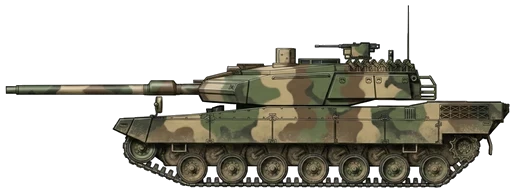
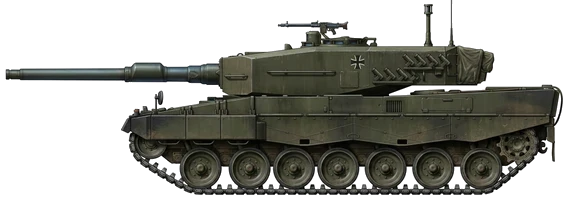
| Altay | Leopard 2 | |
|---|---|---|
| Origin country | 🇹🇷 Turkey | 🇩🇪 Germany |
| Category | Main Battle Tank | Main Battle Tank |
| Type | Main battle tank | Heavy Main Battle Tank |
| Manufacturer | BMC | Krauss-Maffei |
| Number produced | 7 units | 3,600 units |
| Estimated unit price | $11.8 million | $29 million |
| Combat weight | 65.0 tons | 62.5 tons |
| Maximum speed | 65 km/h | 70 km/h |
| Operational range | 450 km | 340 km |
| Length | 10.30 m | 9.97 m |
| Width | 3.90 m | 3.76 m |
| Height | 2.60 m | 3.00 m |
| Crew | 4 | 4 |
| Altay | Leopard 2 | |
|---|---|---|
| Main armament | MKE 120 MM 55C 120 mm smoothbore cannon | Rheinmetall 120 mm L/55 |
| Secondary weapon | Remote controlled weapon station equipped with 12.7 mm / 7.62 mm machine gun | 7.62 mm MG3A1 or 7.62 mm FN MAG |
| Engine | BMC Power BATU V12 4-short stroke, 12-cylinder water-cooled diesel, 1,500 hp (1,100 kW) | MTU MB 873 MTCA Diesel Engine with 1500 hp |
Detailed Comparison
The BMC Altay is a fourth-generation Turkish main battle tank (MBT) entering service in 2025, while the Krauss-Maffei Leopard 2 is a third-generation German platform operational since 1979. The Altay derives technology from the South Korean K2 Black Panther, whereas the Leopard 2 evolved from Cold War requirements to replace the Leopard 1. Both vehicles utilize 120 mm smoothbore armament and diesel propulsion, but differ significantly in production volume, with the Leopard 2 reaching 3,600 units compared to the Altay's initial seven units built by 2025.
Development and Design
The Leopard 2 emerged from 1970s cooperative development efforts, focusing on Cold War armored warfare requirements. It features a conventional layout with iterative upgrades; early models utilized vertical turret armor, while the A5 and subsequent variants introduced spaced, arrow-shaped appliqué armor. Conversely, the Altay stems from the 2007 National Tank Production Project (MİTÜP) to localize Turkish armor production. Developed with design assistance from Hyundai Rotem, it adapts systems from the K2 Black Panther. The program experienced delays regarding powerpack procurement due to German arms embargoes, necessitating the shift from foreign components to the domestic BATU V12 engine.
Protection and Firepower
Both tanks employ 120 mm smoothbore cannons. The Leopard 2 mounts the Rheinmetall L/55 (or L/44 in earlier variants), paired with digital fire control and thermal imaging. The Altay utilizes an MKE 120 mm 55-caliber gun, a derivative of the South Korean CN08 redesigned for manual loading, removing the autoloader found in the K2.
Regarding survivability, the Leopard 2 relies on spaced multilayer armor, enhanced in later models with modular belly protection. However, hull ammunition storage lacks blow-off panels. The Altay integrates a Roketsan composite package based on Korean Special Armor Plate, reactive armor, and the standard AKKOR active protection system (APS) containing hard and soft kill capabilities. It features an isolated ammunition compartment in the turret bustle.
Mobility and Logistics
The Leopard 2 is powered by an MTU MB 873 V12 diesel engine generating 1,500 hp, achieving a maximum speed of 70.0 km/h and an operational range of 340 km. At 62.5 tons, it utilizes a torsion bar suspension. The Altay is heavier at 65.0 tons, powered by the 1,500 hp BMC Power BATU V12. It utilizes a passive in-arm suspension system and achieves a lower top speed of 65.0 km/h but extends operational range to 450 km. The Altay is designed for underwater operation, a capability shared by the Leopard 2 which can ford deep water with preparation.
Deployment and Combat Record
The Leopard 2 possesses an extensive combat history. German forces deployed it in Kosovo, while Canadian and Danish units utilized it in Afghanistan against IED threats. Turkish A4 variants saw action in the Syrian Civil War, exposing vulnerabilities to ATGMs, and Ukrainian forces operate the platform in the Russo-Ukrainian War. The Altay entered service with the Turkish Land Forces in October 2025 and has not seen combat. Export orders include Qatar, with interest from nations such as Pakistan and Saudi Arabia.
Conclusion
The Leopard 2 represents an established NATO standard, offering wide interoperability and a logistics chain supported by 3,600 units produced. Its design emphasizes mobility and firepower, though combat in Syria and Ukraine highlighted the necessity for up-armoring against modern anti-tank weapons. The Altay offers a modernized platform integrating active protection and indigenous subsystems to circumvent export restrictions. While the Altay exceeds the Leopard 2 in operational range and integrated defensive suites, it currently lacks the extensive combat validation and mass production history of the German vehicle.