Leopard 1 vs Leopard 2
Leopard 1 vs Leopard 2 at a glance — weight 42,400 vs 62,500 kg, top speed 65 vs 70 km/h, range 600 vs 340 km, crew — vs 4.
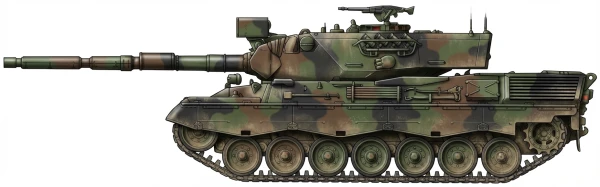
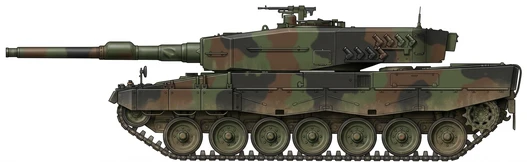
| Leopard 1 | Leopard 2 | |
|---|---|---|
| Origin country | 🇩🇪 Germany | 🇩🇪 Germany |
| Category | Main Battle Tank | Main Battle Tank |
| Type | Medium Main Battle Tank | Heavy Main Battle Tank |
| Manufacturer | Krauss-Maffei | Krauss-Maffei |
| Number produced | 6,565 units | 3,600 units |
| Estimated unit price | $0.3 million | $29 million |
| Combat weight | 42.4 tons | 62.5 tons |
| Maximum speed | 65 km/h | 70 km/h |
| Operational range | 600 km | 340 km |
| Length | 9.54 m | 9.97 m |
| Width | 3.37 m | 3.76 m |
| Height | 2.70 m | 3.00 m |
| Crew | 4 (commander, driver, gunner, radio operator/loader) | 4 |
Detailed Comparison
Krauss-Maffei's Leopard 1 and Leopard 2 diverge in their response to anti-tank threats. The 42.4-ton Leopard 1 relies on mobility to evade engagement, while the 62.5-ton Leopard 2 absorbs strikes through mass and advanced composites. Separated by 14 years of development, these platforms map the transition from the post-WWII vulnerability of steel-armored tanks to the layered survivability requirements of modern high-intensity conflict.
Development and Design
The Leopard 1 emerged in 1965 from a European initiative built on the premise that HEAT warheads rendered heavy armor obsolete. Krauss-Maffei engineered a vehicle prioritizing speed. By the 1970s, advancements in Soviet gunnery and the failure of the MBT-70 project shifted German doctrine. The Leopard 2, entering service in 1979, adopted a different architecture. It integrated spaced multilayer armor and a 120mm smoothbore gun, increasing weight by 20 tons over its predecessor to survive direct hits from 125mm Soviet cannons.
Protection and Firepower
The protection and lethality gap between the two platforms dictates their modern utility:
- Leopard 1: Rolled homogenous steel armor (max 70mm glacis), vulnerable to modern auto-cannons. Armament is the Royal Ordnance L7 105mm rifled gun.
- Leopard 2: Composite layered armor, augmented with angled appliqué modules from the A5 variant onward. Armament is the Rheinmetall 120mm smoothbore (up to L/55), firing APFSDS rounds. Turret ammunition is stored in a bustle with blow-off panels.
The Leopard 2's digital fire control system and thermal optics improve first-round hit probability, whereas the Leopard 1's baseline stereoscopic rangefinder requires extensive modernization to remain competitive.
Mobility and Logistics
At 42.4 tons, the Leopard 1 generates a power-to-weight ratio of 19.5 hp/ton via an 830 hp MTU diesel, reaching 65 km/h. It crosses most bridges and offers a 600 km operational range. The Leopard 2 weighs 62.5 tons, powered by a 1,500 hp MTU diesel. It achieves 70 km/h but consumes fuel at a higher rate, restricting its range to 340 km. The 20-ton weight penalty restricts the Leopard 2's bridge classification, limits strategic airlift options, and demands heavier recovery vehicles.
Deployment and Combat Record
The Leopard 1 saw limited deployment in the Yugoslav Wars and Afghanistan. In Ukraine, the Leopard 1A5 has suffered attrition; its thin armor is routinely penetrated by FPV drones and artillery fragments. The Leopard 2 saw combat in Kosovo and Afghanistan, where its hull survived large IEDs. In Syria (Operation Euphrates Shield), Turkish Leopard 2A4s suffered catastrophic hull detonations from ATGMs striking the unisolated forward ammo racks. In Ukraine, Leopard 2s retrofitted with Kontakt-1 reactive armor demonstrate higher crew survivability against modern threats like the Kornet ATGM and Lancet drones.
Conclusion
The Leopard 2 renders the Leopard 1 obsolete for mechanized peer-to-peer combat. The Leopard 1's $0.25 million price tag and 600 km range make it a mobile fire support asset, but its steel armor cannot survive a battlefield saturated with loitering munitions and ATGMs. The Leopard 2 is the mandatory choice for armored warfare. Despite the vulnerability of its hull ammunition rack, its layered composites, blow-off panels, and 120mm gun provide the survivability and lethality required to engage contemporary armored threats.