Leopard 2 vs Merkava 4
Leopard 2 vs Merkava 4 at a glance — weight 62,500 vs 65,000 kg, top speed 70 vs 64 km/h, range 340 vs 500 km, crew 4 vs 4.
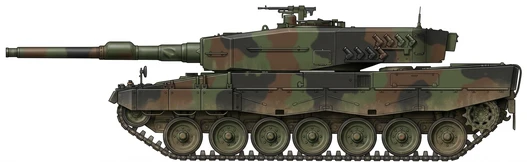
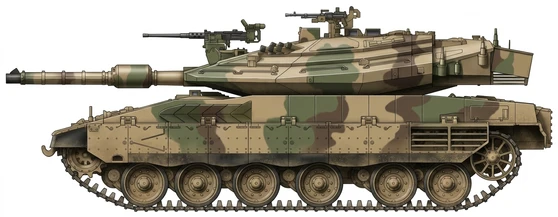
| Leopard 2 | Merkava 4 | |
|---|---|---|
| Origin country | 🇩🇪 Germany | 🇮🇱 Israel |
| Category | Main Battle Tank | Main Battle Tank |
| Type | Heavy Main Battle Tank | Heavy Main Battle Tank |
| Manufacturer | Krauss-Maffei | Israeli Military Industries |
| Number produced | 3,600 units | 360 units |
| Estimated unit price | $29 million | $4.5 million |
| Combat weight | 62.5 tons | 65.0 tons |
| Maximum speed | 70 km/h | 64 km/h |
| Operational range | 340 km | 500 km |
| Length | 9.97 m | 9.04 m |
| Width | 3.76 m | 3.72 m |
| Height | 3.00 m | 2.66 m |
| Crew | 4 | 4 |
Detailed Comparison
The Israeli Merkava Mk. 4 and the German Leopard 2 differ fundamentally in configuration and doctrinal focus. The Merkava Mk. 4, weighing 72.0 tons, adopts a front-engine layout to prioritize crew survival, whereas the 62.5-ton Leopard 2 utilizes a conventional rear-engine design emphasizing mobility. While the Leopard 2 has achieved widespread export success with 3,600 units built since 1979, the Merkava Mk. 4, introduced in 2004, remains limited to approximately 360 units primarily within the Israel Defense Forces.
Development and Design
Designed by MANTAK, the Merkava Mk. 4 is the fourth generation of a series focused on crew protection. Its chassis integrates the Continental V12 diesel engine at the front, allowing the engine block to function as additional armor for the crew compartment. This configuration also enables a rear hatch for ammunition resupply or casualty evacuation. The Leopard 2, manufactured by Krauss-Maffei, evolved from 1970s requirements to replace earlier West German armor. It follows a standard main battle tank layout with the MTU MB 873 engine located at the rear. Later variants (A5 onwards) updated the original vertical turret armor with angled, arrow-shaped appliqué modules to deflect kinetic energy penetrators.
Protection and Firepower
The Merkava Mk. 4 utilizes modular composite armor and, in the 'Windbreaker' variant, integrates the Trophy active protection system to intercept anti-tank projectiles. Its armament consists of a 120mm smoothbore cannon (listed as rifled in specs, described as smoothbore in text) fed by a semi-automated drum system. Unique to the Merkava is an internally operated 60mm mortar and the capability to fire LAHAT anti-tank missiles. The Leopard 2 relies on spaced multilayer armor and restricts ammunition blow-off panels to the turret bustle; hull ammunition storage remains vulnerable. It mounts a Rheinmetall 120mm smoothbore gun (L/44 or L/55) with a digital fire control system. The Merkava carries 50 main gun shells, while the Leopard 2's specific load is not detailed in the provided data.
Mobility and Logistics
The Leopard 2 possesses a higher power-to-weight ratio, allowing it to reach a maximum speed of 70.0 km/h compared to the Merkava's 64.0 km/h. The German tank uses a torsion bar suspension system designed for rapid maneuver. Conversely, the Merkava Mk. 4 offers a significantly longer operational range of 500 km against the Leopard's 340 km. The Merkava's suspension is derived from previous generations, optimized for rocky terrain. The Merkava is 9.5 tons heavier than the Leopard 2, which impacts transportability and infrastructure compatibility.
Deployment and Combat Record
The Leopard 2 has been exported to nations including Canada, Indonesia, and Chile. Its combat history includes ISAF operations in Afghanistan, Turkish deployments in the Syrian Civil War against ISIS, and use by Ukrainian forces in the Russo-Ukrainian War since 2023. The Merkava Mk. 4 is operated almost exclusively by Israel. It debuted in the 2006 Lebanon War and has been employed in the 2023 ground offensive in the Gaza Strip. A bridge-layer variant of the Merkava chassis has been acquired by the Philippine Army.
Conclusion
The Leopard 2 excels in mobility and kinetic engagement, reflecting a design optimized for European armored warfare and rapid operational tempo. The Merkava Mk. 4 is a heavier, protection-oriented platform with integrated active defense systems and secondary weaponry like mortars, specifically engineered for survivability in asymmetric and urban combat environments.