PA-34 Seneca
American twin-engined light aircraft, renowned for its versatility, extensively used for flight training and personal use since the 1970s. Key figures: top speed 378 km/h, range 1,611 km, service ceiling 7,620 m, max takeoff weight 2,155 kg, built 5,037. In service with 6 air forces as of 2026 — Colombia (3), Panama (2), Dominican Republic (1) and 3 others.
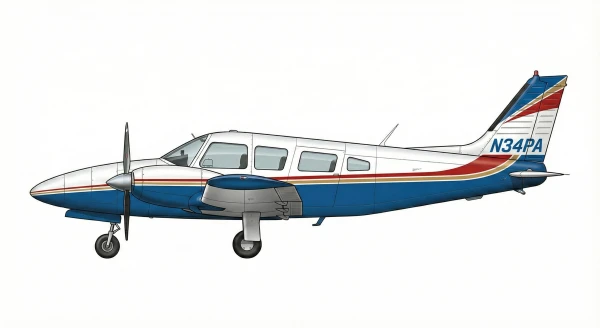
| Length | 8.7 m (28.6 ft) |
| Wingspan | 11.9 m (38.9 ft) |
| Height | 3.0 m (9.9 ft) |
| Wing area | 19.4 m² (208.7 sqft) |
| Empty weight | 1,457 kg (3,212 lbs) |
| Max. takeoff weight | 2,155 kg (4,751 lbs) |
| Powerplant | 2 × pistons engine Continental TSIO-360RB 164 kW each |
| Maximum speed | 378 km/h (235 mph) |
| Operational range | 1,611 km (1,001 mi) |
| Service ceiling | 7,620 m (25,000 ft) |
| Climb rate | 7.87 m/s (25.8 ft/s) |


Description
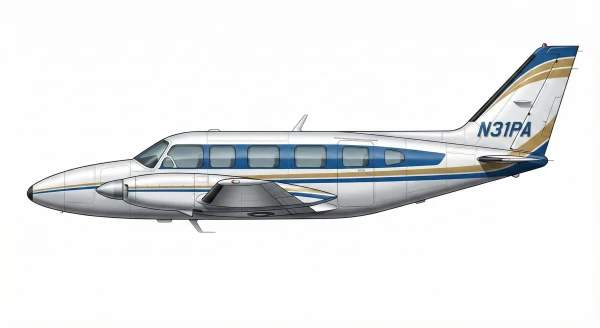
The Piper PA-34 Seneca is a twin-engined light aircraft produced in the United States by Piper Aircraft, certified on 7 May 1971 and introduced at the end of the same year as a 1972 model. Intended for private and business transport as well as multi-engine class rating training, it has been in non-continuous production since 1971 and is distinguished by its counter-rotating engines, which eliminate the critical engine.
Development
The Seneca derives from the single-engined Piper Cherokee Six. The initial prototype, a Cherokee Six fitted with two wing-mounted engines while retaining its nose engine, was tested in a three-engined configuration (PA-32-3M) before this formula was abandoned. The PA-34-180 Twin Six prototype, registered N3401K, flew on 25 April 1967 with two 180 hp Lycoming O-360s, a fixed nosewheel and the fin of the Cherokee Six. The second prototype flew on 30 August 1968 with retractable landing gear and a taller fin; the wingspan was increased by two feet during testing. The third prototype, close to production standard, flew on 20 October 1969 with 200 hp Lycoming IO-360-A1As. Production totalled 934 Seneca Is, 2,588 Seneca IIs, more than 930 Seneca IIIs and 71 Seneca IVs. From 1975, Embraer built the aircraft under licence in Brazil under the designations EMB-810C (452 examples) and EMB-810D (228 examples).
Design
The Seneca is a low-wing monoplane with retractable tricycle landing gear, using a NACA 65₂-415 laminar-flow aerofoil for a wing area of 19.39 m². The right-hand engine is a counter-rotating version ("L" prefix), an arrangement retained on all versions. The Seneca II introduced enlarged, balanced ailerons, a rudder anti-servo tab and a stabilator bobweight to correct the criticised handling qualities, as well as turbocharged Continental TSIO-360E/EB engines and an optional club-seating layout. The Seneca V received 220 hp intercooled Continental TSIO-360-RBs, raising maximum speed to 204 knots at 23,000 ft, the ceiling to 25,000 ft and range to 870 nm. Maximum take-off weight rose from 1,810 kg on the early Senecas to 2,155 kg from the Seneca III onwards.
Operational History
Used by air-taxi companies, small regional airlines and flying schools, the Seneca is also in military service in Brazil (EMB-810C designated U-7), Belize, Colombia, the Dominican Republic, Ecuador, Honduras, Indonesia, Panama, Peru and Serbia (PA-34-220T Seneca V). Three accidents are documented: the crash of 2 August 1978 at Chesterfield County Airport, which killed candidate Richard D. Obenshain and two other occupants; that of 30 January 2009 near KHTS during a snowstorm following fuel exhaustion, with six dead; and that of 18 August 2012 off Masbate, in the Philippines, which cost the life of Secretary Jesse Robredo.
Variants
- PA-34-200 Seneca: Initial version certified in 1971, with 200 hp Lycoming IO-360-C1E6/LIO-360-C1E6 engines, 934 examples.
- PA-34-200T Seneca II: Certified on 18 July 1974, turbocharged Continental TSIO-360E/EB engines and revised control surfaces, 2,588 examples.
- PA-34-220T Seneca III: Certified on 17 December 1980, 220 hp Continental TSIO-360-KB, one-piece windscreen, the highest payload of the range.
- PA-34-220T Seneca V: Certified on 11 December 1996, redesigned cowlings and intercooled TSIO-360-RB.
- Embraer EMB-810: Brazilian licence production of the PA-34-200T (EMB-810C) and PA-34-220T (EMB-810D).
Frequently Asked Questions
What type of aircraft is the PA-34 Seneca?
What is the maximum speed of the PA-34 Seneca?
What is the range of the PA-34 Seneca?
When did the PA-34 Seneca first fly?
How many PA-34 Seneca have been built?
Which countries operate the PA-34 Seneca?
What is the service ceiling of the PA-34 Seneca?
- AUG 302026 Updated Description updated
- JUL 232026 Updated Sources and cross-references refreshed
- APR 72026 Updated Sources and cross-references refreshed
- JAN 122026 Updated Range updated in a site-wide editorial pass