Su-37 Super Flanker
Russian thrust-vectoring technology demonstrator converted from a Su-27M; one built, first flown in 1996 and lost in 2002. Key figures: top speed 2,494 km/h, range 3,300 km, service ceiling 18,000 m, max takeoff weight 35,000 kg, unit price $70M, built 1.
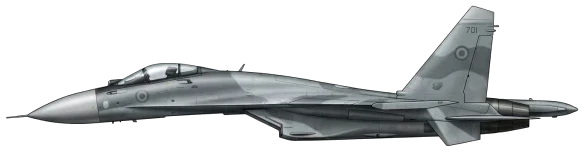
| Crew | 1 |
| Length | 22.2 m (72.8 ft) |
| Wingspan | 14.7 m (48.2 ft) |
| Height | 6.4 m (21.1 ft) |
| Wing area | 62 m² (667.4 sqft) |
| Empty weight | 18,500 kg (40,785 lbs) |
| Max. takeoff weight | 35,000 kg (77,162 lbs) |
| Powerplant | 2 × turbofans Saturn AL-37FU 14,480 kgf each |
| Ejection seat | Zvezda K-36DM |
| Maximum speed | 2494 km/h (Mach 2.3) |
| Operational range | 3,300 km (2,051 mi) |
| Service ceiling | 18,000 m (59,055 ft) |
| Climb rate | 230.0 m/s (754.6 ft/s) |
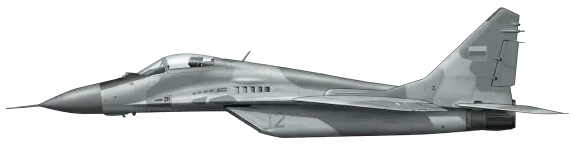
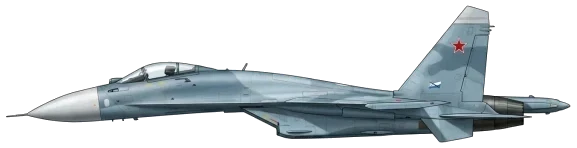
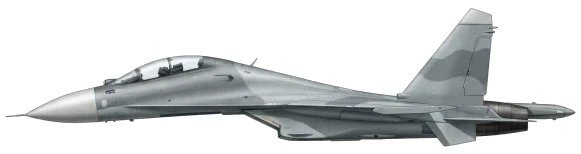
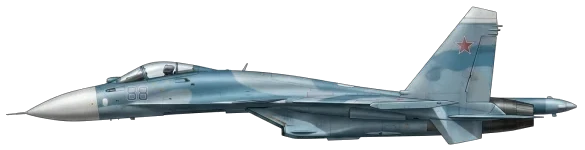
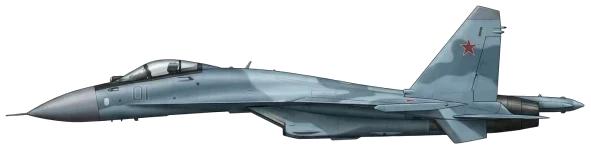
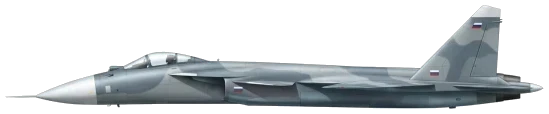
Description
The Sukhoi Su-37 was a Russian single-seat, twin-engine technology demonstrator designed by the Sukhoi Design Bureau. Developed to evaluate thrust-vectoring controls and flight systems for the Su-27M, the aircraft did not enter production, with a single prototype constructed. The aircraft was known for demonstrating high-angle-of-attack supermaneuverability at international flight displays.
Development
Sukhoi initiated research into axisymmetrical thrust vectoring in 1983, running parallel to the Soviet government's development mandate for the Su-27M. The sole prototype was converted from the eleventh Su-27M airframe (factory code T10M-11), manufactured by the Komsomolsk-on-Amur Aircraft Production Association. Due to a lack of funding from the Russian Air Force, Sukhoi financed the project using export revenues from Su-27 sales to China and Vietnam. The aircraft made its first flight on 2 April 1996 from Zhukovsky Airfield, flown by a Sukhoi test pilot. T10M-11 remained the only prototype built throughout the flight-test program.
Design
The Su-37 retained the aerodynamic configuration and canards of the Su-27M. Power was initially provided by two Lyulka-Saturn AL-37FU afterburning turbofans equipped with axisymmetrical thrust-vectoring nozzles capable of pitching 15 degrees up or down. The aircraft utilized a digital fly-by-wire flight control system linked directly to the thrust-vectoring system and full-authority digital engine controls. Avionics included an N011M Bars passive electronically scanned array radar capable of tracking twenty aerial targets and engaging eight simultaneously, an N012 rear-facing radar, and an OLS-35 infrared search and track system. The cockpit was configured with four Sextant Avionique liquid crystal multi-function displays and an ejection seat reclined to 30 degrees to improve g-force tolerance.
Armament
Internal armament consisted of one 30 mm GSh-30-1 cannon with 150 rounds. The airframe featured 12 hardpoints—comprising two wingtip rails and ten wing and fuselage stations—with a total ordnance payload capacity of 8,000 kg (17,630 lb).
Operational History
During its flight-test program, the Su-37 demonstrated low-speed maneuvers including the "Super Cobra" and a 360-degree loop termed the "kulbit." The aircraft made its international debut at the Farnborough Airshow in September 1996, followed by display flights at the Paris Air Show, MAKS, the International Defence Exhibition in Dubai, and the FIDAE air show in Chile. After the AL-37FU engines reached the end of their service lives, they were replaced with standard AL-31F engines lacking vectoring nozzles, and the flight control system was updated to compensate. The aircraft was entered into fighter procurement tenders in Brazil and South Korea but gained no export orders. On 19 December 2002, the prototype crashed near Shatura when its port tailplane broke off during a high-g maneuver due to structural fatigue; the pilot ejected safely. Systems tested on the Su-37 were later integrated into the Su-30 and Su-35 programs.
Frequently Asked Questions
What type of aircraft is the Su-37 Super Flanker?
What is the maximum speed of the Su-37 Super Flanker?
What is the range of the Su-37 Super Flanker?
When did the Su-37 Super Flanker first fly?
How many Su-37 Super Flanker have been built?
Which countries operate the Su-37 Super Flanker?
How much does a Su-37 Super Flanker cost?
What is the service ceiling of the Su-37 Super Flanker?
- OCT 22026 Updated Description updated
- OCT 22026 Updated Service entry cleared (one-off demonstrator, never in service); first flight date corrected
- AUG 62026 Updated Description updated
- AUG 52026 Updated Climb rate added; powerplant and thrust updated
- APR 72026 Updated Sources and cross-references refreshed
- JAN 242026 Updated Thrust updated
- JAN 122026 Updated Range updated in a site-wide editorial pass