Steam vs EMALS: How the Two Carrier Catapults Work, and What Reverting on Doris Miller Would Change
After the August 13, 2026 memorandum ordering steam catapults back on CVN-81, a technical explainer on how a steam piston and a linear induction motor each throw a 30-tonne jet off a flight deck, and why the Ford class was built around electricity.
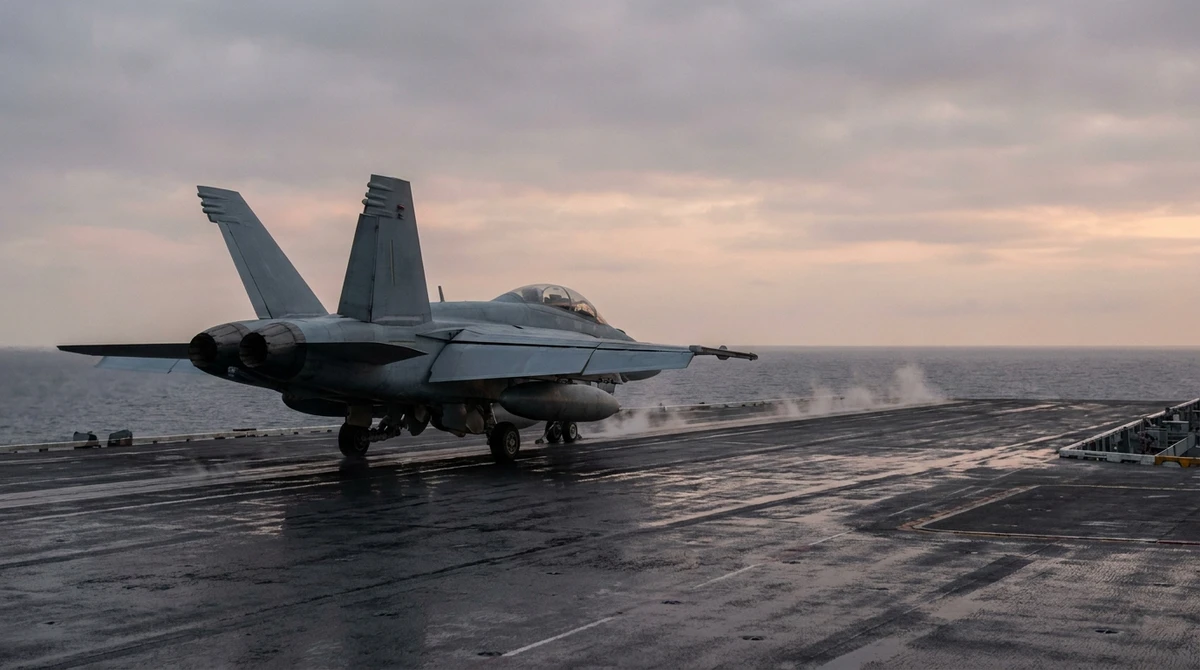
The National Security Presidential Memorandum signed on August 13, 2026, which gives the Pentagon 60 days to plan the replacement of the Electromagnetic Aircraft Launch System (EMALS) with steam catapults on the future USS Doris Miller (CVN-81), turns on a piece of machinery most people never see: the catapult buried under the bow of a carrier. Both systems do the same job, accelerating a fully loaded jet to flying speed in about 90 meters, but they do it with almost nothing in common, and that difference is why the Gerald R. Ford class cannot simply swap one for the other.
A carrier needs catapults because a strike fighter at maximum takeoff weight cannot reach lift-off speed on its own engines within the length of a flight deck; an E-2 Hawkeye, with its low thrust-to-weight ratio, cannot leave the deck at all without one. Whatever the power source, the aircraft's nose gear is hooked to a shuttle running in a slot along the deck, a holdback fitting keeps the airplane in place while the system comes up to power, and two to three seconds later the shuttle has added roughly 240 to 300 km/h to whatever wind is blowing over the deck.
Steam catapults
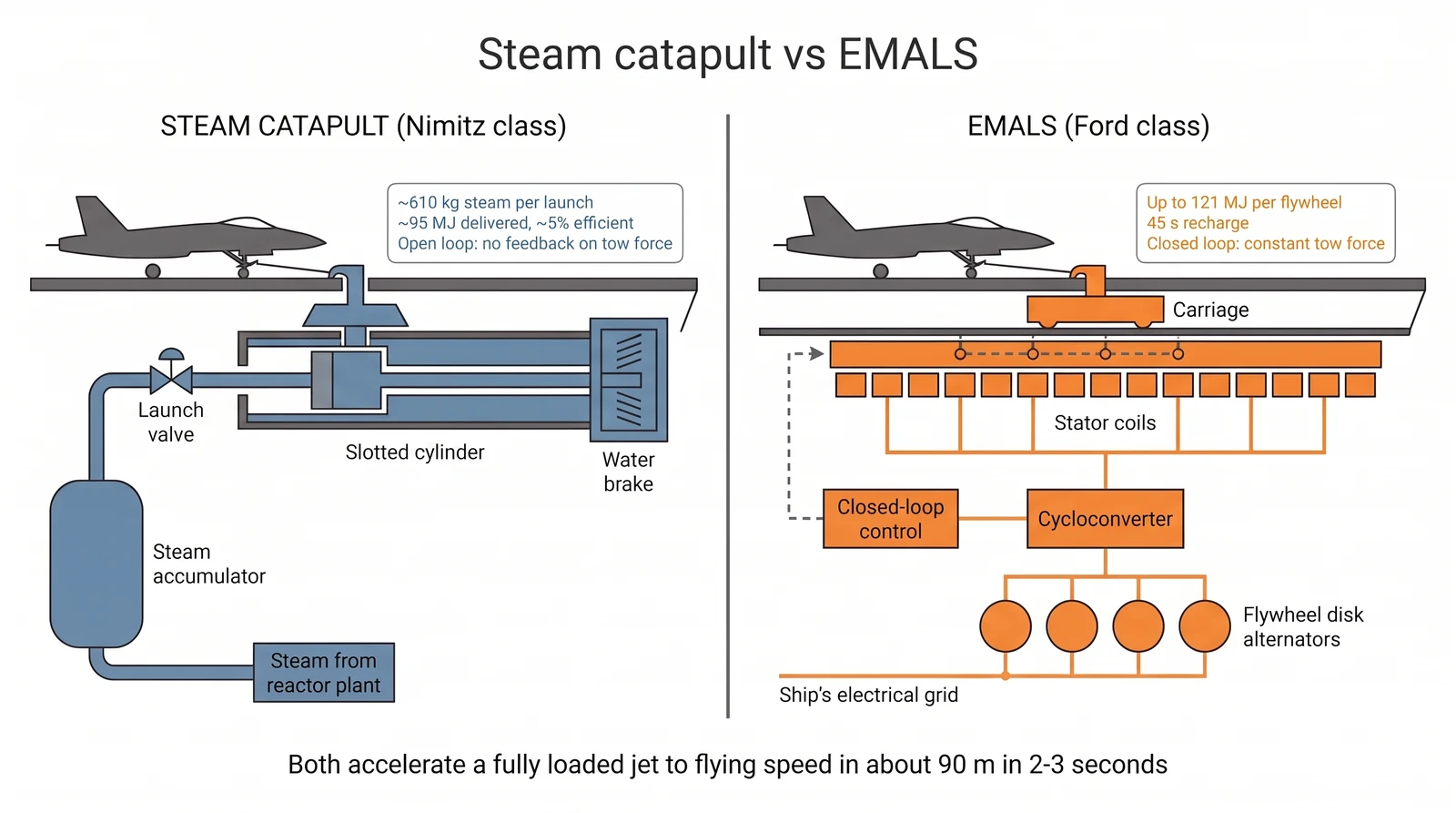
The steam catapult is a British invention, proposed by Commander Colin Mitchell of the Royal Navy Volunteer Reserve and trialed aboard HMS Perseus in 1950; the US Navy fired its first steam shot from USS Hancock in 1954. The C-13-1 and C-13-2 versions fitted to the Nimitz class are 99 m long with a stroke of about 93 to 94 m, and are rated to throw an 80,000 lb (36-tonne) aircraft to 140 knots. Their working fluid is high-pressure steam bled from the ship's reactor plant, stored in accumulators below deck and released into two parallel slotted cylinders. The pistons in those cylinders are connected to the shuttle above; when the launch valve opens, steam pressure drives them forward, and a water brake at the end of the stroke stops the assembly. Each shot consumes roughly 1,350 lb (610 kg) of steam and delivers on the order of 95 megajoules of useful work, at an overall efficiency of about 4 to 6 percent. Everything about it is heavy: the cylinders, the accumulators, the pipework routing steam forward from the machinery spaces, the fresh water needed to make that steam, and the maintenance crews who keep the seals and valves working. It is also open-loop. The launch officer sets a pressure for the aircraft's weight, but once the valve opens there is no feedback: the tow force peaks early and decays along the stroke, and the transients are hard on landing gear and airframes. That coarseness is what makes it difficult to launch very light aircraft: there is a floor below which a steam shot cannot be throttled reliably.
Electromagnetic launch
EMALS replaces the pistons with a linear induction motor. Instead of a rotating stator, a row of coils is laid flat along the 91 m track; energizing them in sequence creates a magnetic field that travels forward and drags the carriage, and the aircraft, along with it. Only the coils around the carriage are powered at any instant, and Hall-effect sensors along the track feed a closed-loop controller that holds tow force constant from start to end. The energy problem is solved with flywheels: a launch demands far more power than the ship's grid can supply in two seconds, so four disk alternators spin up on ship's power during a roughly 45-second recharge and then dump their stored kinetic energy, up to 121 MJ each, through cycloconverters into the motor. General Atomics describes the system as having one moving part, a recharge cycle under one minute, accurate end-speed control and adjustable thrust across a wide range of aircraft weights, and the closed-loop profile is what allows the same catapult to shoot an F/A-18E/F Super Hornet or an F-35C at maximum weight and, at the other end of the envelope, an MQ-25 Stingray or the lighter unmanned types that will follow it. The system uses no steam and no fresh water, weighs less, takes up less volume, and, according to the Navy, needs fewer sailors and less maintenance infrastructure. The Ford class sails with a core ship's company of about 2,600 against roughly 3,200 on a Nimitz-class carrier; not all of that is EMALS, but the shift from steam and hydraulics to electrical systems is a large part of it. Early Navy data cited by Bryan Clark of the Hudson Institute put Ford's operating cost about $100 million a year below a Nimitz-class ship, according to Army Recognition.
The trade-off was maturity. Steam catapults have launched aircraft for seven decades, and a Nimitz-class carrier with four of them has at least one available about 99.5 percent of the time. EMALS was installed on the lead ship while it was still being developed: 201 of 1,967 test launches failed at Lakehurst in 2013, the system could not initially launch fighters carrying external drop tanks, and the Pentagon's Director of Operational Test and Evaluation reported 181 mean cycles between operational mission failure across 3,975 shipboard launches in 2019-2020, rising to 460 in FY2021 and 614 in FY2022 against a requirement of 4,166. Those figures, together with the electric weapons elevators, delayed Ford's first deployment by years and gave the president's 2017 criticism its technical grounding. What has changed since is the operational record: by March 2026 Ford had logged 36,863 electromagnetic launches, and its 326-day deployment ending in May 2026 saw about 12,200 launches by Carrier Air Wing Eight, while the second ship of the class, John F. Kennedy, is running acceptance trials with the same gear.
Returning Doris Miller to steam
The reason a return to steam on Doris Miller is an engineering problem rather than a procurement choice is that the Ford class was designed around electricity from the keel up. Its two A1B reactors were sized to generate far more electrical power than a Nimitz-class plant precisely so that EMALS, the Advanced Arresting Gear, the weapons elevators and future directed-energy weapons could all be electric; EMALS equipment runs through 48 separate construction zones. The steam mains, accumulator rooms, condensate plant and berthing that a C-13 needs were designed out. USS George H.W. Bush, commissioned in 2009, was the last carrier built with steam catapults, and no new sets have been manufactured since, so the production line would have to be reconstituted; the White House's own language about needing to "reactivate portions" of the industrial base concedes as much. General Atomics says its EMALS and arresting-gear work for CVN-81 is close to 50 percent complete, and the ship's keel is due to be laid before the end of 2026 for delivery around 2034.
The US Navy operates eleven carriers, ten of the Nimitz class and Ford herself, so steam will remain the majority technology on American decks well into the 2040s regardless of what happens on CVN-81. Elsewhere, the direction of travel is the other way. China commissioned Fujian on November 5, 2025 with three electromagnetic catapults using a medium-voltage direct-current architecture, and has launched the J-15T, the J-35 and the KJ-600 airborne early warning aircraft from them, making the Type 003 the first non-American carrier to skip steam entirely. France has selected EMALS and the Advanced Arresting Gear for the nuclear-powered carrier that will replace Charles de Gaulle, the only other steam-catapult ship in service today. The United Kingdom is the one navy to have gone the other way, dropping a 2011 plan to fit EMALS to the Queen Elizabeth class in 2012 when the projected cost doubled, and reverting to the short-takeoff F-35B.
The Pentagon's plan, with timelines and resourcing, is due to the president in mid-October. Until it lands, the cost of the change is unknown; the Associated Press has reported it would likely run to billions of dollars, and Navy Lookout notes that the greater damage may be to the schedule of a ship not due in service until the 2030s.
More News
All news →
First HACM Hypersonic Cruise Missile Flight Test Unit Released Over Australia
The U.S. Air Force says a Hypersonic Attack Cruise Missile flight test unit was released by the Royal Australian Air Force over an Australian test range, without disclosing the date, the launch aircraft or whether the scramjet-powered weapon achieved powered flight.
France Fires M51.3 Nuclear-Capable Missile From a Submarine for the First Time
The French Navy ballistic-missile submarine Le Vigilant launched an M51.3 without a nuclear warhead off Finistère, western France, on October 6, 2026, the first submarine firing of the missile's latest version, Defense News reported.
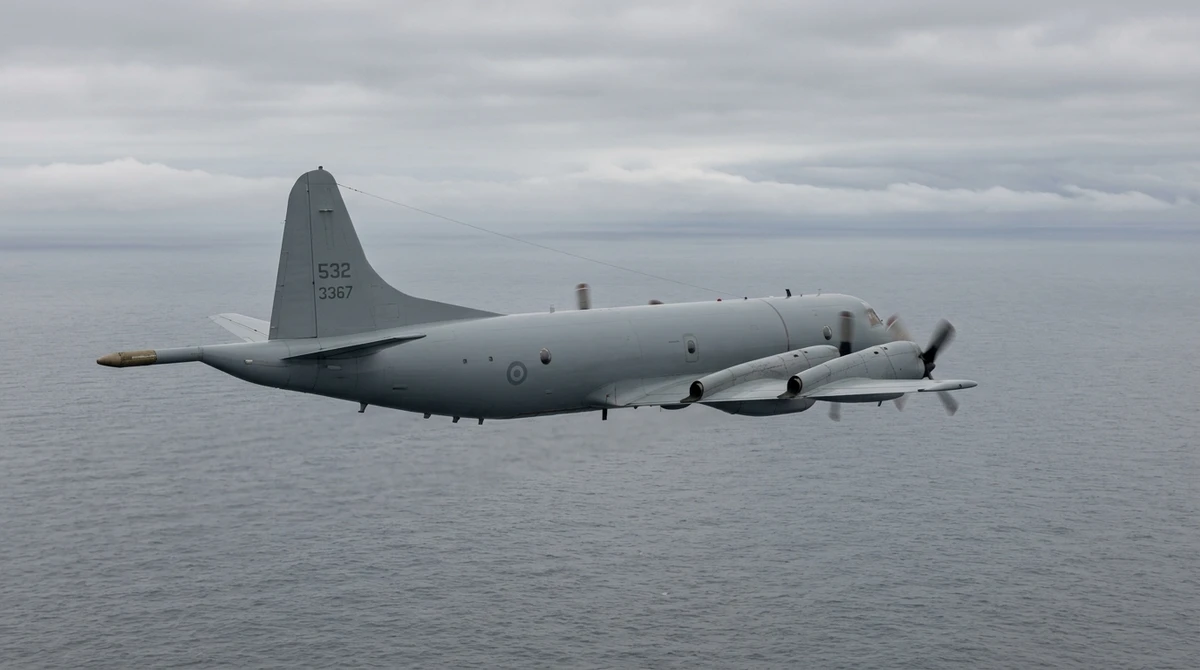
P-3 Orion Fleet Down to 101 Aircraft in 12 Countries, Roughly Half Its 2022 Size
GlobalMilitary.net's inventory data counts 101 P-3 Orions in military service across 12 countries, down from 211 in 16 countries in its 2022 snapshot, as US agencies retire special-mission Orions and Japan draws down the largest remaining fleet.
Bréguet Alizé Turns 70: French Carrier Submarine Hunter Served From 1959 to 2000
The prototype of the Bréguet Br.1050 Alizé, the French Navy's carrier-based anti-submarine turboprop, first flew from Toulouse-Blagnac on 6 October 1956; 89 were built, and the type served France until September 2000 and India until 1991.

Northrop Grumman's YFQ-48A Talon Blue Completes First Fully Autonomous Flight at Mojave
Northrop Grumman said on October 3, 2026 that its company-funded YFQ-48A Talon Blue had taxied, taken off, maneuvered and landed without pilot input at Mojave, California, as the US Air Force prepares to select designs for Increment 2 of its Collaborative Combat Aircraft program.
Australia Retires Its Tigers, Leaving Three Operators Among the World's 3,623 Attack Helicopters
The Australian Army has retired its Tiger attack helicopters, marking the fleet's sundown in Darwin on 30 September and leaving France, Germany and Spain as the only users; GlobalMilitary.net data counts 3,623 active attack helicopters in 81 countries.