D-44
Introduced in 1946, the Soviet D-44 is an 85mm divisional field gun featuring a towed split-trail carriage. Key figures: weight 1.725 t, built 10,918. In service with 6 armies — Vietnam (2,300), Mongolia (200), Azerbaijan (100) and 3 others.
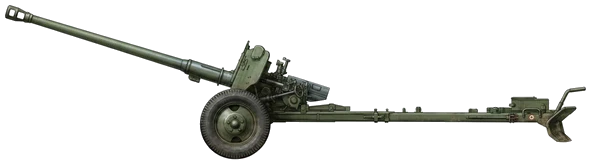
| Sub-type | Field gun |
| Crew | 8 personnels |
| Mass | 1.7 tons |
| Height | 1.42 m (4.7 ft) |
| Width | 1.78 m (5.8 ft) |
| Length | 8.34 m (27.4 ft) |
| Weapon 1 | 85 mm D-44 gun |
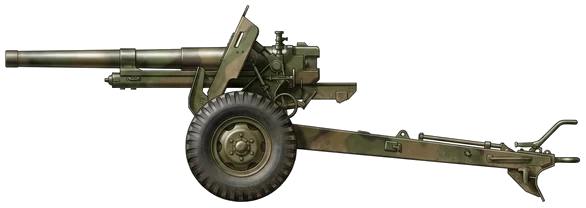
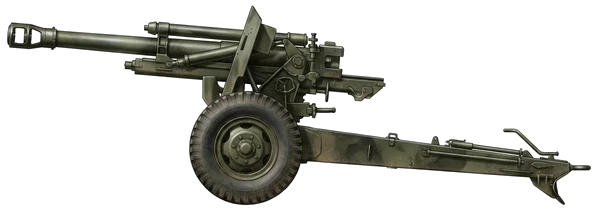
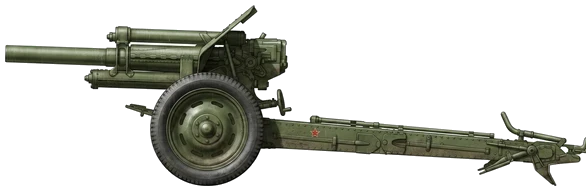
Description
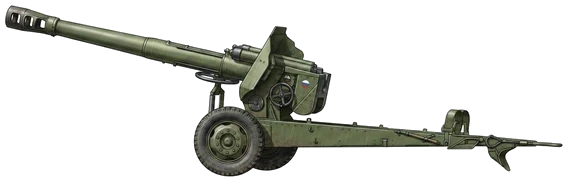
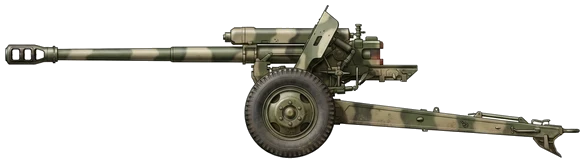
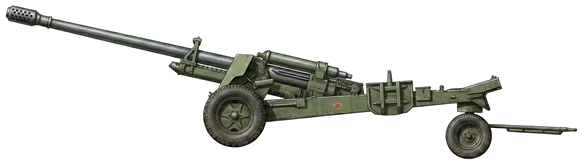
The 85-mm divisional gun D-44 was developed in the Soviet Union between 1943 and 1944 at the design bureau of No. 9 factory (Uralmash) under GRAU index 52-P-367. Designed to replace the 76 mm divisional gun M1942 (ZiS-3), production began in the mid-1940s and continued through 1954, resulting in over 10,000 units built. Several variants were developed during its production life: the SD-44, introduced in the 1950s with an auxiliary propulsion engine and integral ammunition storage for airborne forces; the D-44N, equipped in the 1960s with an APN 3-7 infrared illumination device for night operations; the Chinese Type 56, produced under license starting in the early 1960s; and the Polish D-44M and D-44MN, upgraded with electrical subsystems in the early 1980s. The carriage design was also utilized for the RPU-14 multiple rocket launcher and served as the basis for the D-48 anti-tank gun.
The weapon features an eight-man crew, a split-trail carriage, a hydro-pneumatic recoil system, and a semi-automatic vertical sliding-wedge breech. Its barrel was adapted from the T-34-85 tank gun. Target acquisition for day combat relies on an OP-2-7 sight with 5.5x magnification, permitting engagement at ranges up to 1,500 meters, while maximum indirect firing range reaches 15.65 kilometers. The gun fires fixed quick-firing 85 mm ammunition, including high-explosive, armor-piercing, subcaliber high-velocity armor-piercing tracer (HVAP-T), and fin-stabilized high-explosive anti-tank (HEAT-FS) projectiles, with a burst fire rate of up to 20 rounds per minute. Subcaliber BR-365P HVAP-T rounds penetrate 100 mm of armor at a range of 1,000 meters at a 90-degree obliquity, while the BR-367P variant penetrates 180 mm under the same conditions, and the BK-2M HEAT-FS round penetrates 300 mm. The artillery piece uses GAZ-AA tires and is towed by trucks such as the ZIL-157 and URAL-375D or by Ya-12 tractors, while the SD-44 variant utilizes an internal auxiliary motor for short-distance self-propulsion.
The D-44 saw action in the final stages of World War II and was widely exported starting in the 1950s to Warsaw Pact nations, Asian militaries, Middle Eastern armed forces, and several African countries. Communist forces used the gun during the Korean War and Vietnam War, and Arab armies deployed it during conflicts with Israel. Additional combat operations include the Cambodian Civil War, Lebanese Civil War, Ethiopian Civil War, Iran–Iraq War, First and Second Nagorno-Karabakh Wars, and the War in Donbas. During the Russian invasion of Ukraine, the gun was returned to combat by both Russian and Ukrainian forces, including custom field mountings on tractors as tank destroyers. Multiple nations in Eastern Europe, Asia, Africa, and South America retain the D-44 or Type 56 in active inventory or reserve storage.
Frequently Asked Questions
What type of vehicle is the D-44?
What is the weight of the D-44?
How many crew members does the D-44 require?
How many D-44 have been built?
What weapons does the D-44 carry?
- AUG 112026 Created Page created: D-44