Tu-143 Reys
Soviet unmanned reconnaissance aircraft from 1970s used for tactical reconnaissance missions Key figures: top speed 950 km/h, range 200 km, service ceiling 5,000 m, max takeoff weight 1,230 kg, built 950.
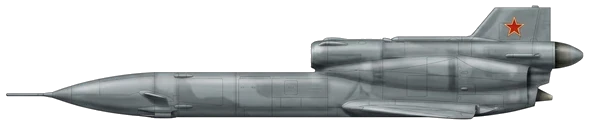
| Length | 8.1 m (26.4 ft) |
| Wingspan | 2.2 m (7.3 ft) |
| Height | 1.5 m (5.1 ft) |
| Max. takeoff weight | 1,230 kg (2,712 lbs) |
| Powerplant | 1 × Klimov turbojet TR3-117 |
| Maximum speed | 950 km/h (590 mph) |
| Operational range | 200 km (124 mi) |
| Endurance | 0 hours |
| Service ceiling | 5,000 m (16,404 ft) |


Description
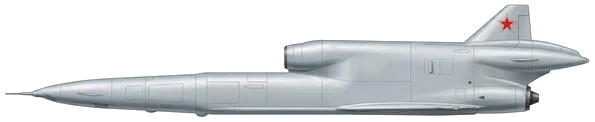
The Tupolev Tu-143 Reys is a Soviet tactical reconnaissance drone built by Tupolev, placed in service in 1976 with the Soviet Army as well as several Warsaw Pact and Middle Eastern allies. Launched from a truck and recovered by parachute, it carried a reconnaissance pod recovered after the flight to extract the imagery. It is known for its use in Afghanistan and Lebanon, then for its reuse by Ukraine as a makeshift cruise missile after 2022.
Development
The Tu-143 was introduced in 1976 as a heavily scaled-down version of the Tu-141, intended for short-range tactical reconnaissance (60 to 70 kilometres) with low-altitude flight capability. Around 950 examples were produced during the 1970s and 1980s. The programme was extended by the Tu-243 in the late 1990s, then by the Tu-300 promoted by Tupolev from 1995, whose development was halted in the late 1990s for financial reasons before being resumed in 2007.
Design
The aircraft is 8.06 m long with a wingspan of 2.24 m and a height of 1.54 m, with a launch weight of 1,230 kg. It is powered by a Klimov TR3-117 turbojet of 5.8 kN (590 kgf, 1,300 lbf), for a maximum speed of 950 km/h, a ceiling of 5,000 m and a range of 200 km. Launch is from a truck with JATO assistance, recovery by parachute. The initial version carried film cameras; later versions received a television or radiation-detection payload, the data being relayed to a ground station by data link.
Operational History
Syria employed the Tu-143 for reconnaissance missions over Israel and Lebanon during the 1982 Lebanon War, and Soviet forces used it in Afghanistan. Syria received VR-3s in 1984, Czechoslovakia two squadrons the same year; Romania operated the VR-3 from 1987 until the early 2000s, the Czech Republic retiring it in 1995. Other users include Belarus, North Korea, Iraq, Bulgaria, Slovakia and Hezbollah, which designates it DR-3. During the 2022 Russian invasion of Ukraine, Ukraine used it to locate Russian air defences and as a makeshift cruise missile; a Tu-143 loaded with explosives was shot down in Kursk Oblast on 29 June 2022. Russia retained it in service as a target drone in 2016.
Variants
- Tu-143 Reys: Initial tactical reconnaissance version of 1976, with film cameras then TV or radiation-detection payloads.
- M-143: Target-drone version introduced in the mid-1980s.
- Tu-243 Reys-D: Improved version entering service in the late 1990s, with a fuselage lengthened by 25 cm, increased fuel capacity, roughly doubled range, TR3-117 uprated to 6.28 kN and improved low-altitude guidance.
- Tu-300 Korshun: Later development fitted with a nose radome, fairings for sensors and electronic systems, and a ventral pylon for a sensor pod or munitions.
Frequently Asked Questions
What type of aircraft is the Tu-143 Reys?
What is the maximum speed of the Tu-143 Reys?
What is the range of the Tu-143 Reys?
When did the Tu-143 Reys first fly?
How many Tu-143 Reys have been built?
Which countries operate the Tu-143 Reys?
What is the service ceiling of the Tu-143 Reys?
- AUG 302026 Updated Description updated
- APR 72026 Updated Picture credits updated in a site-wide editorial pass
- FEB 72026 Updated Endurance added