Falcon 50
French maritime surveillance jet, noteworthy for transcontinental capacity, extensively deployed for government, business, and emergency medical services. Key figures: top speed 888 km/h, range 5,695 km, service ceiling 13,716 m, max takeoff weight 18,500 kg, unit price $6M, built 352. In service with 6 air forces as of 2026 — France (8), Portugal (3), South Africa (2) and 3 others.
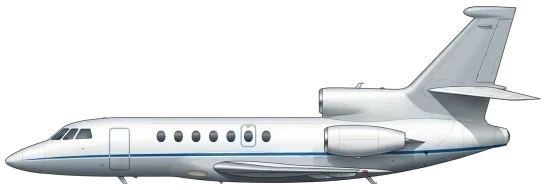
| Length | 18.8 m (61.7 ft) |
| Wingspan | 18.9 m (62.0 ft) |
| Height | 7.0 m (22.9 ft) |
| Wing area | 46.8 m² (504.1 sqft) |
| Empty weight | 9,150 kg (20,172 lbs) |
| Max. takeoff weight | 18,500 kg (40,785 lbs) |
| Powerplant | 3 × turbofans Honeywell TFE731-3-1C 1,681 kgf each |
| Maximum speed | 888 km/h (552 mph) |
| Operational range | 5,695 km (3,539 mi) |
| Service ceiling | 13,716 m (45,000 ft) |
| Climb rate | 17.42 m/s (57.2 ft/s) |
| Takeoff distance | 1,524 m (5,000 ft) |


Description
The Dassault Falcon 50 is a French super-midsize, long-range business jet built by Dassault Aviation, configured as a trijet with an S-duct intake feeding the centre engine. It received French airworthiness certification on 27 February 1979 and FAA certification on 7 March 1979. It is chiefly operated by corporate and private owners, with a smaller number in military and government service, and is known for combining Falcon 20 fuselage dimensions with a new area-ruled airframe and revised wing.
Development
The Falcon 50 reused the fuselage cross-section and passenger capacity of the twin-engined Falcon 20 but was otherwise a new design, area ruled and fitted with a more advanced wing. The first prototype flew on 7 November 1976. Dassault also produced a maritime surveillance and environmental protection derivative, the Gardian 50. The updated Falcon 50EX first flew in 1996 and covered serial numbers 253–352; the final aircraft was delivered in 2008, ending the combined Falcon 50/50EX production run of 352 airframes. The Falcon 900 and Falcon 7X, both with larger fuselages and the same three-engine layout, followed as successors. In January 2008 Dassault announced a replacement programme codenamed "SMS" (Super Mid Size), with design and engine selection intended for completion by early 2009; in June 2009 CEO Charles Edelstenne stated that all design choices had been reopened. Dassault and Aviation Partners Inc. developed and certified High Mach blended winglets as a retrofit kit for both the Falcon 50 and 50EX. By 2018, mid-to-late-1980s Falcon 50s were priced between $0.879 and $1.6 million, with 1998–2003 Falcon 50EXs at $2.95 to $3.95 million.
Design
The 50EX has a length of 18.52 m, a wingspan of 18.86 m, a height of 6.98 m and a wing area of 46.83 m². Maximum take-off weight is 18,008 kg and maximum landing weight 16,200 kg. Power comes from three Honeywell TFE 731-40 turbofans of 16.46 kN thrust each, controlled by DEEC digital electronic engine control; the initial Falcon 50 used TFE 731-3-1C engines with an optional APU, made standard on the EX. Maximum speed is Mach 0.95 (1,015 km/h), cruise speed Mach 0.85 at 15,000 m, range 5,695 km and service ceiling 15,000 m. Crew is two, with 8 to 9 passengers or a 1,080 kg payload with full fuel.
Armament
A single Falcon 50 delivered to Iraq, known as "Susanna", was modified with a Cyrano IV-C5 radar and hardpoints for two AM-39 Exocet anti-ship missiles. No other Falcon 50 variant carries armament.
Operational History
The Iraqi "Susanna" was used to train Mirage F1 crews and may have carried out the attack on USS Stark on 17 May 1987; it was flown to Iran during the Persian Gulf War and never returned. On 6 April 1994 Falcon 50 registration 9XR-NN was shot down near Kigali, killing Rwandan President Juvénal Habyarimana and Burundian President Cyprien Ntaryamira, triggering the Rwandan genocide. Falcon 50EX F-GLSA collided with a snow plough on take-off from Moscow Vnukovo on 20 October 2014, killing all four on board including Total CEO Christophe de Margerie. A runway overrun by N114TD at Greenville, South Carolina, on 27 September 2018 killed both pilots, and a crash near Kesikkavak, Haymana, Turkey, on 23 December 2025 killed eight, including Libyan Armed Forces commander Mohammed Ali Ahmed al-Haddad.
Variants
- Falcon 50: Initial production variant with Honeywell TFE 731-3-1C engines and optional APU; 252 built, one of which served as the Falcon 50EX prototype.
- Falcon 50EX: Version with three DEEC-controlled TFE 731-40 engines, standard APU, revised rudder control system and updated avionics; 100 built plus one converted aircraft.
- Gardian 50: Maritime surveillance and environmental protection derivative.
- Falcon 50 "Susanna": Single Iraqi aircraft fitted with Cyrano IV-C5 radar and hardpoints for two AM-39 Exocet missiles.
Frequently Asked Questions
What type of aircraft is the Falcon 50?
What is the maximum speed of the Falcon 50?
What is the range of the Falcon 50?
When did the Falcon 50 first fly?
How many Falcon 50 have been built?
Which countries operate the Falcon 50?
How much does a Falcon 50 cost?
What is the service ceiling of the Falcon 50?
- AUG 302026 Updated Description updated
- AUG 52026 Updated Powerplant updated in a site-wide editorial pass
- APR 72026 Updated Sources and cross-references refreshed
- JAN 122026 Updated Range updated in a site-wide editorial pass