AW149 vs UH-60 Black Hawk
AW149 vs UH-60 Black Hawk at a glance — top speed 310 vs 294 km/h, range 1,009 vs 2,221 km, max takeoff weight 8,600 vs 10,659 kg, built 31 vs 5,000 units.
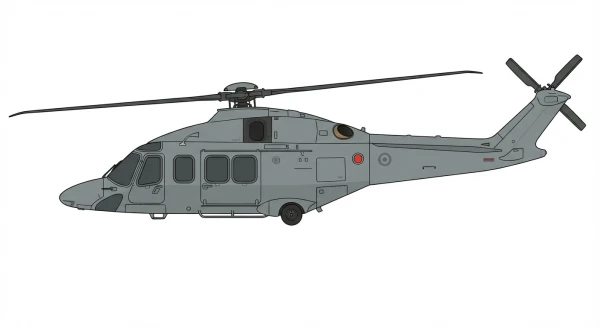
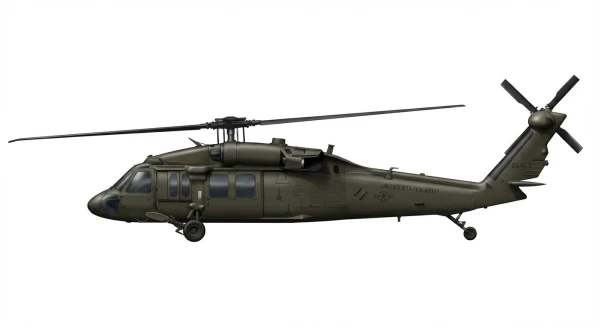
| AW149 | UH-60 Black Hawk | |
|---|---|---|
| Origin country | 🇬🇧 United Kingdom🇮🇹 Italy | 🇺🇸 United States |
| Category | Military Helicopters | Military Helicopters |
| Manufacturer | AgustaWestland | Sikorsky |
| First flight | 13 November 2009 | 29 November 1974 |
| Year introduced | 2014 | 1979 |
| Number produced | 31 units | 5000 units |
| Average unit price | $16 million | $21 million |
| Wingspan | 14.6 m | 16.4 m |
| Height | 5.1 m | 4.9 m |
| Length | 17.6 m | 19.5 m |
| Maximum speed | 310 km/h | 294 km/h |
| Operational range | 1,009 km | 2,221 km |
| Service ceiling | 6,095 m | 5,791 m |
| Max. takeoff weight | 8,600 kg | 10,659 kg |
| Empty weight | 4,720 kg | 4,819 kg |
| Total thrust | 2 x 1,476 kW | 2 x 1,208 kW |
Detailed Comparison
The Sikorsky UH-60 Black Hawk is a combat-proven utility helicopter with a global logistics network, while the Leonardo AW149 is a modern, purpose-built military helicopter marketed as a direct competitor. The Black Hawk, in service since 1979 with over 5,000 units built, represents the established standard for medium-lift utility and transport roles. The AW149, which entered service in 2014, leverages a more recent design philosophy, offering a modern alternative with a significantly lower unit price of approximately $16 million compared to the UH-60's $21 million.
Development and Design
The UH-60 was born from a 1970s U.S. Army requirement to replace the UH-1 Huey, with a design focused on survivability, reliability, and crashworthiness. Its development was driven by lessons from the Vietnam War, resulting in a rugged airframe with redundant systems. The AW149 was conceived later as a dedicated military platform derived from the AW139/189 family. Its design emphasizes a large, unobstructed cabin, increased payload over the AW139, and modern, open-architecture avionics for simplified integration of new systems. A key design distinction is the AW149's landing gear, certified for a high-sink-rate touchdown of 9.5 m/s, reflecting contemporary survivability standards.
Specifications and Performances
While the UH-60 has a higher maximum takeoff weight (10,659 kg vs. 8,600 kg), the AW149 is equipped with more powerful General Electric CT7-3E1 engines, each producing 1,476 kW versus the 1,208 kW of the Black Hawk's T700 engines. This gives the AW149 a higher power-to-weight ratio at its typical operating weights and a slightly higher maximum speed (310 km/h vs. 294 km/h). The AW149's larger fuselage provides greater internal volume, a critical factor for troop transport and medical evacuation missions. Both aircraft can be armed with similar weapon systems, including AGM-114 Hellfire missiles and rocket pods, mounted on external hardpoints.
Deployment and usage
The Black Hawk's operational history is extensive, having served as a cornerstone of U.S. and allied operations since the 1983 invasion of Grenada, through the Gulf War, and in sustained operations in Iraq and Afghanistan. Its numerous variants (MH-60, HH-60, SH-60) fulfill specialized roles from special operations to combat search and rescue. The AW149 is a relative newcomer, securing orders from nations like Poland, Egypt, and Thailand. Leonardo often leverages local production agreements, as seen with the Polish order, to make the AW149 an attractive proposition for countries seeking to develop their domestic aerospace industry.
Conclusion
The choice between the two platforms represents a classic procurement dilemma: proven capability versus modern design. The UH-60 Black Hawk offers unparalleled interoperability, a mature global supply chain, and decades of combat-tested reliability. Its higher acquisition cost is offset by this proven track record. The AW149 presents a compelling alternative, offering a more modern airframe with greater internal volume, superior engine power, and open-architecture avionics at a lower unit cost. Its appeal lies with operators prioritizing future-proofing, cabin flexibility, and industrial partnerships over the Black Hawk's established, but older, ecosystem.