F-35 Variants, Blocks and Technology Refreshes
How the F-35A, B and C differ, what the TR-2 and TR-3 hardware baselines and the Block 2B to Block 4 software releases add, and why Block 4 runs only on TR-3 aircraft.
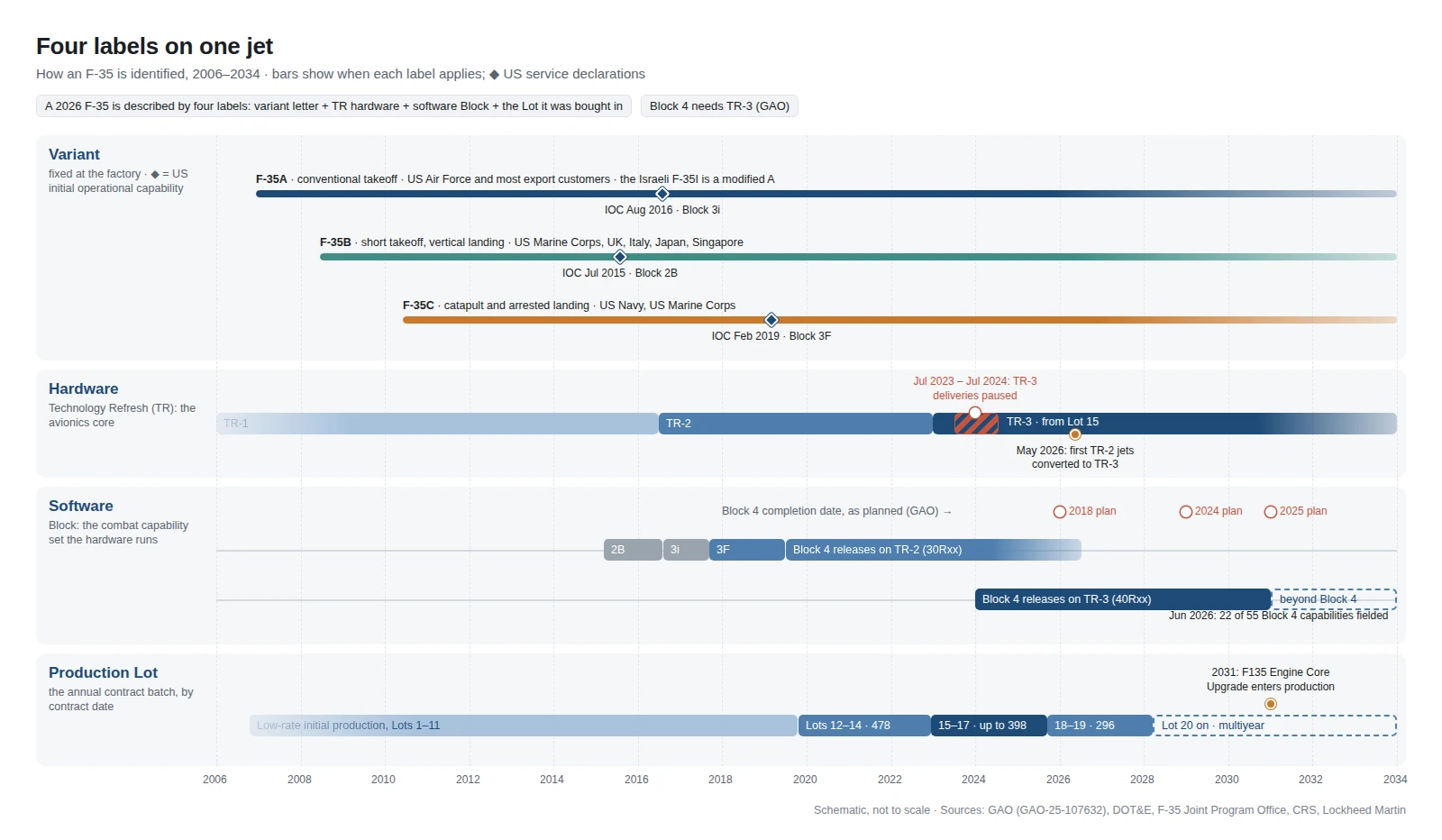
Every F-35 Lightning II carries four labels at once, and reports such as "Lot 17 F-35A", "TR-3 jets" or "Block 4" usually give only one of them. The variant letter (A, B or C) is the airframe, fixed at the factory. The Technology Refresh (TR-2 or TR-3) is the avionics hardware inside it. The Block (2B, 3i, 3F or 4) is the software release: what the aircraft can do. The Lot is the annual contract batch it was bought in. The Rafale carries two such labels, a version and a standard; the F-35 needs four, because its capability arrives as fleet-wide software releases that run only on the right hardware, and that hardware was built into the fleet lot by lot.
Block 4, the modernization program that defines what the aircraft will do in the 2030s, runs only on TR-3 hardware; TR-3 has been built into new aircraft since Lot 15 and is now being fitted to older ones at depots. As of October 2026 the program is in the middle of that transition: the F-35 program executive officer said in June 2026 that 22 of 55 planned Block 4 capabilities had been fielded, according to Military Times, and European Security & Defence reported that as of May 2026 no TR-3 aircraft delivered to the US services had been cleared for operational use.
- Variant: F-35A (conventional takeoff and landing), F-35B (short takeoff, vertical landing), F-35C (carrier). Israel's F-35I is a modified F-35A, not a fourth production model.
- Technology Refresh: the processor, memory and display baseline. TR-2 arrived with Block 3i in 2016; TR-3 is built in from Lot 15 and reaches earlier aircraft only by depot modification.
- Block: the capability release. Blocks 2B, 3i and 3F were the development-phase releases of 2015–2017; Block 4 arrives in increments (30Rxx on TR-2, 40Rxx on TR-3) and needs TR-3 for its full content.
- Lot: the annual procurement batch (Lots 1–11 as low-rate initial production, then 12–14, 15–17, 18–19). It fixes the hardware an aircraft was built with; it is not a Block, and not its delivery year.
- Engine: one F135 on every variant, due for an Engine Core Upgrade in production from 2031. Block 4 does not depend on it; the capabilities that follow Block 4 do.
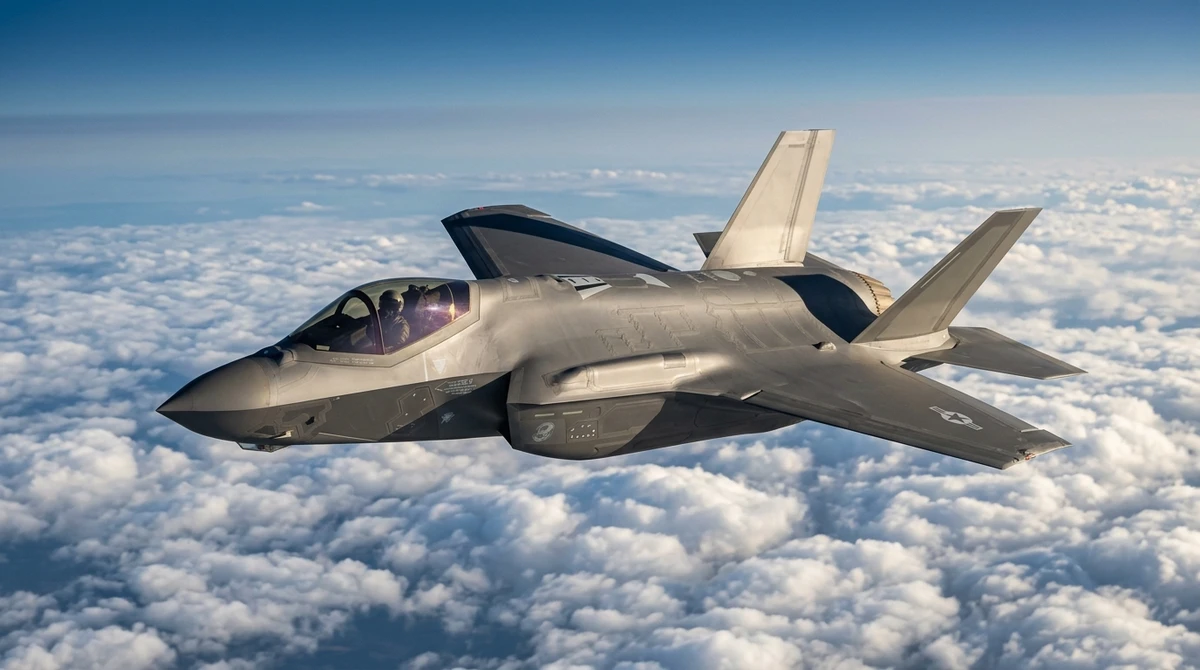
The variants: F-35A, F-35B and F-35C
| F-35A | F-35B | F-35C | |
|---|---|---|---|
| Takeoff and landing | Conventional runway | Short takeoff, vertical landing | Carrier catapult and arrested landing |
| Main operators | US Air Force and most export customers | US Marine Corps, United Kingdom, Italy, Japan; Singapore on order | US Navy and US Marine Corps |
| What sets it apart | Internal gun; boom refuelingOnly variant certified for the B61-12 nuclear bomb | Shaft-driven lift fan and swiveling rear nozzle; less internal fuel; no tailhook | Larger wing with folding tips; strengthened landing gear; arrester hook |
| First flight | 2006 | 2008First vertical landing 18 Mar 2010 | 6 Jun 2010Test aircraft CF-1 |
| US initial operational capability | 2 Aug 2016Air Force, Block 3i | 31 Jul 2015Marine Corps, Block 2B | 28 Feb 2019Navy, Block 3F |
| Delivered to 28 Jun 2026 | 956Including Israel's F-35I | 250 | 138 |
What separates the variants is how they take off and land, and for whom. The F-35B's lift fan and swiveling nozzle let it operate from amphibious ships and short strips at the cost of internal fuel; the F-35C's larger wing, strengthened gear and arrester hook fit it for the catapult and the wire. The F-35I "Adir" flown by Israel is not a fourth production model but an F-35A fitted with Israeli-specific systems; Lockheed Martin's delivery statistics count only A, B and C, so the F-35Is sit inside the F-35A total. By 28 June 2026 Lockheed Martin had delivered 1,344 production aircraft (956 F-35As, 250 F-35Bs and 138 F-35Cs), according to its quarterly SEC filing.
The hardware labels: Technology Refresh and Lot
The Technology Refresh is the label that decides which software an aircraft can run. It names the avionics hardware baseline: processor, memory, displays. The original hardware (TR-1) carried the early Blocks up to 2B. TR-2, built around a new integrated core processor, arrived with Block 3i in 2016; the Congressional Research Service (CRS) describes 3i as "essentially the same software" as 2B "on more powerful hardware". TR-3 is the current baseline, built into every new aircraft from Lot 15 and designed to host Block 4; Lockheed Martin describes it as a new integrated core processor, a panoramic cockpit display and an enhanced memory unit. The first TR-3 aircraft, test jet AF-7, flew at Edwards Air Force Base on 6 January 2023. The Government Accountability Office (GAO) put TR-3's development cost at $1.64 billion in December 2023 and $1.9 billion in September 2025.
The US services stopped accepting new aircraft in July 2023 and resumed in July 2024, according to Defense News and the Pentagon's Director of Operational Test and Evaluation (DOT&E); GAO attributed the delay to the integrated core processor, the new Distributed Aperture System and software stability, and Lockheed Martin stored the aircraft it kept building, around 100 by mid-2024 according to Air & Space Forces Magazine. Acceptance resumed provisionally for what GAO calls "non-combat-capable aircraft with TR-3 hardware", carrying a truncated training software load (40R01, then 40R02). In its FY2025 report DOT&E wrote that "no combat-capable TR-3 aircraft have been delivered to the U.S. Services to date", counting 158 TR-3 aircraft delivered to the US services by 30 September 2025, and judged the 40R02 build "unsuitable for dedicated" operational testing, according to The Aviationist.
Converting TR-2 aircraft to TR-3
Because Block 4 needs TR-3, aircraft built with TR-2 cannot run it unless they are converted. GAO wrote in September 2025 that "according to program officials, there is no plan to equip Technology Refresh 2 aircraft with future Block 4 capabilities". The F-35 Joint Program Office (JPO) has meanwhile begun converting fielded TR-2 aircraft to TR-3: the first three Marine Corps F-35Bs were inducted at Fleet Readiness Center East, MCAS Cherry Point, in early 2026, and the first, BF-105, was returned on 14 May 2026. "We also have more than 700 aircraft already fielded that must be upgraded," the JPO said. A January 2023 US Air Force release quoted by The Aviationist said TR-3 would be retrofitted on in-service aircraft "back to Lot 10"; the JPO's 2026 statements name no lot cut-off and give no count of aircraft that will stay on TR-2. On these statements, a TR-2 aircraft can receive Block 4 only after conversion to TR-3.
The production Lots
| Lots | Aircraft | Contract | Configuration |
|---|---|---|---|
| LRIP 1–11 | – | Low-rate initial production | Early aircraft built in Block 2B or 3i, retrofitted toward 3F |
| 12–14 | 478149 / 160 / 169 | Finalized 29 Oct 2019About $34 billion, the "block buy" | TR-2 |
| 15–17 | Up to 398145 / 127 / up to 126 | Finalized 30 Dec 2022About $30 billion | First TR-3 aircraftFirst jets for Belgium, Finland and Poland |
| 18–19 | 296 | Finalized 29 Sept 2025$24.29 billion | TR-3Deliveries from 2026 |
| 20 onward | – | Planned as a multiyear contract | TR-3 |
A Lot is one annual procurement contract covering US, partner and foreign military sales aircraft together. It fixes the hardware an aircraft was built with (Lots 12–14 TR-2, Lot 15 onward TR-3) and does not match the delivery year: Lot 17 aircraft were delivered from 2025 through September 2026, the Air Force told The War Zone. The "block buy" of Lots 12–14 is a contracting term, three lots bought at once, not a Block. Deliveries have followed the TR-3 story: GAO counted 110 in 2024, all late by an average of 238 days; Lockheed Martin then delivered a record 191 aircraft in 2025 as it cleared the stored backlog, Defense News reported, and 19 in the second quarter of 2026, according to its SEC filing.
The software Blocks of development: 2B, 3i and 3F
| Block | Hardware | What it added | Dates |
|---|---|---|---|
| 1A, 1B, 2A | TR-1 | Early training and test releases | Before 2015Superseded |
| 2B | TR-1 | First combat-capable release | Released Mar 2015Marine Corps IOC 31 Jul 2015 |
| 3i | TR-2 | Same capability on the new processor | Released Aug 2016Air Force IOC 2 Aug 2016 |
| 3F | TR-2 | Final development release, "expanded combat capability with basic weapons"Later renamed 30PXX | Released Sept 2017Navy IOC 28 Feb 2019 |
| Block 4 | TR-3Increments on TR-2 as 30Rxx releases | Electronic warfare, weapons, communications, navigation; APG-85 radar | 2019 onward; complete 2031 at the earliest (GAO)22 of 55 capabilities fielded, Jun 2026 |
The Blocks of the System Development and Demonstration (SDD) phase were cumulative software releases, and each US service declared initial operational capability on a different one: the Marine Corps on Block 2B, the Air Force on Block 3i, the Navy on Block 3F, the final SDD release. SDD flight testing ended on 11 April 2018 and initial operational test and evaluation began on 3 December 2018; the Milestone C decision authorizing full-rate production was signed on 12 March 2024, more than four years later than the Pentagon originally planned, according to Defense News.
Because production ran alongside development, a policy known as concurrency, early aircraft were delivered in earlier Blocks than they would serve in: in March 2018 the Air Force told Congress that "approximately 108 aircraft" in Block 2B or 3i configuration still required retrofit to Block 3F. After SDD, the 3F software line was renamed 30PXX, and current releases are numbered 30Rxx on TR-2 aircraft and 40Rxx on TR-3 aircraft, the first digit saying which hardware the build runs on.
Block 4 and why it needs TR-3
Block 4 is not a production block in the sense of an F-16 Block 70, a batch of airframes built to one standard; it is a capability program applied across the fleet in software drops, to whichever aircraft have the hardware for them. The CRS stated the condition in 2022: Block 4 "will not be available to all F-35s; it will require aircraft upgraded with Technical Refresh-3 (TR-3) hardware".
The program began in 2018 as Continuous Capability Development and Delivery (C2D2), covering the Block 4 software, TR-3 and the nuclear dual-capability work. Its content has been counted three ways: GAO's original list of 66 capabilities; "approximately 80 changes" in DOT&E's FY2024 report, as summarized by Air & Space Forces Magazine; and the 55 capabilities of the reduced Block 4 that the program executive officer presented to the Senate on 23 June 2026. The reduction follows a December 2023 direction by Congress to run Block 4 as a major subprogram covering a subset of the original list, in electronic warfare, weapons, communications and navigation, with the capabilities that need the upgraded engine deferred, GAO reported; 22 of the 55 had been fielded by June 2026, with six more due over the summer, the program chief said according to Military Times. The 2019 weapons list reported by Air & Space Forces Magazine included the GBU-53/B StormBreaker, the ASRAAM, the Meteor and the Joint Strike Missile; European Security & Defence lists the AIM-260 among the Block 4 weapons; the sensor centerpiece is the APG-85 radar.
The schedule has moved with the content. When Block 4 was set up in 2018 it was to be complete in 2026; by 2024 the date was 2029; in September 2025 GAO put completion at 2031 at the earliest, with the estimated cost having grown from $10.6 billion to $16.5 billion. Lockheed Martin told Defense News the same month that Block 4 work "will continue until 2030 or 2032". On aircraft already in service, increments have been fielded on TR-2 hardware as 30Rxx releases since 2019; DOT&E's FY2025 report rated the TR-2 build 30R08 "predominantly unusable" because of stability problems, according to The Aviationist. Export orders marketed as "Block 4" aircraft are TR-3 airframes intended to receive Block 4; no operator, the United States included, had a Block-4-complete aircraft in 2026, on GAO's and European Security & Defence's accounts.
What Block 4 does not include
Nuclear capability is not a Block 4 feature. The CRS expected it in Block 4 in 2022, but the F-35A was certified to carry the B61-12 on 12 October 2023, Breaking Defense reported in March 2024, quoting a US Air Force spokesperson as saying that Block 4 upgrades "are not a requirement to use the weapon". The certification covers the F-35A only.
The APG-85 is not yet in production. According to European Security & Defence, the nose of Lot 17 aircraft cannot accept the older APG-81; the JPO confirmed to the Senate Armed Services Committee on 23 June 2026 that the Marine Corps had accepted six F-35Bs without a radar, The War Zone reported, while saying no Air Force or Navy aircraft had been accepted in that state, and the Air Force told the same outlet in February 2026 that its Lot 17 F-35As deliver with the APG-81. The first production APG-85 units are expected in April 2028 or later, per the JPO.
The engine: F135 and the Engine Core Upgrade
The engine determines what can follow Block 4. GAO reports a problem identified in 2008: Block 4 and later capabilities need more power and cooling than the F135 and its thermal management system were designed to supply, and running the engine harder than designed adds an estimated $38 billion to life-cycle cost, by the program's own estimate. The Engine Core Upgrade (ECU), a new power module that "will support all three aircraft variants" in GAO's words, received a $1.3 billion risk-reduction contract to Pratt & Whitney in September 2024; a development contract is due after the end of 2026 and production from 2031. A power and thermal management upgrade follows, with production in 2033. The reduced Block 4 depends on neither; the capabilities deferred out of it and the post-Block 4 content that need more power and cooling do, and GAO places them in 2033.
Who flies which variant
Twenty nations operate or have ordered the F-35: the United States plus seven cooperative partners and twelve foreign military sales customers, by the JPO's June 2026 count. Variants are easy to assign by country; standards are not, because a fleet mixes aircraft from several Lots. Customers whose first aircraft came in Lot 15 or later begin on TR-3 airframes; Lockheed Martin named Belgium, Finland and Poland among them.
- United States: the Air Force flies the F-35A, the Navy the F-35C and the Marine Corps both the F-35B and the F-35C; the FY2027 request is for 85 aircraft: 38 F-35As, 10 F-35Bs and 17 F-35Cs for the Marine Corps, and 20 F-35Cs for the Navy.
- United Kingdom: F-35B, with more than 30 of a first 48 delivered by June 2025 out of 138 planned; 12 F-35As for the NATO nuclear mission, announced on 25 June 2025, to be based at RAF Marham.
- Italy: F-35A and F-35B for the Air Force, F-35B for the Navy; the plan was raised from 90 to 115 aircraft in September 2024.
- Japan: 105 F-35As and 42 F-35Bs planned; the first three F-35Bs arrived at Nyutabaru on 7 August 2025, ahead of operations from the Izumo from 2027 and the Kaga in 2028.
- Singapore: 12 F-35Bs and 8 F-35As (announced 28 February 2024); first F-35Bs in 2026, F-35As around 2030.
- Israel: F-35I only; a contract for 25 more, signed on 5 June 2024, takes the planned fleet to 75, with deliveries from 2028.
- F-35A only, Europe: Belgium, Czechia, Denmark, Finland, Germany, Greece, the Netherlands, Norway, Poland, Romania and Switzerland. Germany's first F-35A was rolled out on 18 September 2026; the first Polish F-35A assembled at Cameri, Italy's final assembly line, flew on 22 July 2026.
- F-35A only, elsewhere: Australia, Canada and South Korea. Canada has ordered the Joint Strike Missile for its fleet.
Two other countries were in the F-35 news in 2026. The US State Department approved a possible sale of 48 F-35s and 49 F135 engines to Saudi Arabia on 17 September 2026. Turkey, removed from the program in 2019, held talks on a return in July 2026.
What comes next
- Hardware: TR-3 combat clearance, planned for 2026 (GAO) and not granted as of May 2026 (European Security & Defence); the TR-2 to TR-3 retrofit of more than 700 fielded aircraft, begun in 2026 (JPO).
- Software: the remaining Block 4 capabilities, to 2031 at the earliest (GAO) or 2030 to 2032 (Lockheed Martin); first production APG-85 radars in April 2028 or later (JPO).
- Engine: ECU development contract after the end of 2026, production from 2031; post-Block 4 capabilities in 2033 (GAO).
- Lots: Lots 18–19 deliveries from 2026; a multiyear contract expected for Lot 20 onward.
The readiness backdrop is GAO's June 2026 sustainment report, which put the fleet's mission-capable rate at 44 percent in fiscal 2025 against 67 percent in fiscal 2021, as cited by Military Times.