J-16 Qianlong vs Su-35 Flanker-E
J-16 Qianlong vs Su-35 Flanker-E at a glance — top speed 2,120 vs 2,400 km/h, range 4,000 vs 4,500 km, max takeoff weight 35,000 vs 34,500 kg, built 365 vs 151 units.
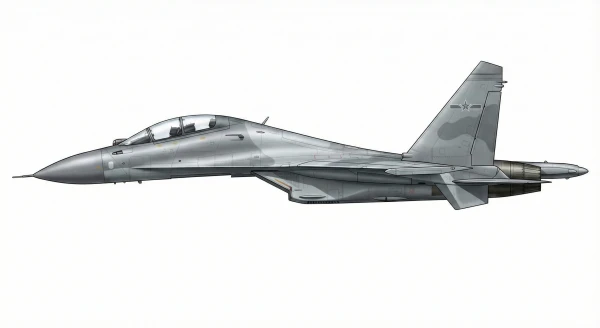
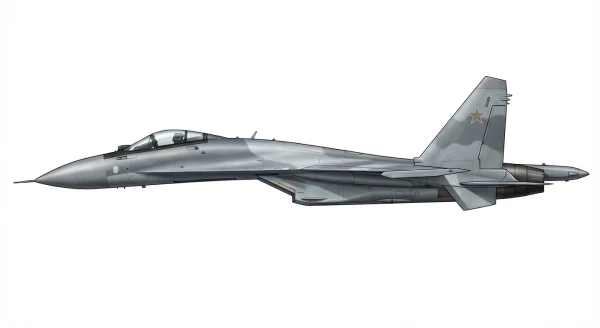
| J-16 Qianlong | Su-35 Flanker-E | |
|---|---|---|
| Origin country | 🇨🇳 China | 🇷🇺 Russia |
| Category | Combat Aircraft | Combat Aircraft |
| Manufacturer | Shenyang | Sukhoi |
| First flight | 1 January 2011 | 19 February 2008 |
| Year introduced | 2015 | 2014 |
| Number produced | 365 units | 151 units |
| Average unit price | -- | $83 million |
| Wing area | 62.0 m² | 62.0 m² |
| Wingspan | 14.7 m | 15.3 m |
| Height | 6.4 m | 5.9 m |
| Length | 21.9 m | 21.9 m |
| Maximum speed | 2120 km/h | 2400 km/h |
| Operational range | 4,000 km | 4,500 km |
| Service ceiling | 17,300 m | 18,000 m |
| Max. takeoff weight | 35,000 kg | 34,500 kg |
| Empty weight | 17,700 kg | 19,000 kg |
| Total thrust | 2 x 13,766 kgf | 2 x 14,000 kgf |
Detailed Comparison
The Shenyang J-16 and Sukhoi Su-35 trace their lineage to the Soviet Su-27, yet they reflect divergent evolutionary paths for the Flanker airframe. Beijing optimized the two-seat J-16 as a sensor-rich strike and electronic warfare platform integrated into a broader network, while Moscow engineered the single-seat Su-35 around thrust-vectoring kinematics and high-output, passively scanned radar for independent air-to-air missions.
Development and Design
Sukhoi iteratively modernized the Su-27 into the Su-35 through the 1990s and 2000s, prioritizing airframe reinforcement and AL-41F1S engines. This design path retained the Irbis-E Passive Electronically Scanned Array (PESA) radar, which emits high peak power but lacks the low probability of intercept and simultaneous multi-target engagement fidelity of modern systems. Shenyang bypassed PESA technology for the J-16, integrating an indigenous Active Electronically Scanned Array (AESA) radar and a digital glass cockpit adapted for two crew members. The inclusion of a Weapon Systems Officer (WSO) in the J-16 directly supports its doctrine: managing complex air-to-ground ordnance and operating the J-16D electronic warfare variant's wingtip pods, mirroring the US Navy's EA-18G Growler structure.
Specifications and Performances
The Su-35 dictates the kinetic envelope, achieving Mach 2.25 (2500 km/h) and a 3600 km range, outpacing the J-16's 2120 km/h top speed and 3000 km range. Sukhoi's thrust-vectoring nozzles grant the Su-35 high-alpha maneuverability in the within-visual-range (WVR) arena. However, modern air combat prioritizes the beyond-visual-range (BVR) kill chain, where the J-16's sensor suite dictates the engagement geometry. Paired with the PL-15 (~200 km range) and PL-17 (estimated 400 km range) air-to-air missiles, the J-16 out-ranges the Su-35's R-77-1 and older R-27 variants. The J-16’s 17,700 kg empty weight is 700 kg lighter than the Su-35 (18,400 kg), partially due to Shenyang's utilization of composite materials.
Deployment and usage
The Russian Aerospace Forces deployed the Su-35 in Ukraine and Syria. Combat data from Ukraine indicates Su-35s frequently fall victim to ground-based air defenses and struggle to establish localized air dominance, exposing limitations in electronic countermeasures. This combat record, compounded by CAATSA sanctions, collapsed its export market, leading to cancelled procurements:
- Indonesia abandoned a contract for 11 airframes in favor of the Rafale.
- Egypt cancelled an order for two dozen Su-35s after production began.
- Algeria ceased negotiations following the aircraft's performance reviews in Ukraine.
Conversely, the PLAAF retains the J-16 strictly for domestic use, with 365 units built. Beijing deploys it for airspace incursions in the Taiwan Strait and interceptions over the South China Sea. During a May 2022 intercept, a J-16 released chaff into a Royal Australian Air Force P-8A engine intake, indicating a shift toward aggressive tactical enforcement.
Conclusion
The J-16 holds the edge in modern, peer-level conflicts. Its AESA radar, two-seat configuration for EW workload management, and integration of long-range PL-15/PL-17 missiles provide a structural advantage in the BVR environment over the Su-35. The Su-35 retains an advantage in WVR engagements and raw kinematics, making it an effective interceptor against less advanced adversaries. However, Moscow’s reliance on PESA radar and older missile seekers renders the Su-35 outmatched against networked, stealth-supported forces, whereas the J-16 functions precisely as the heavy missile truck and EW enabler within such a network.