MQ-4 Triton vs MQ-9 Reaper
MQ-4 Triton vs MQ-9 Reaper at a glance — top speed 610 vs 300 km/h, range 15,200 vs 1,850 km, max takeoff weight 14,628 vs 4,760 kg, built 30 vs 300 units.
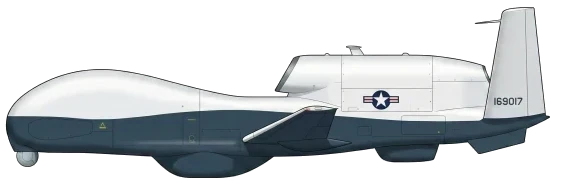
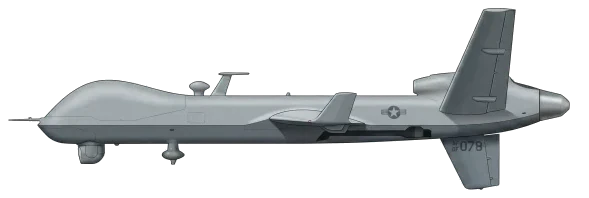
| MQ-4 Triton | MQ-9 Reaper | |
|---|---|---|
| Origin country | 🇺🇸 United States | 🇺🇸 United States |
| Category | Military Drones | Military Drones |
| Manufacturer | Northrop Grumman | General Atomics |
| First flight | 22 May 2013 | 1 February 2001 |
| Year introduced | 2018 | 2007 |
| Number produced | 30 units | 300 units |
| Average unit price | $180 million | $30 million |
| Wingspan | 39.9 m | 20.0 m |
| Length | 14.5 m | 11.0 m |
| Maximum speed | 610 km/h | 300 km/h |
| Operational range | 15,200 km | 1,850 km |
| Service ceiling | 16,800 m | 15,000 m |
| Max. takeoff weight | 14,628 kg | 4,760 kg |
| Empty weight | 6,781 kg | 2,223 kg |
Detailed Comparison
At $180 million per unit, the Northrop Grumman MQ-4C Triton operates as a theater-level maritime intelligence node, contrasting with the $30 million General Atomics MQ-9 Reaper, a tactical hunter-killer. The U.S. Navy procured the Triton in small numbers—approximately 30 airframes—to map vast ocean expanses, while the U.S. Air Force and allied nations have fielded over 300 Reapers for targeted strike and persistent surveillance in permissive airspace.
Development and Design
The Reaper evolved from the MQ-1 Predator to correct altitude and payload deficiencies, transitioning from a 115-horsepower piston engine to a 900-horsepower turboprop. This airframe enlargement allowed for a 3,750-pound external payload across wing hardpoints, shifting UAV doctrine from ISR-primary to strike-primary.
The Triton originated from the Broad Area Maritime Surveillance (BAMS) program as a heavily modified RQ-4 Global Hawk. Northrop Grumman reinforced the airframe, added de-icing, and installed lightning protection to allow descent through maritime cloud layers. Its core architecture centers on the AN/ZPY-3 X-band AESA radar and electronic support measures (ESM) suite, functioning as a flying data fusion center rather than a weapons platform.
Specifications and Performances
The performance metrics dictate their diverging operational concepts:
- The jet-powered MQ-4C cruises at 610 km/h with a 15,200 km range and a 14,628 kg maximum takeoff weight, tripling the Reaper's 4,760 kg MTOW.
- The MQ-9 operates at half the speed (300 km/h) and a lower ceiling (15,000 m versus the Triton's 16,800 m).
- Both aircraft offer similar endurance—30 hours for the Triton and 27 hours for the Reaper.
The Triton covers theater-scale maritime distances in a single sortie, whereas the Reaper's tighter 1,850 km combat radius anchors it to localized tactical grids.
Deployment and usage
The MQ-9 defined counterterrorism air operations post-9/11. Operating since 2007 in Iraq, Afghanistan, and the Horn of Africa, it executed thousands of close air support missions. Combat feedback exposes extreme vulnerability in contested environments; Houthis downed multiple Reapers over Yemen with legacy SAMs, and Russian aircraft intercepted units over the Black Sea and Libya.
The MQ-4C reached initial operational capability in 2018 with VUP-19. Operating from Guam, Japan, and Italy, it tracks naval movements across the Indo-Pacific. Like the Reaper, the Triton lacks survivability against integrated air defense systems (IADS), demonstrated when Iran destroyed a BAMS-D prototype over the Strait of Hormuz in 2019. This survivability deficit factored into Germany cancelling its signals intelligence Triton acquisition in favor of manned Bombardier Global 6000s.
Conclusion
The MQ-9 Reaper holds the absolute advantage in counterinsurgency and permissive strike environments. Its low cost, weaponized hardpoints, and exportability make it the most efficient platform for localized kinetic operations. The MQ-4C Triton wins in wide-area maritime domain awareness. In a Pacific naval deployment, the Reaper lacks the sensor reach and transit speed required, whereas the Triton's AESA radar maps adversary fleets across thousands of miles of ocean. Both platforms remain unsurvivable inside a modern kinetic kill web, limiting their application to peacetime ISR, gray-zone monitoring, and asymmetric warfare.