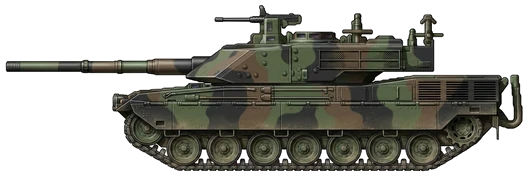
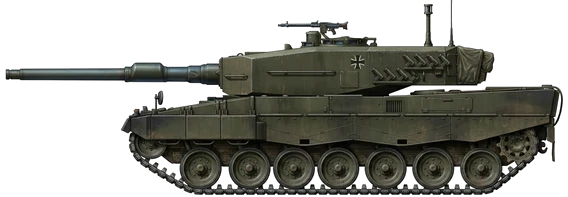
Italy’s Ariete, limited to a single domestic operator with roughly 200 hulls produced, contrasts heavily with the Krauss-Maffei Leopard 2, which numbers over 3,600 units across two dozen nations. While Berlin iteratively upgraded the Leopard 2 through successive generations (A4 to A8), Rome neglected the Ariete for decades until the recent C2 modernization contract.
Development and Design
The Leopard 2 entered service in 1979 following the collapse of the US-German MBT-70 project. Krauss-Maffei designed the platform around the MTU MB 873 1,500 hp diesel engine and the Rheinmetall 120 mm smoothbore. The Consorzio Iveco-Fiat OTO Melara developed the Ariete later, completing trials in 1989 and starting deliveries in 1994. Italy prioritized a lower combat weight—54 tons compared to the Leopard’s 62.5-ton baseline—to navigate the country's older bridges and mountainous infrastructure. While the Leopard 2 evolved into a widely exported architecture, the Ariete failed to secure foreign buyers, notably losing a Brazilian bid due to weight restrictions.
Protection and Firepower
Both tanks mount 120 mm NATO-standard smoothbore guns. The Leopard 2 transitioned to the longer, higher-velocity Rheinmetall L/55 on newer variants, while the Ariete retains its original OTO Breda 44-caliber equivalent. The Leopard 2 stores 15 rounds in a turret bustle with blow-off panels, though its 27-round hull rack lacks this protection—a layout vulnerability exposed by ATGM strikes in Syria. The Ariete mirrors this 15/27 stowage split. Frontal protection on the Leopard 2 from the A5 variant onward utilizes wedge-shaped spaced appliqué armor. The Ariete C1 relies on older steel-composite arrays, forcing the 2023 C2 upgrade to integrate modular PSO armor packages and electric turret drives to replace hazardous hydraulic systems.
Mobility and Logistics
Speed: The Leopard 2 reaches 70 km/h via its 1,500 hp MTU engine, whereas the Ariete C1 tops out at 65 km/h on a 1,275 hp Fiat MTCA V12.
Range: The Ariete travels 500 km on a single tank, exceeding the Leopard 2's 340 km range.
Upgrades: The C2 modernization integrates a 30.1-liter Iveco Vector 12 engine to offset the weight of new armor.
The Leopard 2 utilizes a massive multinational supply chain across Europe. The Ariete relies entirely on domestic Italian industry, creating a localized supply line that limits economies of scale.
Deployment and Combat Record
Leopard 2s have recorded extensive combat hours. Canadian and Danish units took IED hits in Afghanistan. Turkish 2A4s suffered losses from Kornet ATGMs in Syria due to exposed flanks and static deployment tactics. In Ukraine, 2A4s and 2A6s have engaged in continuous operations against mines and Lancet loitering munitions, prompting Ukrainian crews to retrofit Kontakt-1 reactive armor. The Ariete has zero combat history, operating strictly in domestic training and multinational exercises.
Conclusion
The Leopard 2 holds a definitive advantage in high-intensity combat. Its iterative armor configurations, L/55 gun lethality, and active multinational production line provide survivability and sustainment that the Italian platform cannot match. The Ariete C2 serves purely as a domestic stopgap. Its lighter weight facilitates transit over restrictive Italian infrastructure, but it remains under-armored and structurally isolated by the economics of a single-nation fleet.
The Leopard 2 is faster with a maximum road speed of 70 km/h compared to the Ariete 2's 65 km/h.
Which has longer operational range, the Ariete 2 or Leopard 2?
The Ariete 2 has a longer operational range at 500 km compared to the Leopard 2's 340 km.
Which is heavier, the Ariete 2 or Leopard 2?
The Leopard 2 is heavier at 62.5 tons combat weight compared to the Ariete 2's 54.0 tons.
Which is larger, the Ariete 2 or Leopard 2?
The Leopard 2 is longer at 9.97 meters compared to the Ariete 2's 9.67 meters.
How many crew members do the Ariete 2 and Leopard 2 require?
Both the Ariete 2 and Leopard 2 require a crew of 4.
Which is more expensive, the Ariete 2 or Leopard 2?
The Leopard 2 is more expensive at approximately $29.0 million per unit compared to the Ariete 2 at $2.9 million.
Which has been built in greater numbers, the Ariete 2 or Leopard 2?
The Leopard 2 has been produced in greater numbers with 3,600 units compared to 90 units of the Ariete 2.
What are the main armaments of the Ariete 2 and Leopard 2?
The Ariete 2 is armed with 1 OTO-Breda 120mm smoothbore barrel (40 shells) gun while the Leopard 2 carries Rheinmetall 120 mm L/55 as its main armament.