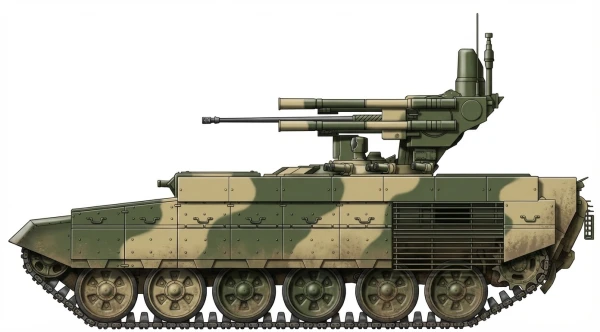
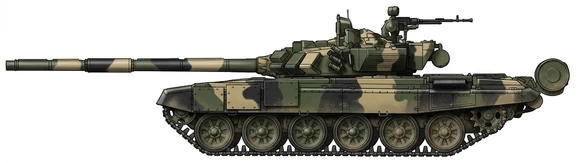
The BMPT Terminator and the T-90 share identical 48.0-ton chassis dimensions and baseline mobility metrics, yet fulfill mutually exclusive tactical doctrines. The Russian military's procurement divergence—4,000 T-90s built versus 33 BMPTs—quantifies their respective utility in standard force structures. While the T-90 functions as a standard main battle tank centered on a 125mm gun, the BMPT isolates anti-infantry and urban combat into a bespoke, high-elevation fire-support platform.
Development and Design
The T-90 originated in the late 1980s as Object 188, a cost-effective upgrade to the T-72B designed to bypass the expensive T-80 line. It relies on a three-man crew and an automatic carousel loader, a design choice maximizing armored volume but introducing structural vulnerabilities to ammunition cook-offs. Conversely, the BMPT emerged from the urban armor losses of the First Chechen War. It mounts a localized weapon station on the same T-72/T-90 hull, expanding the crew to five to manage multiple independent weapon systems. This divergence trades the MBT's large-caliber kinetic energy for multi-axis target suppression.
Protection and Firepower
Both vehicles utilize a base of composite and steel armor layered with explosive reactive armor. The T-90 dictates armor-on-armor engagements with its 2A46M-5 125mm smoothbore gun and laser beam-riding AT-11 missiles. The BMPT sacrifices the main gun for volume of fire, utilizing twin 30mm 2A42 autocannons (850 rounds), dual grenade launchers, and four 130mm Ataka-T anti-tank missiles. The Terminator elevates its autocannons to 45 degrees, allowing engagement of top-floor urban targets or low-flying drones, correcting a persistent blind spot caused by the T-90's restricted turret elevation.
Mobility and Logistics
Built on shared mechanical foundations, both platforms achieve a maximum speed of 60.0 km/h and an operational range of 550 km.
The T-90 operates the V-92S2F diesel engine, matched by the BMPT's 1000 hp diesel power plant.
Maintenance lines for both vehicles overlap heavily with existing T-72 fleets, simplifying supply chains for export users.
The BMPT's five-man crew strains personnel requirements in mechanized battalions compared to the T-90's three-man standard.
Deployment and Combat Record
The T-90 has sustained massive deployment across Syria, Nagorno-Karabakh, and Ukraine. Combat data from 2022-2024 confirms extreme vulnerability to top-attack munitions and FPV drones, frequently resulting in catastrophic ammunition detonation. The BMPT saw limited deployment in Ukraine, specifically in the Sievierodonetsk urban fighting and the Svatove-Kreminna forests. Visual evidence confirms BMPTs suppressed infantry in tree lines but remained equally vulnerable to artillery and FPV strikes once tracked, proving that removing the 125mm gun does not inherently increase chassis survivability.
Conclusion
The T-90 retains the edge in mechanized maneuver warfare and export viability. At $4.5 million per unit, it provides a baseline kinetic capability that the international market demands. The BMPT Terminator is an over-specialized asset. While it solves the specific problem of high-angle urban engagements, its niche utility does not justify the procurement cost of fielding a separate vehicle class. Modern mechanized forces increasingly prefer equipping standard infantry fighting vehicles with programmable air-burst ammunition rather than committing main battle tank chassis to localized infantry support tasks.