T-14 Armata vs T-90
T-14 Armata vs T-90 at a glance — weight 55,000 vs 48,000 kg, top speed 90 vs 60 km/h, range 500 vs 550 km, crew 3 vs 3.
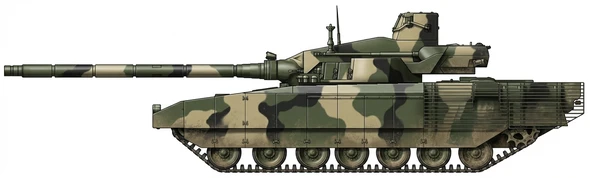
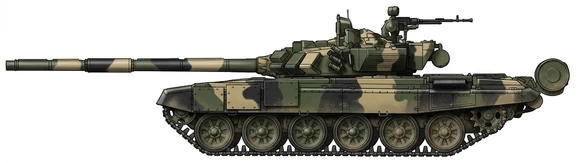
| T-14 Armata | T-90 | |
|---|---|---|
| Origin country | 🇷🇺 Russia | 🇷🇺 Russia |
| Category | Main Battle Tank | Main Battle Tank |
| Type | Main battle tank | Medium Main Battle Tank |
| Manufacturer | Uralvagonzavod | Malyshev HMB Plant |
| Number produced | -- units | 4,000 units |
| Estimated unit price | $4.5 million | $4.5 million |
| Combat weight | 55.0 tons | 48.0 tons |
| Maximum speed | 90 km/h | 60 km/h |
| Operational range | 500 km | 550 km |
| Length | 10.70 m | 9.63 m |
| Width | 3.50 m | 3.78 m |
| Height | 3.30 m | 2.22 m |
| Crew | 3 | 3 |
| T-14 Armata | T-90 | |
|---|---|---|
| Main armament | 2A82-1M 125 mm smoothbore cannon | 2A46M-5 125 mm smoothbore gun |
| Secondary weapon | 12.7 mm Kord machine gun (6P49) | 12.7mm Kord Heavy machine gun |
| Engine | 12N360 Twin Turbo Diesel 1,100 kW (1,500 hp) | V-92S2F |
Detailed Comparison
Russia's armored warfare doctrine currently relies on two platforms with identical stated unit costs of $4.5 million but vastly different operational realities. The T-90 operates as the backbone of Russian mechanized forces with 4,000 units built, iterating on a Cold War-era chassis. The next-generation T-14 Armata is a clean-sheet design that remains stalled in limited production, relegated to testing and rear-echelon evaluations.
Development and Design
The T-90 originated in 1992 as Object 188, a cost-effective evolution of the T-72B that retained existing Soviet hull architectures to maximize production efficiency. The T-14, introduced publicly in 2015 following the aborted T-95 project, abandons this legacy paradigm. It isolates its three-man crew in a frontal armored capsule and utilizes an entirely unmanned turret, directly addressing the crew survivability deficit inherent in the T-90's hull-stored ammunition carousel.
Protection and Firepower
Both tanks mount 125mm smoothbore guns fed by autoloaders, but their capabilities differ heavily:
- The T-90 mounts the 2A46M-5, firing standard APFSDS and AT-11 Sniper missiles. Its ammunition sits unshielded directly beneath the crew.
- The T-14 uses the 2A82-1M, accommodating longer, higher-penetration Vacuum-1 APFSDS rounds, with all ammunition isolated in the unmanned turret.
The T-90 relies on steel-composite layers and Kontakt-5 or Relikt explosive reactive armor (ERA). The T-14 layers Malachit dual-ERA and the Afganit active protection system (APS), utilizing millimeter-wave radar for hard-kill intercepts. While the T-14 provides superior kinetic protection for the crew, the unmanned turret trades situational awareness for armor; kinetic damage to its external optics leaves the isolated crew completely blind.
Mobility and Logistics
At 48 tons, the T-90 fits standard Russian rail logistics and military bridging equipment. Its V-92S2F diesel engine pushes it to 60 km/h, allowing straightforward field maintenance established over three decades. The 55-ton T-14 uses a 1,100 kW 12N360 twin-turbo diesel and a 12-speed automatic transmission, yielding a 90 km/h top speed. This introduces a complex hydropneumatic suspension and a massive logistical footprint that frontline Russian repair battalions lack the tooling and training to support.
Deployment and Combat Record
The T-90 has a documented combat record spanning Dagestan, Syria, Nagorno-Karabakh, and Ukraine. In Ukraine, T-90 fleets have sustained extreme attrition from top-attack missiles, artillery, and FPV drones, frequently suffering catastrophic ammunition detonations resulting in total crew loss. The T-14’s combat record is functionally non-existent. After limited Syrian testing in 2020, its 2023 deployment to Ukraine was restricted to indirect fire before a rapid withdrawal, executed to avoid the political fallout of a destroyed unit.
Conclusion
The T-90 holds the definitive edge in protracted industrial warfare simply because it is a mature, producible platform. The T-14 conceptually solves the fatal "jack-in-the-box" flaw of Soviet-era autoloaders, but its reliance on complex subsystems and imported electronics makes it unmanufacturable at scale under current sanctions. Until Uralvagonzavod can mass-produce the Armata's thermal sights and APS components domestically, the T-14 is a parade asset, leaving the highly vulnerable but available T-90 to bear the burden of Russian armored operations.