How the Nimitz Class's Mk 7 Hydraulics and the Ford Class's Advanced Arresting Gear Stop a Landing Jet
Lockheed Martin said on November 19 that two F-35Cs made 122 arrested landings aboard the future USS John F. Kennedy using the Advanced Arresting Gear, the turboelectric system Ford-class carriers use where the Nimitz class has hydraulic Mk 7 engines.
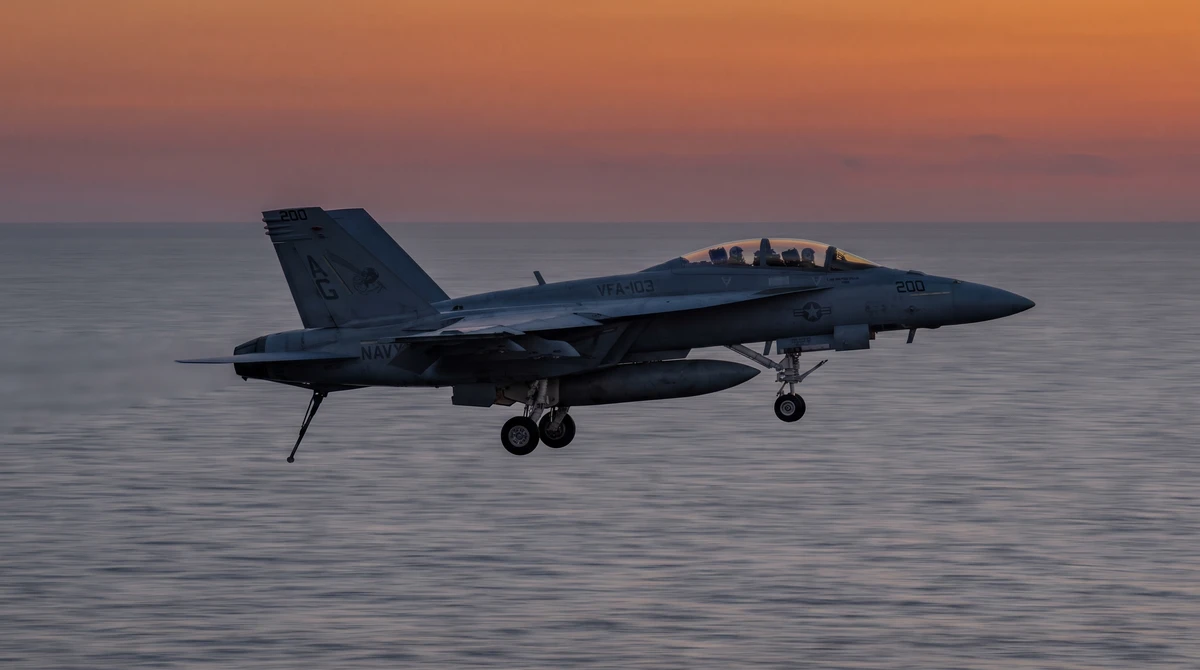
Lockheed Martin said on November 19, 2026 that two F-35Cs from Naval Air Station Patuxent River, Maryland, completed 34 flights over 11 days aboard the future USS John F. Kennedy (CVN-79), with 122 catapult launches and 122 arrested landings using the Electromagnetic Aircraft Launch System (EMALS) and the Advanced Arresting Gear (AAG). The company said the first recovery aboard took place on October 13, 2026, after shore-based trials that ran from January 2024 to May 2025, and that the Navy has now cleared the F-35C for operations across its entire fleet of aircraft carriers.
That fleet uses two different machines to stop a landing aircraft. A US Navy training manual says aircraft on a carrier are stopped within 350 feet after contacting the deck, where runways on land are 5,000 to 8,000 feet long. On the Nimitz class the work is done by the Mk 7 Mod 3, a hydraulic engine, and on the Ford class by AAG, which its maker General Atomics describes as a turboelectric system. GlobalMilitary.net data on the US Navy's carrier fleet lists eight Nimitz-class ships and USS Gerald R. Ford as active, Kennedy as fitting out, and Enterprise (CVN-80) and Doris Miller (CVN-81) on order.
The launch end of the flight deck was the subject of GlobalMilitary.net's explainer on steam and electromagnetic catapults. On the recovery end, the Pentagon's Director, Operational Test and Evaluation (DOT&E) has reported on AAG's reliability in documents dating from 2015 to fiscal 2024, and the Navy's fiscal 2026 budget book ties Kennedy's delivery date to the system's certification. The two ship designs are set side by side in a Ford and Nimitz class comparison.
The Mk 7 Mod 3 hydraulic arresting gear
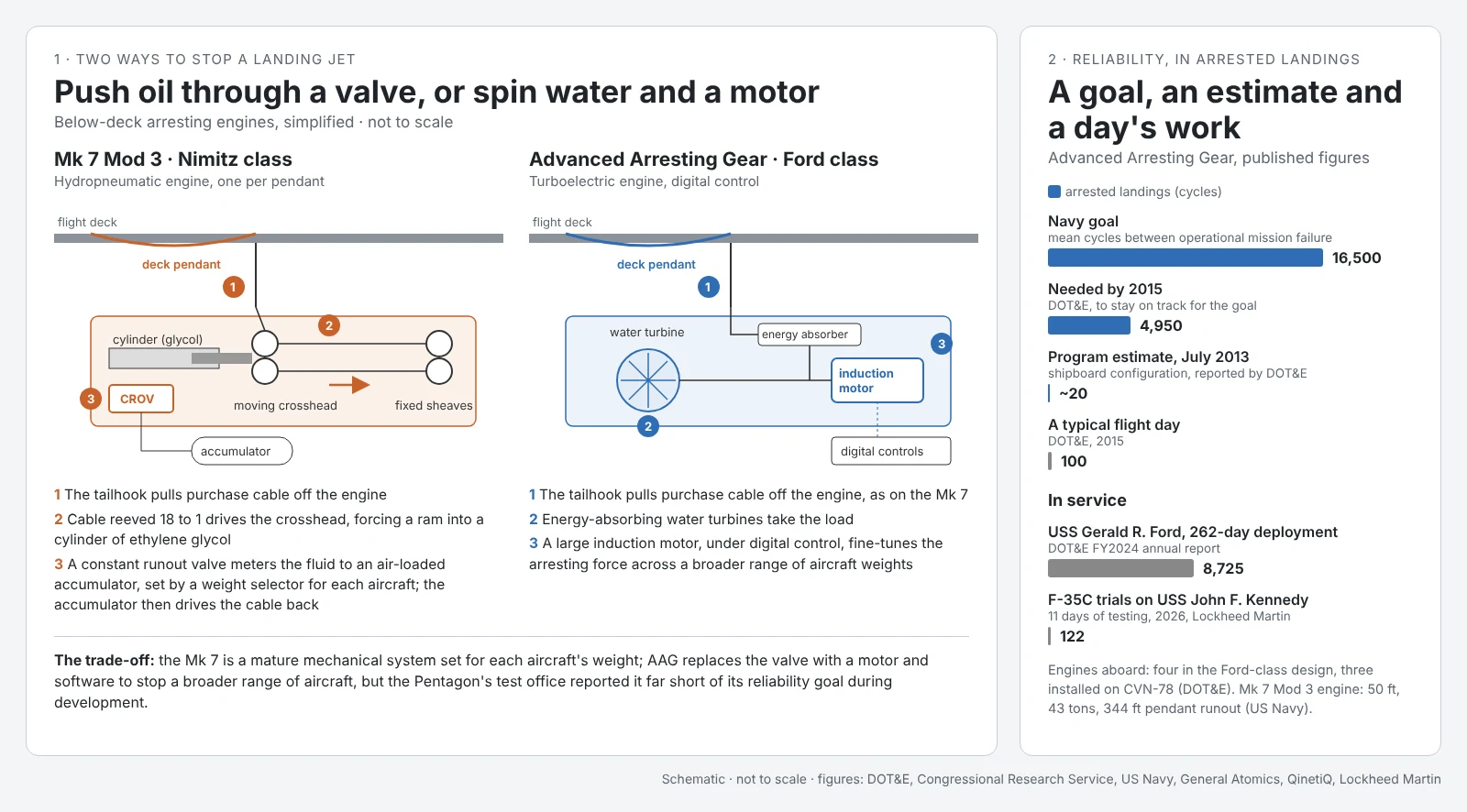
The Navy's Aviation Boatswain's Mate E training manual, NAVEDTRA 14310, describes the Mk 7 Mod 3 as a hydropneumatic system made up of an engine structure, a cylinder and ram assembly, a crosshead and fixed sheaves, a control valve system, an accumulator system, air flasks, and a sheave and cable arrangement. All pendant and barricade engines are Mk 7 Mod 3, according to the manual.
The sequence the manual sets out begins when the aircraft's tailhook engages a deck pendant spanning the landing area. The force is transferred to purchase cables reeved around a movable crosshead of sheaves and a fixed sheave assembly, and the pull forces a ram into a cylinder of pressurized hydraulic fluid, which is ethylene glycol. The fluid is forced out of the cylinder through a control valve that meters its flow to an accumulator until the aircraft is stopped.
That valve is the constant runout valve, which the manual places at the fixed-sheave end of the engine, where it controls the flow from the cylinder to the accumulator. The manual says the valve is designed to stop all aircraft with the same amount of runout regardless of their weight and speed, within the limits set in recovery bulletins, and that an aircraft weight selector adjusts the valve's initial opening for aircraft of different weight.
Retraction follows once the hook is disengaged, when, the manual says, a retract valve lets fluid be forced from the accumulator back into the cylinder, which forces the ram out and pulls the purchase cables back until the crosshead is in its battery position and the pendant is back in place on deck.
Table 3-1 of the manual gives the engine's main figures:
- Deck pendant runout of 344 feet, measured to the tailhook, and barricade runout of 388 feet.
- Maximum energy absorption of 47,500,000 foot-pounds.
- An arresting engine 50 feet long and weighing 43 tons, with a ram 20 inches in diameter and a reeving ratio of 18 to 1.
- Engine fluid of 380 gallons of ethylene glycol, or 560 gallons with the cooler, and sea water as the coolant.
- An accumulator with an initial working pressure of 400 pounds per square inch and a maximum of 650.
The Advanced Arresting Gear
General Atomics describes AAG as a modular design that combines energy absorbers, power conditioning equipment, and a turboelectric system with water turbines and an induction motor, to provide controlled deceleration across a broader range of aircraft. QinetiQ, which presents AAG among its maritime systems, says the system uses energy-absorbing water turbines coupled to a large induction motor for fine control of the arresting forces, and describes it as compatible with both Nimitz-class and Ford-class carriers.
Where the Mk 7 is set for each recovery through its weight selector and control valve, General Atomics says AAG has digital controls, built-in diagnostics and health monitoring. The company calls it a "three wire system" and says the design reduces maintenance, manpower, ship weight and energy use.
As with the Mk 7, what the gear may recover is fixed by Aircraft Recovery Bulletins, official Navy documents that give the authorized weights and engaging speeds for each aircraft type. Naval Air Systems Command (NAVAIR) said, in a statement reported by Naval News on August 13, 2019, that bulletins released on August 2, 2019 cleared AAG to recover the C-2A Greyhound, the E-2C and E-2D Hawkeye, the F/A-18E/F Super Hornet and the EA-18G Growler aboard USS Gerald R. Ford.
NAVAIR said that clearance followed more than 2,500 dead-load arrestments at the Jet Car Track Site and 1,420 manned aircraft arrestments at the Runway Arrested Landing Site, both at Lakehurst, New Jersey. The F-35C trials that Lockheed Martin reported followed the same order, with shore-based testing before the 122 arrested landings aboard Kennedy.
AAG reliability and the fourth engine
DOT&E told the Senate Armed Services Committee in a statement dated October 1, 2015 that testing at Lakehurst had uncovered deficiencies in major components and software that contributed to several redesigns of AAG since 2007. In December 2014, according to the same statement, the program acknowledged that the design did not meet service-life requirements and decided to redesign it.
The statement measured reliability in mean cycles between operational mission failure, where a cycle is the recovery of one aircraft and an operational mission failure means fewer than two AAG engines are available. DOT&E said the AAG program in July 2013 estimated shipboard reliability at about 20 cycles, against a Navy goal of 16,500, and that the figure should have been above 4,950 at that point to have a reasonable chance of reaching the goal. A typical day of flight operations requires 100 arrested landings, DOT&E said.
That number is a 2013 program estimate reported in 2015, not a current measurement. DOT&E's fiscal 2024 annual report, as reproduced in Congressional Research Service (CRS) report RS20643, updated on December 4, 2025, said the ship and its air wing completed 8,725 arrested landings with AAG during Ford's 262-day deployment, and that the office had not received enough data to update its reliability statistics. The same report said replacement parts and reliance on off-ship technical support remain an issue, and that the reliability and maintainability of Ford's EMALS and AAG continue to adversely affect sortie generation and flight operations, which it called the greatest risk to demonstrating effectiveness and suitability in initial operational test and evaluation (IOT&E).
The Navy originally planned four AAG engines on Ford, and only three were expected to be installed, DOT&E said in 2015. Its fiscal 2024 report, as reproduced by CRS, said the fourth engine was incorporated into the design but not installed, as a cost saving. Fitting it would improve reliability and availability, improve the pilot boarding rate and restore a redundant capability to rig the barricade if an AAG engine fails, which the current configuration does not support, according to the report, which added that the Navy is using IOT&E to inform a decision on whether to retrofit it.
The Navy's fiscal 2026 shipbuilding budget book, quoted by CRS, says "the CVN 79 delivery date shifted from July 2025 to March 2027 (preliminary acceptance TBD) to support completion of Advanced Arresting Gear (AAG) certification and continued Advanced Weapons Elevator (AWE) work."
A National Security Presidential Memorandum signed on August 13, 2026 asked for a plan to replace EMALS and the Advanced Weapons Elevators with steam and hydraulic systems on CVN-81, the future USS Doris Miller. The memorandum did not name the arresting gear.
More News
All news →
Pentagon Warns Canada on Mixed Fighter Fleet; 13 of 16 F-35 Operators Fly a Second Combat Type
A Pentagon fact sheet released on November 23 says a mixed fighter fleet could worsen Canada's personnel shortages, the Associated Press reported; GlobalMilitary.net data shows 13 of the 16 air forces flying the F-35 keep another combat type, none of them the Gripen.
How Crewed Minehunters and Drone Motherships Find and Destroy Sea Mines
The three motherships the UK said on November 12 it will buy are meant to stay outside the minefield and send uncrewed boats, towed sonars and underwater vehicles in, where today's non-magnetic minehunters and their divers go themselves.
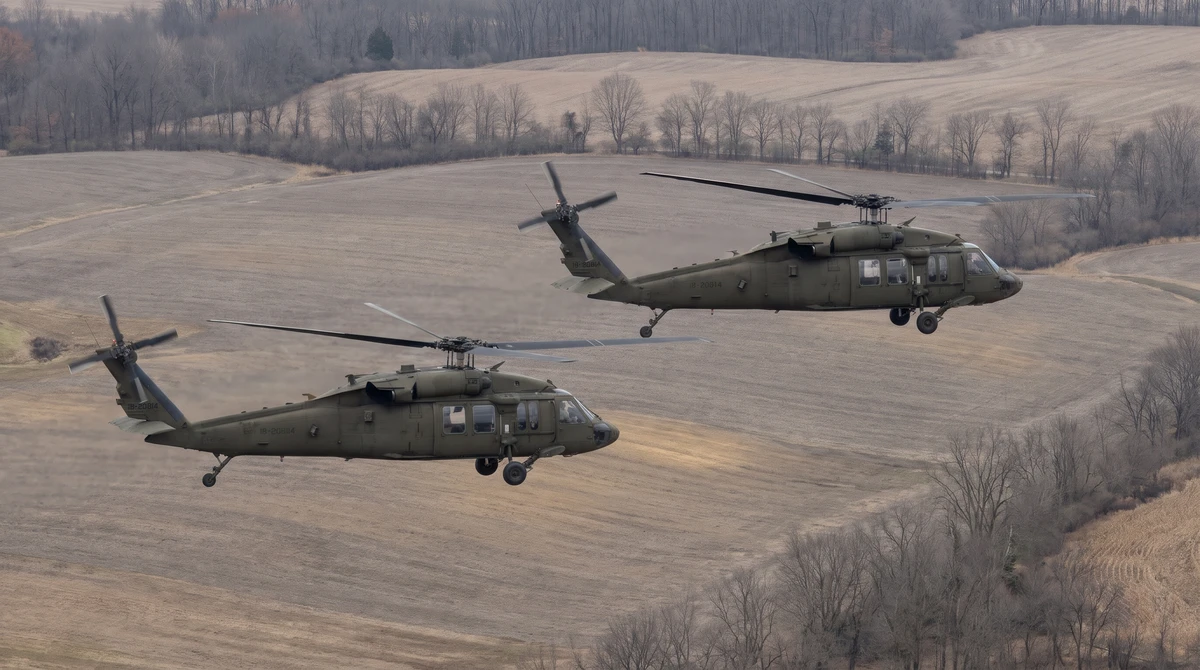
US Army Aviation, Larger Than All but Two Foreign Militaries' Air Fleets, Sees Class A Flight Mishaps Double
The Army's aviation branch fields 4,263 aircraft and about one in five of the world's military helicopters on GMN's count, and its own safety newsletter lists 10 Class A flight mishaps in fiscal 2026, up from five, as the under secretary says readiness is below goal.

Senate Energy Bill Funds a New B94 Nuclear Bomb at $77.1 Million, Cuts SLCM-N Warhead by 59%
The Senate Appropriations Committee's fiscal 2027 Energy and Water Development bill, released on November 12, 2026, opens a B94 line at $77.108 million and reduces the W80-5 warhead for the nuclear sea-launched cruise missile from $186.0 million to $76.9 million.

Senate FY2027 Defense Bill Adds F-35s and a Second Destroyer, Cuts F-15EX Buy From 24 to 18
The Senate Appropriations Committee's fiscal 2027 defense bill, released on November 16, 2026, funds more F-35s, C-130Js and a second DDG-51 than requested, and fewer F-15EX, P-8A, KC-130J and E-2D aircraft, its explanatory statement shows.
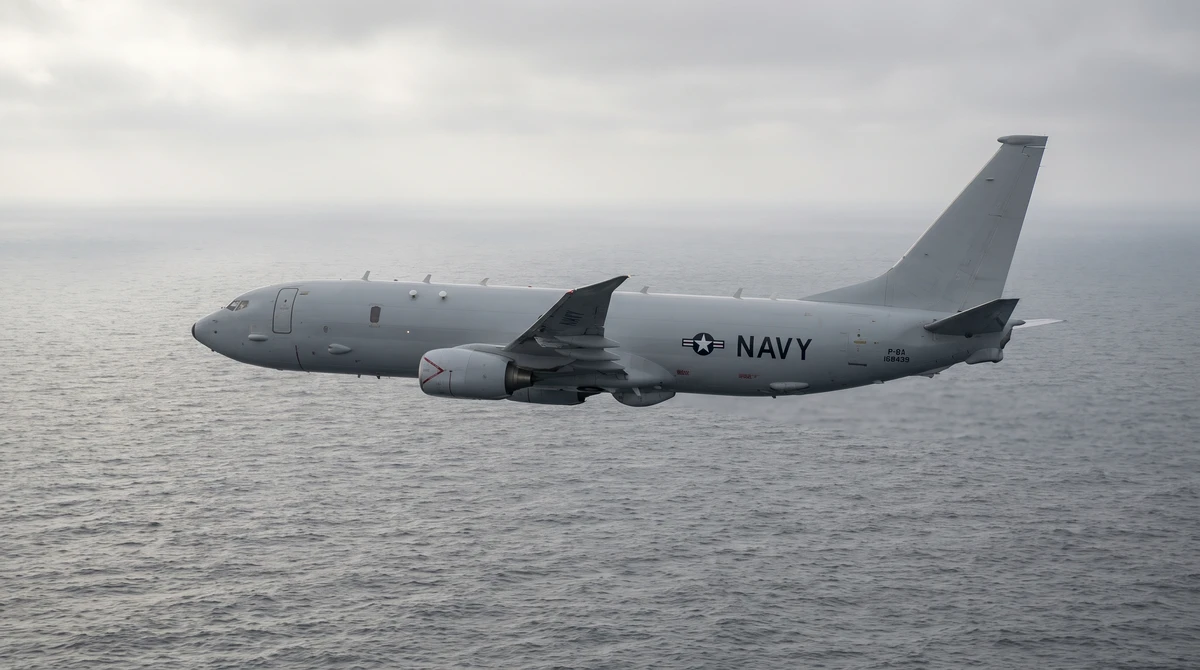
Senate Appropriators Fund 4 of 12 P-8A Poseidons as Worldwide Fleet Stands at 171 Aircraft
The Senate Appropriations Committee's fiscal 2027 defense bill, released November 16, 2026, funds four of the 12 P-8A Poseidons the US Navy requested, a cut to an aircraft GlobalMilitary.net's inventory data counts at 171 in service in eight countries.