Why 52-Caliber Howitzers Outrange the M777 as the UK and US Move to Make More 155mm Barrels
As the UK restarted 155mm barrel production on October 22, 2026 and the US Army sought new makers for its M777 and Paladin tubes, the reach of a howitzer comes down to barrel length in calibers first, then to what the shell itself can do.
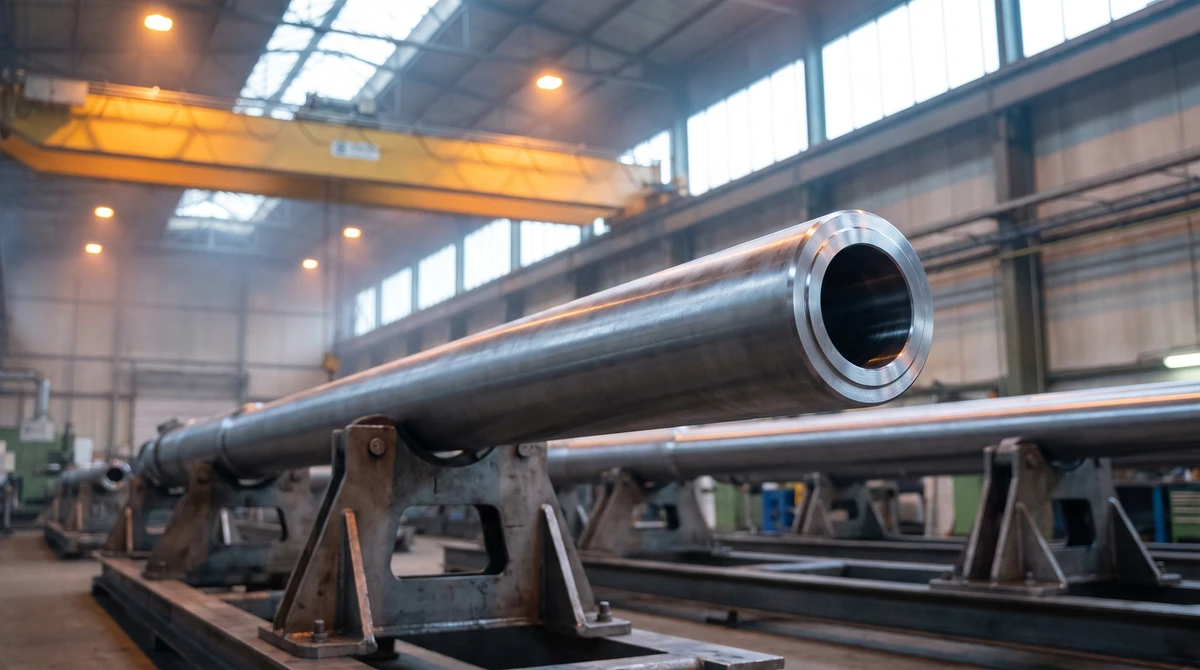
Within 48 hours, two allies moved on making their own howitzer barrels. On October 22, 2026 the UK Ministry of Defence announced that Rheinmetall UK had begun producing barrels and breeches for 120mm and 155mm weapons at its gun hall in Telford, "including for RCH 155 and future artillery platforms", the return of large-caliber weapon manufacturing to the UK after twenty years, the ministry said. A day earlier, US Army Contracting Command at Rock Island posted a Sources Sought notice on SAM.gov, "for planning purposes only", for domestic makers of the Paladin's M284A2 cannon tube and the M777A2's M776 tube, asking for a path to 10 tubes a month within 36 months. Defense News reported that Watervliet Arsenal in New York is the Army's only large-caliber tube maker, and that a 2024 Army budget document put the demand created by the M777's use in Ukraine at more than 30 tubes a month.
On October 12 the US Army accepted the first XM1776, a wheeled 155mm howitzer derived from Hanwha's K9, to replace the M777 in select units. Both fire 155mm shells, yet with base-bleed rounds the K9 reaches 41 km and the M777 30 km, as the K9 and M777 side by side show. The explanation is the barrel first, the shell second.
Barrel length
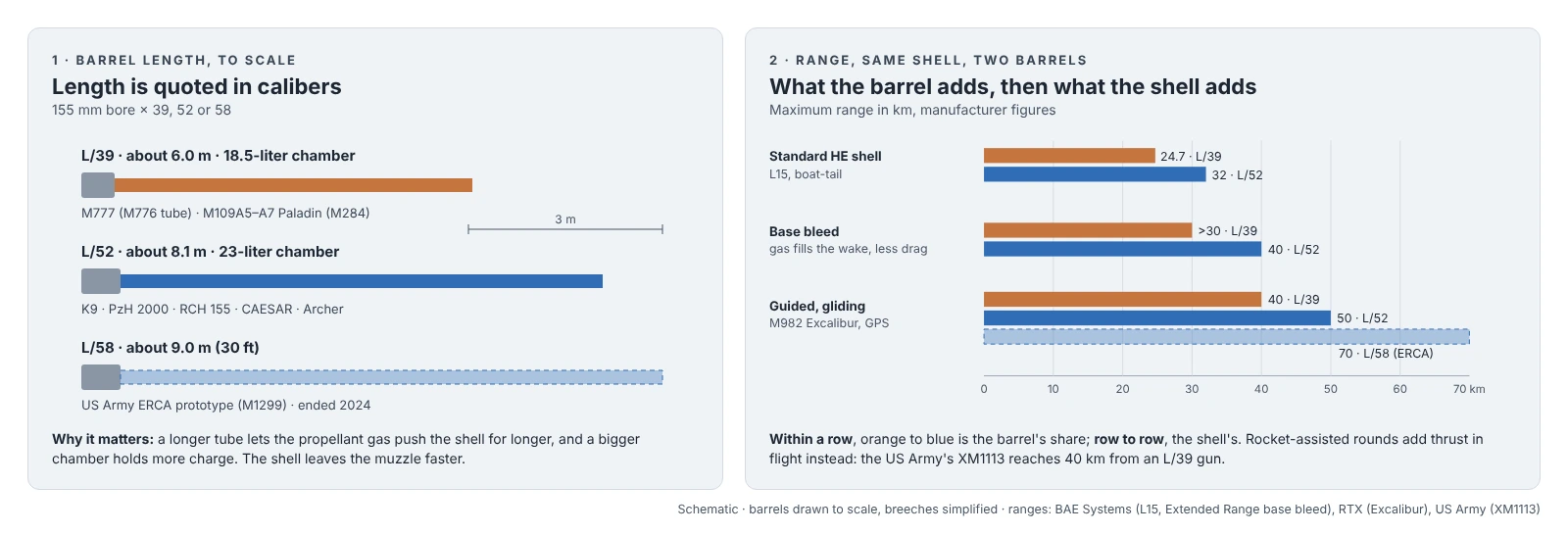
A barrel's length is quoted in multiples of its bore diameter. A "39-caliber" 155mm barrel is 39 times 155 mm, about 6 m long; a 52-caliber barrel is about 8 m; a 58-caliber one about 9 m. The lengths are written L/39 and L/52. The shell's base acts as a piston pushed by the propellant gas; a longer barrel keeps the gas pushing for longer, so the same pressure limit yields a higher muzzle velocity, and more propellant can be burned usefully. The M777, an L/39 gun, fires at about 827 m/s with its top charge; the K9 Thunder's 52-caliber CN98 gun fires the NATO reference shell at about 945 m/s from a larger chamber.
That chamber is the second difference. The NATO Joint Ballistics Memorandum of Understanding standardizes 155mm guns so that shells and charges interchange between them. It sets chamber volumes of 18.5 liters for L/39 guns and 23 liters for L/52 guns, and allows a maximum of five propelling charge modules in the shorter gun and six in the longer one. It does not standardize every parameter, and a compliant shell and charge can still fail to work with a compliant gun. BAE Systems shows the effect of the longer barrel in its February 2026 ammunition brochure: the L15 high-explosive shell, the standard boat-tail round that serves as the JBMoU reference, reaches 24.7 km from an L/39 gun and 32 km from an L/52 gun. Same shell, two barrels, 24.7 against 32 km.
The 39-caliber barrel was itself an upgrade: the original 1960s M109 carried a 23-caliber gun, and the M109A1, fielded in 1973, moved to 39 calibers and 18.1 km. The M109A5 through A7 carry the 39-caliber M284, and the M777, with its M776 tube, is 39-caliber too, with more than 1,200 ordered by US, Canadian, Australian and Indian forces, according to BAE Systems. The US Army's largest operational caliber remains the 155mm L/39. The newer European and Korean guns use 52-caliber barrels: the German PzH 2000, whose Rheinmetall gun is chromium-lined over its entire 8 m length; the French CAESAR, designed to the then-emerging NATO 52-caliber standard in place of the 39-caliber barrels of GIAT's earlier guns; the Swedish Archer, a fully automated L/52 gun-howitzer on a 6x6 chassis; the South Korean K9; and the RCH 155, which takes the PzH 2000's L/52 gun into a remote-controlled module and is the platform the UK ministry ties the Telford output to. Rheinmetall gives the PzH 2000 up to 30 km with NATO projectiles and up to 40 km with range-enhanced ones.
Base bleed, rocket assistance and guided shells
The barrel sets the muzzle velocity; the shell decides the rest. Three designs stretch the flight.
- Base bleed. Most of a shell's drag, 50 to 60 percent, comes from its nose; the low-pressure zone behind its base is the other large component. A base bleed unit is a small gas generator in the base that fills that zone, cutting drag with little or no thrust, and typically adds about 20 to 35 percent to range. It was developed in Sweden in the mid-1960s. BAE Systems' Extended Range shell, the L15 with a screw-on base bleed unit, reaches more than 30 km from an L/39 gun and 40 km from an L/52 gun, with "greater than 40 km achieved" in qualification. The US Army describes its own base bleed motor as one that "burns right out of gun".
- Rocket assistance. A rocket-assisted projectile carries a motor that adds thrust. When NATO required corps artillery to reach at least 30 km, nearly all member armies met it with rocket-assisted rounds in their 155mm guns. The Army says the XM1113's motor "doesn't burn until it gets the top of its flight, before it boosts and increases the velocity of the projectile"; its maximum range is 40 km, reached from the M109A7's 39-caliber barrel.
- Guided gliding. The M982 Excalibur, built by RTX's Raytheon with BAE Systems Bofors, is GPS-guided and glides on fins after the top of its trajectory. RTX gives its reach as 40 km from 39-caliber artillery, 50 km from 52-caliber and 70 km from 58-caliber, with impact "less than two meters" from the target. In June 2012 a US Marine Corps M777 battery fired it at 36 km in Helmand Province, Afghanistan, the longest operational shot in the gun's history.
Together the two variables give the ladder. From the M777: M795 high-explosive 23.5 km, M795E1 base bleed 30 km, Excalibur 40 km. From the Paladin's M284: high-explosive 21 km, rocket-assisted 30 km, Excalibur 40 km. From the K9: M107 high-explosive 18 km, M549A1 rocket-assisted 30 km, K307 base bleed 41 km, and the K315, which combines base bleed with rocket assistance, 54 km from the K9A1. CAESAR's extended-range full-bore shells reach 40 km.
The 58-caliber attempt and barrel wear
A longer tube still was the next step. The US Army's Extended Range Cannon Artillery prototype, the M1299, replaced the Paladin's 39-caliber tube with a 58-caliber, 30-foot one, paired with the XM1113 and a supercharged propellant. On December 19, 2020 at Yuma Proving Ground, Arizona, it hit a target 43 miles (70 km) away with an Excalibur shell, Defense News reported. On March 8, 2024 the Army's acquisition chief said "We concluded the prototyping activity last fall" and that the gun was "not successful enough to go straight into production"; Defense News reported that early testing had shown excessive wear on the tube after a relatively small number of rounds. The Army would evaluate existing industry systems instead and keep developing the ERCA munitions.
Wear is the price of the barrel lever: longer barrels and bigger charges mean higher pressures and velocities, and both erode the bore faster. Tube life is counted in equivalent full charges; the K9's CN98 is rated for 1,000. The US notice asks prospective makers about autofrettage, rifling and chrome bore coating; the PzH 2000's gun is chromium-lined throughout. The more than 30 M777 tubes a month that the 2024 budget document attributed to Ukraine is what that wear looks like at the scale of a war, with a single arsenal making them, according to Defense News. The 58-caliber idea persists: South Korea's Agency for Defense Development began research in September 2022 on a 58-caliber K9 variant aiming beyond 80 km, scheduled to complete in August 2027, and in December 2025 Hanwha Aerospace and the US Army's DEVCOM Armaments Center agreed to integrate the ERCA 58-caliber tube on a K9A1 for tests.
The shell can stretch a gun's reach, and guidance can make that reach precise, but the barrel sets the starting point: the same L15 shell flies 24.7 km from a 39-caliber tube and 32 km from a 52-caliber one. Every one of those kilometers starts in a tube that wears with each full charge, and the countries with the most self-propelled howitzers and the armies still firing towed ones need to know not only who builds their guns but who can keep making the barrels.
More News
All news →
F-35 at 25: The 2001 Joint Strike Fighter Award Promised 3,000 Jets and a First Delivery in 2008
Twenty-five years after the Pentagon chose the Lockheed Martin-led team to build the Joint Strike Fighter on October 26, 2001, Lockheed counts more than 1,375 F-35s fielded, the Joint Program Office lists 20 partner and customer nations, and production lots 20 and higher remain under negotiation.
USS Pinckney Begins US Navy's First SPY-6(V)4 Radar Installation on an Arleigh Burke Destroyer
The US Navy said on October 22 that the Arleigh Burke-class destroyer USS Pinckney (DDG 91) has entered a Depot Modernization Period at General Dynamics NASSCO in San Diego, the service's first installation of the SPY-6(V)4 radar and HESC cooling plants under the DDG MOD 2.0 program.
RAF Typhoons Escort French Rafales in First Joint Nuclear Strike Exercise
Royal Air Force Typhoons flew alongside French Rafales simulating a nuclear strike over the Mediterranean on 20-21 October, the first British participation in a French nuclear air exercise, the UK Ministry of Defence said on 23 October.
UK Restarts Tank and Howitzer Barrel Production as US Army Seeks New 155mm Tube Makers
Rheinmetall UK has begun making 120mm and 155mm barrels in Telford, the Ministry of Defence said on 22 October, a day after a US Army contracting command posted a market survey for domestic makers of Paladin and M777 cannon tubes.
Pentagon and Lockheed Martin Unveil 10-Year F-35 Framework for 850 US Jets, Pending Congress
The Department of War and Lockheed Martin announced on October 22 a framework agreement covering 850 US F-35s over 10 years at a steady 156 aircraft a year, an arrangement that requires multiyear authority and appropriations from Congress before any contract is awarded.
US Air Force Wants 1,509 Combat-Coded Fighters by 2035 as F-35 Share Rises to About 40%
The US Air Force told Congress on October 16, 2026 that it needs 1,509 combat-coded fighters by 2035; GlobalMilitary.net sets the report's approximate type shares against its own count of 1,816 USAF F-16s, F-35As, F-15s and F-22s.