2S1 Gvozdika
Summary
| Origin country | 🇷🇺 Russia |
| Category | Self-Propelled Artillery |
| Sub-type | Self-propelled howitzer |
| Manufacturer | Kharkiv Tractor Plant |
Technical specifications
| Crew | 4 (commander, loader, gunner, driver) personnels |
| Range | 500 km |
| Mass | 16.0 tons |
| Height | 2.73 m (9.0 ft) |
| Width | 2.85 m (9.4 ft) |
| Length | 7.26 m (23.8 ft) |
| Max. speed | 60 km/h (37 mph) |
| Engine | YaMZ-238N V-8 diesel, 300 hp |
| Weapon 1 | 122 mm 2A18 howitzer |
| Weapon 2 | 12.7 mm machine gun |
Historical operators
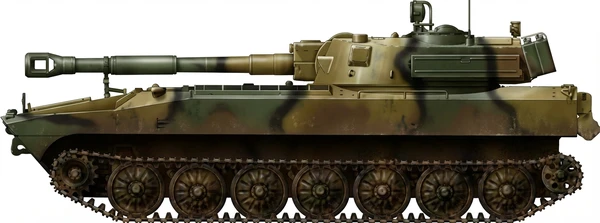
Profile of 2S1 Gvozdika
Description
The 2S1 Gvozdika is a Soviet self-propelled howitzer that entered service in 1972. Developed in Kharkiv, Ukrainian Soviet Socialist Republic, the vehicle is based on the MT-LBu multi-purpose chassis. A first prototype was completed in 1958, and the system was first observed publicly during a Polish Army parade in 1974. Designated M1974 by the U.S. Army, the vehicle was produced in Soviet, Polish, and Bulgarian state factories.
The 2S1 features an all-welded turret mounted on a hull divided into three main sections: a driver's compartment at the front left, an engine compartment at the front right, and a fighting compartment at the rear. The crew consists of a driver, commander, loader, and gunner. The suspension uses seven road wheels on each side, and the running gear can be fitted with different track widths to allow operation in snow or swamp conditions. The vehicle is fully amphibious with minimal preparation, using its tracks for propulsion in water. Standard systems include NBC protection and infrared night-vision equipment.
Primary armament consists of a 122 mm 2A18 howitzer, a variant of the towed D-30. The gun is equipped with a power rammer, a double-baffle muzzle brake, and a fume extractor. It is capable of firing high-explosive (HE), armor-piercing HE, HE/RAP, flechette, leaflet, and chemical rounds. Modernized variants have introduced further capabilities, such as the Polish 2S1T featuring a digital fire control system and the Russian 2S34 Khosta, which replaces the 122 mm gun with a 120 mm gun-mortar. Other variants include the Romanian OAPR model 89 and the Iranian Raad-1.
The 2S1 was originally deployed in large numbers within Soviet tank and motorized rifle divisions. It has been widely exported and remains in service with numerous operators across Europe, Asia, Africa, and the Middle East, including Russia, Ukraine, Poland, Finland, Algeria, and Serbia.
The vehicle has an extensive combat history. It was utilized during the Soviet-Afghan War, the Iran-Iraq War, the Gulf War, and the Iraq War. It saw action throughout the Yugoslav Wars and both Chechen Wars. More recently, the 2S1 has been deployed in the Russo-Georgian War, the Syrian Civil War, the Second Nagorno-Karabakh War, and the Russo-Ukrainian War. As of 2025, several nations continue to modernize the platform or provide it as military aid, including the recent addition of systems to Ukrainian inventories via international donations.