2S1 Gvozdika
The 2S1 Gvozdika is a Soviet 122mm self-propelled howitzer introduced in 1971, featuring a tracked chassis with amphibious capabilities. Key figures: weight 16 t, top speed 60 km/h, range 500 km, built 10,000. In service with 22 armies — Russia (400), Poland (206), Vietnam (150) and 19 others.
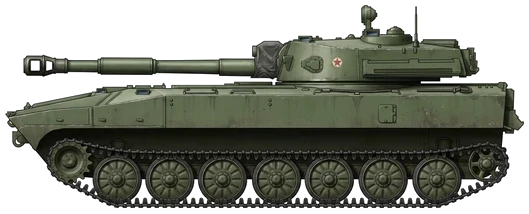
| Sub-type | Self-propelled howitzer |
| Crew | 4 (commander, loader, gunner, driver) personnels |
| Range | 500 km |
| Mass | 16.0 tons |
| Height | 2.73 m (9.0 ft) |
| Width | 2.85 m (9.4 ft) |
| Length | 7.26 m (23.8 ft) |
| Max. speed | 60 km/h (37 mph) |
| Engine | YaMZ-238N V-8 diesel, 300 hp |
| Weapon 1 | 122 mm 2A18 howitzer |
| Weapon 2 | 12.7 mm machine gun |
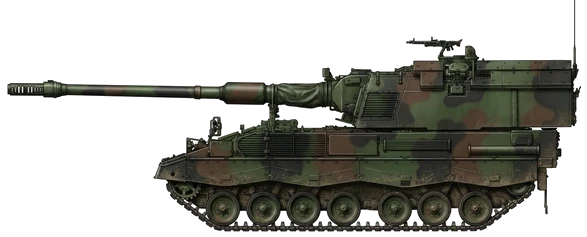
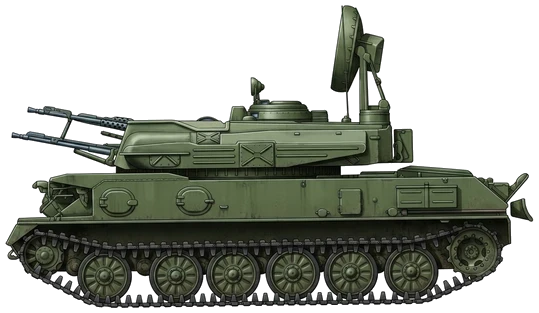
Description
The 2S1 Gvozdika ("Carnation") is a Soviet self-propelled howitzer developed in Kharkiv, Ukrainian SSR, with a first prototype completed in 1958. It entered service with the Soviet Army in the early 1970s and was first observed publicly at a Polish Army parade in 1974, receiving the U.S. Army designation M1974. Its GRAU index is 2S1; the alternative Russian designation SAU-122 is also used. Production was carried out in Soviet, Polish and Bulgarian state factories, and the type was fielded on the scale of 72 vehicles per tank division and 36 per motorised rifle division.
The vehicle is built on the MT-LBu multi-purpose chassis with seven road wheels per side. The hull interior is divided into a driver's compartment on the left, an engine compartment on the right, and a rear fighting compartment holding the commander on the left, loader on the right and gunner forward, beneath an all-welded turret. Armament is the 122 mm 2A18 howitzer, derived from the towed D-30, fitted with a double-baffle muzzle brake, fume extractor and power rammer. Ammunition types include HE, HE/RAP, armour-piercing HE, flechette, chemical and leaflet rounds. The 2S1 is NBC-protected and equipped with infrared night-vision. It is amphibious with minimal preparation and is propelled in water by its tracks; several track widths can be fitted for operation in snow or swamp.
Polish production by Huta Stalowa Wola used the designation 2S1 Goździk. The 2S1M added an amphibious kit, while the 2S1T received the WB Electronics TOPAZ fire control system with FONET-IP intercom, digital radio, military GPS and computer, common to the AHS Krab, Dana-T and WR-40 Langusta. Romania fielded the Model 89 (OAPR model 89), pairing the 2S1 turret with a modified MLI-84 chassis, produced between 1987 and 1992. Iran's Raad-1 mounts the system on the Boragh APC hull. Russia's 2S34 Khosta replaces the gun with the 120 mm 2A80-1 gun-mortar and adds the Malakhit fire control system and Kitolov-2M guided ammunition capability; the 21st Guards Motor Rifle Brigade at Totskoye operates the type. Serbia introduced its first modernised battery in 2021, drawing on the SORA 122 mm and NORA B-52 programmes, with new projectiles extending range from 15,200 to 22,000 m, a new ballistic computer, inertial navigation, MRSI capability and a 12.7 mm machine gun turret. Ukrainian derivatives include the Kevlar-E infantry fighting vehicle, introduced in April 2018, with a Shturm remote weapon station, re-engined with a Western diesel; its prototype has served in the Russian invasion of Ukraine. Vietnam's PTH-01 appeared in 2025, and a 2019 joint venture with Ukraine's Great Export Import Company covered 2S1U assembly in Myanmar. Soviet-era derivatives include the 2S15 Norov tank destroyer prototype and the UR-77 Meteorit mine-clearing vehicle.
The 2S1 remains in service across the former Soviet states, Eastern Europe, Africa, the Middle East and Southeast Asia, with Russia holding large stocks in storage. Combat use includes the Soviet–Afghan War, the Iran–Iraq War, the Gulf War, both Chechen wars, the Yugoslav Wars, the Iraq War, the Russo-Georgian War, both Libyan civil wars, the Syrian Civil War, the Second Nagorno-Karabakh War and the Russo-Ukrainian War. Denmark added the type to its list of donations to Ukraine on 21 January 2025.
Frequently Asked Questions
What type of vehicle is the 2S1 Gvozdika?
What is the weight of the 2S1 Gvozdika?
What is the maximum speed of the 2S1 Gvozdika?
What is the operational range of the 2S1 Gvozdika?
How many crew members does the 2S1 Gvozdika require?
How many 2S1 Gvozdika have been built?
What weapons does the 2S1 Gvozdika carry?
- AUG 302026 Updated Description updated
- JUL 272026 Updated Number built added
- APR 72026 Updated Type updated
- MAR 242026 Created Page created: 2S1 Gvozdika