Jet Provost
British two-seat jet trainer developed by Hunting Percival from the piston Provost, flown by the Royal Air Force from 1955 to 1993 and exported in armed versions. Key figures: top speed 707 km/h, range 1,445 km, service ceiling 11,200 m, max takeoff weight 4,173 kg.
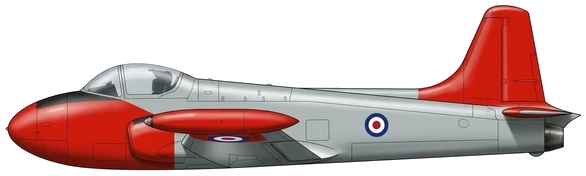
| Crew | 2 (student, instructor) |
| Length | 10.4 m (34.0 ft) |
| Wingspan | 10.8 m (35.3 ft) |
| Height | 3.1 m (10.2 ft) |
| Wing area | 19.9 m² (213.7 sqft) |
| Empty weight | 2,217 kg (4,888 lbs) |
| Max. takeoff weight | 4,173 kg (9,200 lbs) |
| Powerplant | 1 × turbojet Armstrong Siddeley Viper Mk.202 1,134 kgf each |
| Maximum speed | 707 km/h (439 mph) |
| Operational range | 1,445 km (898 mi) |
| Service ceiling | 11,200 m (36,745 ft) |
| Climb rate | 20.3 m/s (66.6 ft/s) |
- Unguided Bomb 540 lb (245 kg) bomb (armed export versions)
- Rocket Pod 68 mm SNEB rocket pod (armed export versions)
- Unguided Rocket 60 lb or 25 lb rockets (armed export versions)
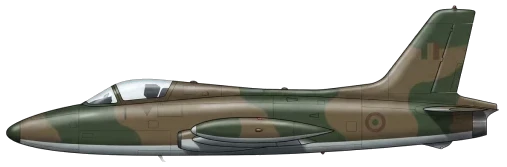
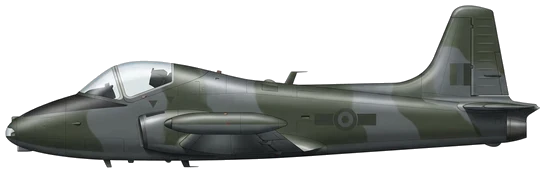
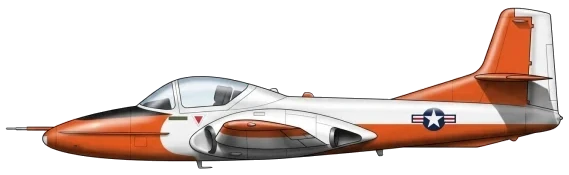
Description
The BAC Jet Provost is a British two-seat jet trainer developed by Hunting Percival from the piston-engined Percival Provost and later built by the British Aircraft Corporation. It served with the Royal Air Force from 1955 to 1993. According to Flight International, it was the first ab initio jet trainer standardised by any air force. Armed versions were exported, and the design led to the BAC Strikemaster.
Development
Hunting Percival began design studies in 1951 as a private venture. To speed development, the design reused the Provost's tail surfaces, wings and main undercarriage legs. Ministry of Supply sponsorship and an order for service-test aircraft followed in March 1953. The prototype, XD674, first flew from Luton on 26 June 1954, and Boscombe Down trials led to shortened undercarriage legs. The first of ten pre-production T1s flew on 19 February 1955, and Central Flying School trials ended at RAF Hullavington in July 1956. The T2 was used only for development and flew on 1 September 1955 with hydraulic systems and a dorsal fillet. The T3 first flew on 22 June 1958, and 201 were delivered by 1962. The T4 followed on 15 July 1960 and the pressurised T5 on 28 February 1967.
Design
The instructor and student sit side by side with duplicated controls. The flight surfaces are moved manually by cables and tie rods. A Centralised Warning Panel indicates icing, fire and oxygen failure. The all-metal fuselage has a double-framed forward section that carries wing and engine loads, and a semi-monocoque rear section. Fuel is carried in the wings, and 49 panels give maintenance access. A single Armstrong Siddeley Viper turbojet sits behind the cockpit, fed by two ram-air intakes. The T5 reaches 707 km/h at 7,620 m and has a 1,440 km range with tip tanks.
Armament
The T51 and T52 export versions carry two 7.7 mm (0.303 in) machine guns. External loads listed for the Mark 55 are six 60 lb or twelve 25 lb rockets, 28 68 mm SNEB rockets in four pods, or four 540 lb (245 kg) bombs.
Operational History
The RAF accepted the type in 1957, and the T3 entered service with No. 2 FTS at RAF Syerston in June 1959. The type later equipped the Central Flying School, RAF College Cranwell and Nos. 1, 3, 6 and 7 FTS. RAF Brawdy used it to train Forward Air Controllers. The T5 was also used for aerobatic, air warfare and tactical weapons training. The Short Tucano replaced the Jet Provost in the early 1990s.
Ceylon received 12 T51s, which were mothballed in the late 1960s. During the 1971 JVP insurrection, they were readied in three days and flew ground attack sorties against targets marked by helicopters. Nigeria used two ex-Sudanese T51s against Biafra from 1967. Iraq, Kuwait, Sudan, Venezuela, South Yemen and Singapore also operated the type, while Australia and Portugal each evaluated a single aircraft.
Variants
- T1: Pre-production version, of which ten were built for evaluation and Central Flying School trials.
- T3: First production version, with a more powerful Viper, ejector seats and a shortened, strengthened undercarriage.
- T4: Version fitted with the 2,500 lb Viper A.S.V. 11.
- T5: Pressurised version with the Viper 201, delivered from Warton beginning in 1969.
- T51/T52/T55: Export versions armed with two 7.7 mm machine guns.
Frequently Asked Questions
What type of aircraft is the Jet Provost?
What is the maximum speed of the Jet Provost?
What is the range of the Jet Provost?
When did the Jet Provost first fly?
Which countries operate the Jet Provost?
What is the service ceiling of the Jet Provost?
- SEP 302026 Created Page created: Jet Provost