NH90 / Caiman
Summary
| Category | Military Helicopters |
| Origin country | 🇩🇪 Germany • 🇫🇷 France • 🇮🇹 Italy • 🇳🇱 Netherlands |
| Manufacturer | NHIndustries |
| First flight | 18 December 1995 |
| Year introduced | 2004 |
| Number produced | 471 units |
| Average unit price | $42 million |
Technical specifications
| Version: NH-90 TTH | |
|---|---|
| Crew | 1 to 3 |
| Operational range | 880 km (547 mi) |
| Maximum speed | 300 km/h (186 mph) |
| Wingspan | 16.3 m (53.5 ft) |
| Height | 5.3 m (17.4 ft) |
| Length | 19.6 m (64.2 ft) |
| Service ceiling | 6,000 m (19,685 ft) |
| Empty weight | 6,400 kg (14,110 lbs) |
| Max. takeoff weight | 10,600 kg (23,369 lbs) |
| Climb rate | 11.2 m/s (36.7 ft/s) |
| Powerplant | 2 x turboprops Rolls-Royce-Turbomeca RTM322 delivering 1693 kW each |
Current operating countries
| Country | Units | ||
|---|---|---|---|

|
Italy | 114 | |

|
Germany | 101 (+30) | |

|
France | 90 (+17) | |

|
Qatar | 28 | |

|
Spain | 25 (+49) | |

|
Finland | 20 | |

|
Greece | 20 | |

|
Netherlands | 19 (+3) | |

|
Oman | 18 | |

|
Sweden | 18 | |

|
New Zealand | 8 | |

|
Belgium | 4 | |
All operators
1 recent event involving the NH90 / Caiman
| Date | Air Force | Aircraft | Active Δ | Ordered Δ |
|---|---|---|---|---|
| 22 Mar 2026 | 🇶🇦 Qatar Emiri Air Force | NH90 (NFH/TTH) | -1 | — |
| NH90 crashed into Persian Gulf during joint Qatar-Turkey training after technical malfunction; all 7 aboard killed. Details → | ||||
Description
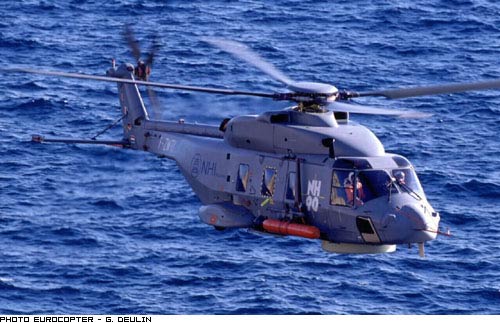
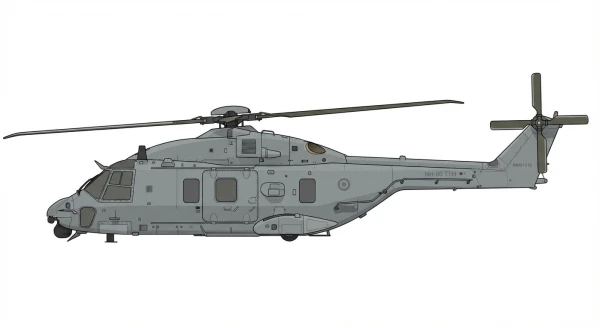
The NH90 was developed in response to North Atlantic Treaty Organization (NATO) requirements for a battlefield helicopter also capable of operating in naval environments. Developed and manufactured by NHIndustries, a collaborative company owned by Airbus Helicopters, Leonardo, and Fokker Aerostructures, the first prototype conducted its maiden flight in December 1995. Design work on the helicopter started in 1993, and the second and third prototypes followed in March 1997 and November 1998, respectively. In June 2000, the partner states placed a production order for a total of 366 helicopters, and additional orders have since followed from customers in Europe, Asia, and Australia. As of early 2023, there were 597 on order, and the 500th airframe was delivered at that time.
One key innovation of the rotorcraft is the four-channel fly-by-wire control system employed; the NH90 is the first helicopter in the world to be equipped with full fly-by-wire flight controls. A four-axis autopilot is also integrated with the fly-by-wire system, as are mission and navigation systems, to enable greater autonomy during operations and reduce pilot workload. The flight envelope of the NH90 is capable of all-weather day-and-night operations, ship-borne operations during high sea states, across a temperature range from −40 °C to +50 °C, and up to a maximum altitude of 20,000 feet. Power is provided by a pair of turboshaft engines, dependent on customer selection, the NH90 is either fitted with Rolls-Royce Turbomeca RTM322 or General Electric CT7-8F powerplants; exhaust gases from the engines are filtered through an infrared suppression system for decreased sensory visibility. The NH90 has three gearboxes including the Main Gearbox (MGB), Intermediate Gearbox (IGB), and a Tail Rotor Gearbox (TGB). The NH90 possesses the lowest radar signature in its class, principally due to its diamond-shaped composite fuselage.
The NH90's armament varies depending on its variant and intended role. The NFH (NATO Frigate Helicopter) version is equipped for anti-submarine warfare (ASW) and anti-surface unit warfare, and thus can carry anti-submarine missiles and/or air-to-surface missiles. The TTH (Tactical Transport Helicopter) version, typically employed in land-based operations, can be fitted with two door guns for self-defense and fire support, and is capable of carrying 20 mm cannon pods and rocket pods for offensive missions.
Since entering operational service in 2007, the NH90 has been deployed in various theaters by a dozen countries, with two main versions: the TTH for army use and the NFH for naval operations. It has undertaken missions including naval search and rescue, anti-submarine warfare (ASW), troop transport, special operations, disaster relief, and medical evacuation. Operational challenges have included delays in delivery, high maintenance demands, software issues, and durability concerns. Some nations opted for early retirement, while others continue to invest in upgrades and expanded roles. The global use of the NH90 has seen specialization of variants to meet specific requirements.
Main Variants:
-
NFH: NATO Frigate Helicopter: This naval variant is primarily designed for autonomous anti-submarine warfare (ASW) and anti-surface unit warfare (ASuW) from naval vessels.
-
SH-90A: Italian Navy designation from 2012 for NH90 NFH, indicating its specific use within the Italian naval forces.
-
NH90 NFH Caïman: This is the French Navy's designation for their version of the NH90 NFH, tailored to their operational requirements.
-
NH90 Sea Lion: A German Navy development of the French NH90 NFH, the Sea Lion features a reduced set of sensors as the main task is SAR and ship based Transport (VERTREP and Special Forces).
-
NH90 Sea Tiger: Another German Navy development of the NFH90 for anti-submarine warfare (ASW) and anti-surface unit warfare, which operates in conjunction with German Navy Frigates.