NH90 / Caiman vs UH-60 Black Hawk
NH90 / Caiman vs UH-60 Black Hawk at a glance — top speed 300 vs 294 km/h, range 880 vs 2,221 km, max takeoff weight 10,600 vs 10,659 kg, built 471 vs 5,000 units.
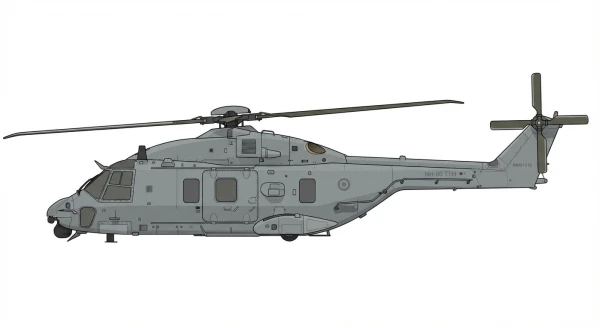
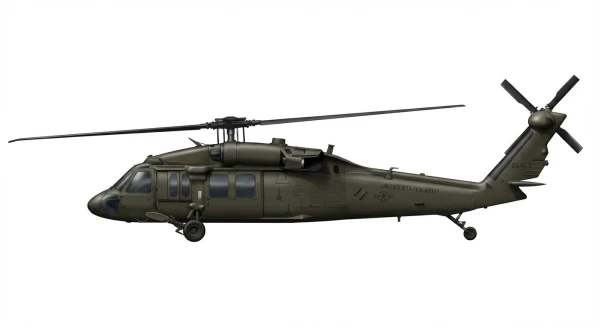
| NH90 / Caiman | UH-60 Black Hawk | |
|---|---|---|
| Origin country | 🇩🇪 Germany🇫🇷 France🇮🇹 Italy🇳🇱 Netherlands | 🇺🇸 United States |
| Category | Military Helicopters | Military Helicopters |
| Manufacturer | NHIndustries | Sikorsky |
| First flight | 18 December 1995 | 29 November 1974 |
| Year introduced | 2004 | 1979 |
| Number produced | 471 units | 5000 units |
| Average unit price | $42 million | $21 million |
| Wingspan | 16.3 m | 16.4 m |
| Height | 5.3 m | 4.9 m |
| Length | 19.6 m | 19.5 m |
| Maximum speed | 300 km/h | 294 km/h |
| Operational range | 880 km | 2,221 km |
| Service ceiling | 6,000 m | 5,791 m |
| Max. takeoff weight | 10,600 kg | 10,659 kg |
| Empty weight | 6,400 kg | 4,819 kg |
| Total thrust | 2 x 1,693 kW | 2 x 1,208 kW |
Detailed Comparison
The NH90 and UH-60 Black Hawk represent different generational and philosophical approaches to the medium-lift utility helicopter. The NH90, a product of a multi-national European consortium, was conceived as a high-tech, multi-role platform with distinct naval (NFH) and land (TTH) versions. In contrast, the Sikorsky UH-60 Black Hawk is an older, combat-proven American design focused on utility, reliability, and adaptability, which has since evolved into a large family of specialized aircraft.
Development and Design
The NH90’s design was driven by a NATO requirement for a common helicopter. Its key innovations include being the world's first production helicopter with full fly-by-wire flight controls and a diamond-shaped, all-composite fuselage to reduce its radar signature. This focus on advanced technology aimed to deliver a leap in capability but also contributed to its complexity and high cost of $42 million per unit. The UH-60 was developed from a U.S. Army competition to replace the UH-1 Huey, prioritizing durability, crashworthiness, and performance. Its design is more conventional but has proven exceptionally robust and adaptable over decades of service, allowing for continuous upgrades and specialization from a mature, reliable base.
Specifications and Performances
The NH90 offers superior flight performance, with a greater range of 880 km compared to the Black Hawk's 593 km and a significantly faster rate of climb at 11.2 m/s versus 3.6 m/s. However, the Black Hawk's lower empty weight (4,819 kg vs. 6,400 kg) for a nearly identical maximum takeoff weight gives it a larger useful load. This makes the UH-60 a more efficient pure transport aircraft, while the NH90's weight reflects its heavier, more advanced onboard systems.
Deployment and usage
The Black Hawk's operational history is extensive, serving as a utility workhorse in major conflicts since the 1980s. With over 5,000 units built, its reliability and the maturity of its logistics chain are well-established globally. Its adaptability has spawned numerous variants like the MH-60 for special operations and the SH-60 Seahawk for naval warfare. The NH90 has been deployed in roles from anti-submarine warfare to disaster relief, but its service life has been marked by significant challenges. Several operators have reported issues with high maintenance demands, software integration, and parts availability, leading some nations to ground their fleets or pursue early retirement.
Conclusion
The comparison between the NH90 and the UH-60 is a case of advanced technology versus proven performance. The NH90 provides a modern airframe with cutting-edge systems, a low radar profile, and superior flight characteristics, but this comes with a high acquisition cost and well-documented operational and sustainment difficulties. The UH-60 Black Hawk, while a generation older, offers a less expensive, highly reliable, and combat-tested platform with a vast global support network. The choice ultimately hinges on an operator’s priorities: the high-capability, high-risk proposition of the NH90, or the dependable, versatile, and economical nature of the Black Hawk.