Po-2 Mule
Soviet multirole biplane, introduced in 1929 and deployed extensively during World War II and the Cold War for primary flight training, light night attack, reconnaissance, and liaison duties. Key figures: top speed 152 km/h, range 630 km, service ceiling 3,000 m, max takeoff weight 1,350 kg, built 33,000.
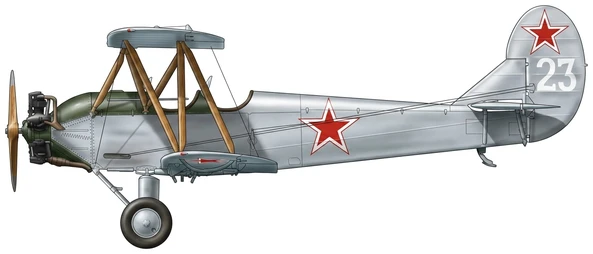
| Crew | 2 |
| Length | 8.2 m (26.8 ft) |
| Wingspan | 11.4 m (37.4 ft) |
| Height | 3.1 m (10.2 ft) |
| Wing area | 33.2 m² (357.4 sqft) |
| Empty weight | 770 kg (1,698 lbs) |
| Max. takeoff weight | 1,350 kg (2,976 lbs) |
| Powerplant | 1 × radial piston engine Shvetsov M-11D 93 kW each |
| Maximum speed | 152 km/h (94 mph) |
| Operational range | 630 km (391 mi) |
| Service ceiling | 3,000 m (9,843 ft) |
| Climb rate | 2.78 m/s (9.1 ft/s) |
- Unguided Bomb FAB-50
Description
The Polikarpov Po-2 (designated U-2 until 1944) is a Soviet all-weather multirole biplane designed as a primary trainer and light utility aircraft. Developed by Nikolai Polikarpov, the type entered serial production in 1929 and served in light ground-attack, aerial reconnaissance, medevac, and liaison roles. It is known for its long production span, high production volume, and low-altitude night bombing tactics during World War II and the Korean War.
Development
Nikolai Polikarpov designed the U-2 to replace the U-1 trainer. Powered by a 74 kW (99 hp) Shvetsov M-11 air-cooled five-cylinder radial engine, the prototype first flew on 7 January 1928 piloted by M.M. Gromov. Serial production commenced in 1929 at Factory No. 23 in Leningrad and expanded to other facilities, including a plant near Moscow. Following Polikarpov's death, the aircraft was redesignated Po-2 in 1944. Soviet production ended in 1953, though total combined production reached between 20,000 and 33,000 units, including license-built Polish models assembled until 1959.
Design
The aircraft is an open-cockpit biplane constructed primarily of wood and fabric. It is powered by an air-cooled five-cylinder Shvetsov M-11 radial engine driving a two-bladed fixed-pitch propeller, providing short takeoff and landing capabilities and a low stall speed. Its light construction yielded a small radar cross-section, while specific military adaptations included belly armor plating and interchangeable wheel, float, or ski undercarriage configurations.
Armament
Dedicated combat variants, such as the U-2VS and U-2LNB, featured underwing bomb carriers capable of carrying up to 350 kg (771 lb) of ordnance, typically six 50 kg FAB-50 bombs or combinations of 50 kg and 100 kg high-explosive bombs. Defensive armament comprised a single 7.62 mm ShKAS or DA machine gun mounted in the rear observer cockpit. Ground-attack configurations could also be fitted to launch four RS-82 unguided rockets.
Operational History
During World War II, the Po-2 operated extensively on the Eastern Front, delivering supplies to partisan forces and conducting medical evacuations. Adapted into a light night attack aircraft, it was operated by specialized units such as the all-female 588th Night Bomber Regiment. These crews executed low-altitude gliding night strikes, using the biplane's low stall speed and maneuverability to evade German Bf 109 and Fw 190 fighters. During the Korean War, North Korean forces deployed the biplane for night raids against UN airbases, damaging ground-parked aircraft including P-51 Mustangs and F-86 Sabres.
Variants
- U-2: Basic initial production two-seat primary trainer powered by a 75 kW M-11 radial engine.
- U-2VS: Military series two-seat light night bomber equipped with underwing bomb carriers and a rear defensive machine gun.
- U-2LSh: Two-seat ground-attack aircraft armed with a 7.62 mm ShKAS machine gun, underwing bomb racks, and RS-82 rockets.
- U-2S: Air ambulance variant configured with an enclosed rear fuselage compartment or underwing pods for stretcher patients.
- CSS-13: Postwar license-built Polish variant manufactured at WSK-Okęcie and WSK-Mielec.
Frequently Asked Questions
What type of aircraft is the Po-2 Mule?
What is the maximum speed of the Po-2 Mule?
What is the range of the Po-2 Mule?
When did the Po-2 Mule first fly?
How many Po-2 Mule have been built?
What is the service ceiling of the Po-2 Mule?
- AUG 62026 Created Page created: Po-2 Mule