An-12 Cub vs C-130 Hercules
An-12 Cub vs C-130 Hercules at a glance — top speed 770 vs 593 km/h, range 5,700 vs 3,800 km, max takeoff weight 61,000 vs 70,307 kg, built 1,248 vs 2,500 units.
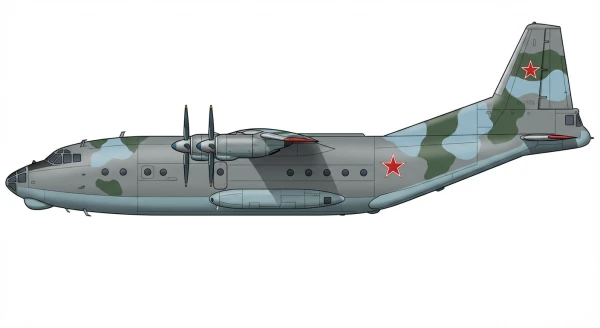
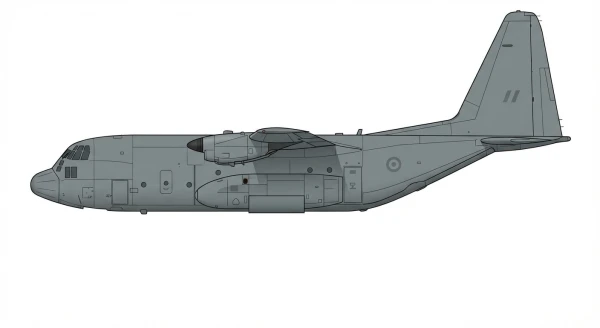
| An-12 Cub | C-130 Hercules | |
|---|---|---|
| Origin country | 🇺🇦 Ukraine | 🇺🇸 United States |
| Category | Military Transport Aircraft | Military Transport Aircraft |
| Manufacturer | Antonov | Lockheed |
| First flight | 16 December 1957 | 23 August 1954 |
| Year introduced | 1959 | 1956 |
| Number produced | 1248 units | 2500 units |
| Average unit price | $20 million | $68 million |
| Wing area | 121.7 m² | 162.0 m² |
| Wingspan | 38.0 m | 40.4 m |
| Height | 10.5 m | 11.7 m |
| Length | 33.1 m | 29.8 m |
| Maximum speed | 770 km/h | 593 km/h |
| Operational range | 5,700 km | 3,800 km |
| Service ceiling | 10,200 m | 10,058 m |
| Max. takeoff weight | 61,000 kg | 70,307 kg |
| Empty weight | 28,000 kg | 35,800 kg |
| Total thrust | 4 x 3,126 kW | 4 x 3,661 kW |
Detailed Comparison
The Soviet Antonov An-12 Cub and the American Lockheed C-130 Hercules are contemporaneous four-engine turboprops that defined tactical airlift for their respective Cold War blocs. Introduced within three years of each other—the C-130 in 1956 and the An-12 in 1959—both aircraft feature a high-wing configuration, rear-loading ramps, and ruggedized landing gear designed for operations from unprepared airstrips. While the C-130 remains in production with over 2,500 units built, the An-12 production line closed in 1973 after 1,248 units, though it continues to see service in secondary markets.
Development and Design
The C-130 was developed to meet a USAF requirement for a versatile transport capable of short takeoff and landing (STOL). Lockheed utilized an aluminum alloy airframe and a high-wing design to maximize ground clearance and cargo volume. Conversely, the An-12 was developed alongside the Antonov An-10 passenger airliner; while they shared aerodynamic principles, the An-12 received a specialized fuselage for heavy military lifting.
A distinct design divergence is the defensive capability. The An-12 incorporates a manned tail turret housing two 23 mm NR-23 cannons, reflecting Soviet doctrine anticipating operations in contested airspace without total air superiority. The C-130 prioritized internal flexibility and standardized pallet loading systems. Additionally, the Chinese Y-8 variant of the An-12 modified the design further by incorporating a bomber-style navigator cockpit derived from the Tu-16.
Specifications and Performances
Performance metrics reveal a significant trade-off between speed and payload capacity. The An-12 possesses a distinct kinematic advantage, with a maximum speed of 770 km/h compared to the C-130's 593 km/h. It also offers a superior range of 5,700 km against the Hercules' 3,800 km, allowing for longer unrefueled logical legs.
However, the C-130 demonstrates superior heavy-lift utility. It features a Max Takeoff Weight of 70,307 kg, surpassing the An-12’s 61,000 kg. Power distribution favors the American platform; its four Allison T56 engines generate 3,661 kW each, providing greater total thrust than the An-12’s Ivchenko-Progress AI-20M engines (3,126 kW). This power advantage is critical for the C-130's ability to operate with heavier loads from shorter runways.
Deployment and Usage
The C-130 has achieved unparalleled operational versatility. Beyond standard troop and cargo transport, airframes were adapted for gunship support (AC-130), aerial refueling (KC-130), electronic warfare (EC-130), and polar operations (LC-130). It has served in every major US conflict since Vietnam, including the Gulf War and operations in Afghanistan.
The An-12 served as the backbone of Soviet tactical airlift. It saw extensive use during the Soviet-Afghan War, where it earned the "Black Tulip" nickname for its role in repatriating fallen soldiers. Notably, the Indian Air Force utilized the An-12 offensively as a heavy bomber during the 1971 Indo-Pakistani War. While the An-12 has been largely retired from Russian and Ukrainian service, it remains active in nations such as Angola and Myanmar.
Conclusion
Ultimately, the An-12 Cub and C-130 Hercules achieved the same objective through similar engineering solutions, yet their legacies diverge on adaptability. The An-12 offered superior speed and range, making it a strategic asset for rapid Soviet deployments. However, the C-130's airframe proved significantly more adaptable to modernization and specialized roles. While the An-12 is a durable relic of Cold War logistics, the Hercules successfully transitioned into the digital age with the C-130J Super Hercules, validating Lockheed’s original design as the definitive platform for medium military transport.