F-15 Eagle vs F-15E Strike Eagle
F-15 Eagle vs F-15E Strike Eagle at a glance — top speed 2,655 vs 2,655 km/h, range 3,971 vs 3,889 km, max takeoff weight 30,844 vs 36,741 kg, built 1,198 vs 525 units.
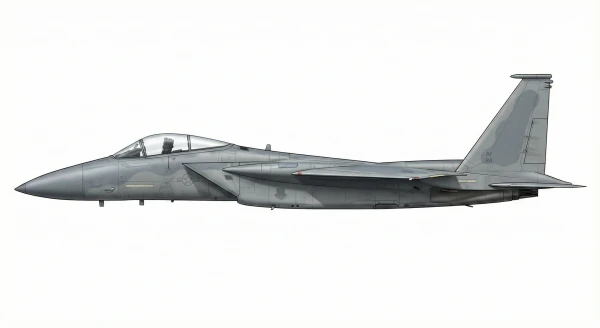
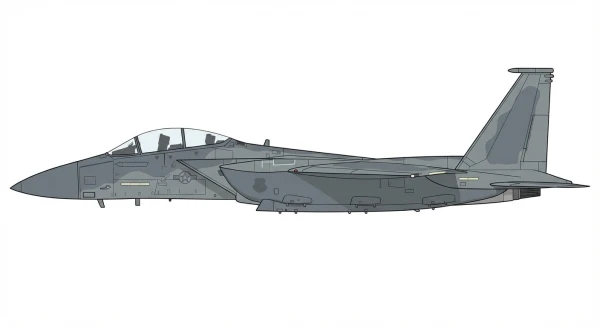
| F-15 Eagle | F-15E Strike Eagle | |
|---|---|---|
| Origin country | 🇺🇸 United States | 🇺🇸 United States |
| Category | Combat Aircraft | Combat Aircraft |
| Manufacturer | McDonnell Douglas | McDonnell Douglas |
| First flight | 27 July 1972 | 11 December 1986 |
| Year introduced | 1976 | 1986 |
| Number produced | 1198 units | 525 units |
| Average unit price | $29 million | $31.1 million |
| Wing area | 56.5 m² | 56.0 m² |
| Wingspan | 13.1 m | 13.1 m |
| Height | 5.6 m | 5.6 m |
| Length | 19.4 m | 19.4 m |
| Maximum speed | 2655 km/h | 2655 km/h |
| Operational range | 3,971 km | 3,889 km |
| Service ceiling | 19,812 m | 18,288 m |
| Max. takeoff weight | 30,844 kg | 36,741 kg |
| Empty weight | 12,701 kg | 14,379 kg |
| Total thrust | 2 x 10,782 kgf | 2 x 13,200 kgf |
Detailed Comparison
Born from the requirement to counter the MiG-25 and dominate visual dogfights, the single-seat F-15C Eagle functions strictly as a kinetic air superiority platform. Conversely, the F-15E Strike Eagle is an evolution engineered for deep interdiction, functioning as a direct replacement for the F-111 Aardvark. While they share a basic aerodynamic mold line, the two platforms execute divergent doctrinal roles: the F-15C clears the airspace, and the F-15E exploits it to strike ground targets.
Development and Design
The original F-15 adhered to the "not a pound for air-to-ground" doctrine, born from Energy-Maneuverability theory and Vietnam-era lessons regarding the vulnerability of heavy fighters to agile interceptors. McDonnell Douglas utilized a 25.8% titanium and 37.3% aluminum semi-monocoque structure to achieve a thrust-to-weight ratio exceeding 1:1. The F-15E, flying a decade later in 1986, discarded the single-mission constraint. Engineers strengthened the airframe to withstand 9-G maneuvers at higher gross weights and integrated a two-seat cockpit. The addition of a Weapons Systems Officer (WSO) in the aft seat manages a complex air-to-ground sensor suite, allowing the pilot to focus on terrain avoidance and defensive counter-air.
Specifications and Performances
The structural modifications required for the F-15E's dual role result in a heavier airframe. The Strike Eagle's empty weight is 14,379 kg, compared to the Eagle's 12,701 kg. To compensate for the mass, the F-15E utilizes uprated Pratt & Whitney F100-PW-229 engines producing a combined 26,308 kgf of thrust, whereas the baseline F-15 operates with 15,830 kgf F100-PW-220s. Key performance disparities include:
- The F-15E's maximum takeoff weight (36,741 kg) exceeds the F-15C's (30,844 kg) by nearly 6,000 kg.
- Both airframes maintain a Mach 2.5 top speed, but the F-15E carries this kinetic energy with a higher wing loading (distributed over a slightly smaller 56.0 m² wing area versus the F-15C's 56.5 m²), which degrades its sustained turn rate compared to a clean F-15C.
- The F-15E integrates Conformal Fuel Tanks (CFTs) as baseline equipment, freeing underwing hardpoints for munitions while maintaining a 1,272 km combat radius.
Deployment and usage
The F-15C built an unblemished combat record operating in sweep and escort roles. Israeli Air Force F-15s destroyed 41 Syrian aircraft in the 1982 Lebanon War, and USAF F-15s secured 36 of 39 fixed-wing kills during Operation Desert Storm. The F-15E's operational history is defined by complex strike packages. During Desert Storm, Strike Eagles executed SCUD hunting and deep interdiction (Package Q). In Operations Enduring Freedom and Inherent Resolve, the F-15E loitered over battlespaces utilizing targeting pods to deploy laser-guided bombs, JDAMs, and SDBs. The airframe's deep-strike adaptability drove continuous export iterations (Saudi Arabia's SA, South Korea's K, Qatar's QA), which directly funded the architecture for the F-15EX.
Conclusion
In a clean, air-to-air engagement, the F-15C holds the kinematic edge. Its lower weight and lower wing loading dictate superior Energy-Maneuverability in Within-Visual-Range combat. However, the F-15E Strike Eagle is the superior combat aircraft for modern military doctrine. Its structural fatigue life, diverse ordnance capacity, and two-crew division of labor for sensor management allow it to persist in complex multi-domain environments. Pure air superiority platforms like the F-15C face retirement without direct 1:1 replacements, while the F-15E's multirole architecture forms the basis for current USAF procurement.