F-15E Strike Eagle vs Su-34 Fullback
F-15E Strike Eagle vs Su-34 Fullback at a glance — top speed 2,655 vs 1,900 km/h, range 3,889 vs 4,500 km, max takeoff weight 36,741 vs 45,000 kg, built 525 vs 155 units.
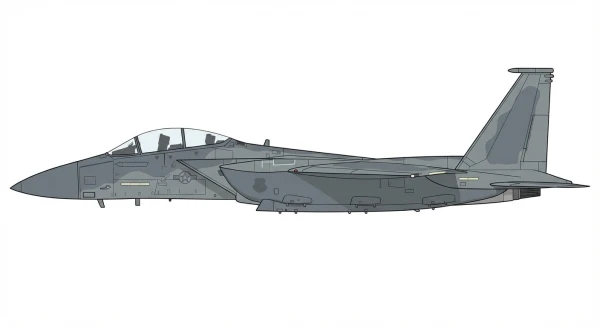
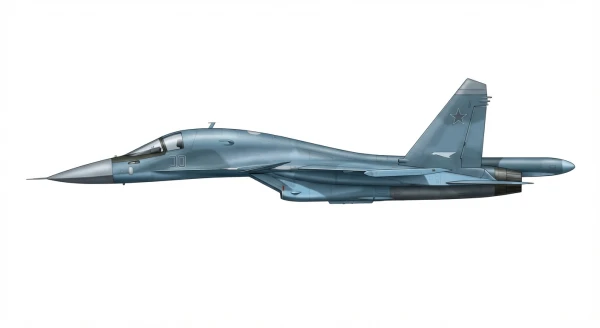
| F-15E Strike Eagle | Su-34 Fullback | |
|---|---|---|
| Origin country | 🇺🇸 United States | 🇷🇺 Russia |
| Category | Combat Aircraft | Combat Aircraft |
| Manufacturer | McDonnell Douglas | Sukhoi |
| First flight | 11 December 1986 | 13 April 1990 |
| Year introduced | 1986 | 2014 |
| Number produced | 525 units | 155 units |
| Average unit price | $31.1 million | $36 million |
| Wing area | 56.0 m² | 52.0 m² |
| Wingspan | 13.1 m | 14.7 m |
| Height | 5.6 m | 6.4 m |
| Length | 19.4 m | 23.3 m |
| Maximum speed | 2655 km/h | 1900 km/h |
| Operational range | 3,889 km | 4,500 km |
| Service ceiling | 18,288 m | 15,000 m |
| Max. takeoff weight | 36,741 kg | 45,000 kg |
| Empty weight | 14,379 kg | 20,000 kg |
| Total thrust | 2 x 13,200 kgf | 2 x 13,460 kgf |
Detailed Comparison
McDonnell Douglas developed the F-15E Strike Eagle by adapting an air superiority airframe into a deep interdiction platform, retaining the kinematic performance of a dedicated fighter. Sukhoi engineered the Su-34 Fullback by taking the Su-27 airframe and heavily modifying its forward section to function as a dedicated, armored tactical bomber to replace the Su-24. While both occupy the twin-engine, heavy strike fighter category, their structural divergence dictates completely different operational envelopes.
Development and Design
The F-15E retains the tandem seating and aerodynamic profile of the F-15, relying on conformal fuel tanks (CFTs) to extend unrefueled range without sacrificing weapon hardpoints. This minimizes drag and preserves the airframe’s high-G maneuverability. Sukhoi opted for a side-by-side cockpit to improve crew coordination on long-duration sorties. The Su-34 incorporates a 17mm titanium armored "bathtub" around the cockpit, inflating its empty weight to 20,000 kg—nearly 5,600 kg heavier than the F-15E. This armor reflects Soviet doctrine expecting low-level penetration through dense short-range air defense (SHORAD) networks, a design choice that permanently compromises the Su-34's agility and air-to-air viability.
Specifications and Performances
The F-15E’s twin Pratt & Whitney F100-PW-229 engines generate 26,308 kgf of thrust against a 14,379 kg empty weight, enabling a 2,655 km/h top speed and a high thrust-to-weight ratio. The Su-34, powered by AL-31F turbofans, produces 25,000 kgf of thrust but must push a 45,000 kg maximum takeoff weight, limiting its speed to 2,120 km/h and severely restricting its climb rate.
- Targeting Infrastructure: Modern F-15E variants utilize AESA radars and advanced external targeting pods (Sniper, Litening) for autonomous precision strikes at high altitudes. The Su-34 relies on its internal Platan electro-optical targeting system, which lacks the resolution and field of regard of Western pods, limiting its ability to self-designate targets from safe standoff distances.
Deployment and usage
The F-15E has a 30-year combat record. During Desert Storm, it hunted Scud launchers; over the Balkans and Afghanistan, it delivered precision-guided munitions (PGMs) from medium altitudes, bypassing SHORAD entirely. The Su-34’s record is strictly bifurcated. In Syria, operating against insurgents lacking complex anti-air capabilities, it functioned adequately dropping unguided FAB-500s. However, the 2022 invasion of Ukraine exposed systemic flaws. Russian forces repeatedly committed Su-34s to low-altitude unguided bomb delivery profiles due to PGM shortages. This resulted in dozens of documented airframe losses to man-portable air-defense systems (MANPADS) and medium-range SAMs. The titanium armor proved insufficient against modern kinetic interceptors.
Conclusion
The F-15E outperforms the Su-34 in contested airspace. By operating at medium-to-high altitudes with advanced targeting pods and reliable PGMs, the F-15E avoids the low-altitude threat environment the Su-34 was built to survive. Furthermore, the F-15E retains credible beyond-visual-range air-to-air lethality with AIM-120s, whereas the heavily burdened Su-34 is defensively deficient against modern fighters. The Su-34's side-by-side layout suits permissive patrol environments, but in peer-level combat, its reliance on low-altitude penetration makes it highly vulnerable. The global market reflects this: 525 F-15Es have been built with extensive export success, while the Su-34, despite a lower $36.0 million price tag, sits at 155 units with zero foreign buyers.