F-15E Strike Eagle vs F-16 Fighting Falcon
F-15E Strike Eagle vs F-16 Fighting Falcon at a glance — top speed 2,655 vs 2,178 km/h, range 3,889 vs 4,217 km, max takeoff weight 36,741 vs 19,200 kg, built 525 vs 4,604 units.
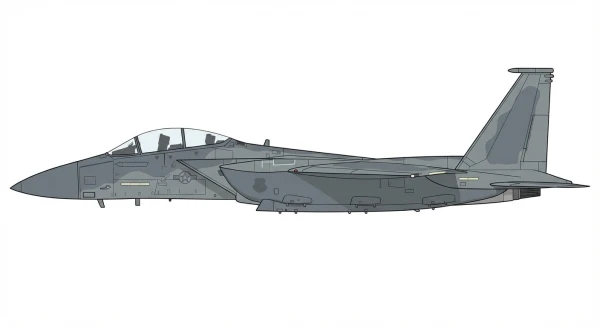
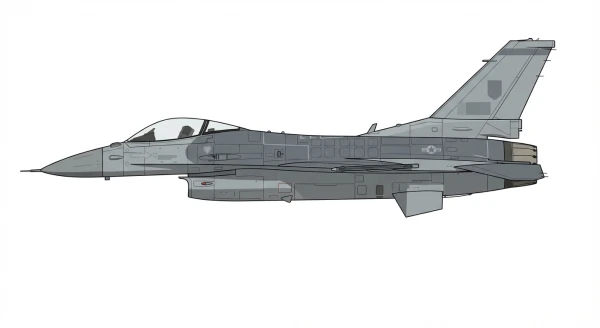
| F-15E Strike Eagle | F-16 Fighting Falcon | |
|---|---|---|
| Origin country | 🇺🇸 United States | 🇺🇸 United States |
| Category | Combat Aircraft | Combat Aircraft |
| Manufacturer | McDonnell Douglas | General Dynamics |
| First flight | 11 December 1986 | 2 February 1974 |
| Year introduced | 1986 | 1979 |
| Number produced | 525 units | 4604 units |
| Average unit price | $31.1 million | $18.8 million |
| Wing area | 56.0 m² | 27.9 m² |
| Wingspan | 13.1 m | 10.0 m |
| Height | 5.6 m | 4.9 m |
| Length | 19.4 m | 15.1 m |
| Maximum speed | 2655 km/h | 2178 km/h |
| Operational range | 3,889 km | 4,217 km |
| Service ceiling | 18,288 m | 15,240 m |
| Max. takeoff weight | 36,741 kg | 19,200 kg |
| Empty weight | 14,379 kg | 8,570 kg |
| Total thrust | 2 x 13,200 kgf | 1 x 12,701 kgf |
Detailed Comparison
At $87.0 million per unit, the McDonnell Douglas F-15E Strike Eagle operates as a heavy, twin-engine interdictor, while the $75.0 million General Dynamics F-16 Fighting Falcon functions as a lightweight, single-engine multirole fighter. The USAF procured 525 Strike Eagles to replace the F-111 Aardvark for unescorted deep-strike missions. By contrast, the F-16, with over 4,600 units built, was designed to populate tactical fighter fleets with a cheaper, high-volume airframe.
Development and Design
The F-16 emerged from the early 1970s Lightweight Fighter Program. Driven by the doctrine of the "Fighter Mafia," it rejected heavy, complex radar interceptors in favor of a 19,200 kg maximum takeoff weight airframe built around a single General Electric F110 engine. It introduced fly-by-wire controls and a relaxed static stability layout to maximize dogfighting kinematics.
The F-15E, completing its first flight in 1986, adapted the F-15 air superiority platform into an all-weather strike fighter. At 36,741 kg maximum takeoff weight, it added conformal fuel tanks (CFTs) and a Weapon Systems Officer (WSO) station. This twin-engine, dual-crew setup allows the F-15E to manage complex air-to-ground targeting while retaining the F100-PW-229 engines' thrust for self-escort.
Specifications and Performances
The physical disparities dictate their tactical employment. The F-15E carries an empty weight of 14,379 kg, nearly double the F-16's 8,570 kg. The F-15E's twin Pratt & Whitney engines produce a combined 26,308 kgf of thrust, pushing the aircraft to Mach 2.5 and outrunning the F-16's Mach 2.0 limit, which is restricted by its single 7,777 kgf engine.
The Strike Eagle achieves a 1,272 km range, surpassing the F-16's 546 km baseline range. This allows the F-15E to carry heavy munitions like the AGM-130 and AGM-158 JASSM deep into contested airspace. The F-16 is limited by its single engine and fewer hardpoints, though newer export blocks (like the UAE's Block 60 F-16E/F) add CFTs to mitigate this gap.
Deployment and usage
Operation Desert Storm in 1991 defined both aircraft's combat records. F-15Es executed the "Package Q" strike over Baghdad and hunted Scud missile launchers, leveraging LANTIRN pods for low-altitude night interdiction. F-16s executed daytime strikes and Suppression of Enemy Air Defenses (SEAD) missions with AGM-88 HARM missiles, initially sustaining higher attrition due to low-altitude unguided bomb delivery before precision targeting pods became standard.
Export markets diverge sharply. Over 25 nations operate the F-16, making it the standard for NATO interoperability. F-16s see frequent combat use by Israel in Lebanon and Syria, and by Turkey in Iraq. The F-15E is restricted to high-budget allies requiring heavy, long-range platforms:
Conclusion
The F-16 has the edge in fleet-wide tactical volume and SEAD operations. Its lower procurement costs and single-seat agility make it the optimal platform for allied nations requiring a standardized, high-sortie-rate fighter for local airspace control and close air support. The F-15E holds the advantage in deep-penetration strike and heavy payload delivery. When a mission requires launching 2,000-lb bunker-busting munitions or standoff cruise missiles at targets 1,000 kilometers away without dedicated fighter escort, the Strike Eagle's twin-engine survivability, WSO workload management, and kinetic performance make it the necessary tool.