F-16 Fighting Falcon vs F-4 Phantom II
F-16 Fighting Falcon vs F-4 Phantom II at a glance — top speed 2,178 vs 2,370 km/h, range 4,217 vs 2,699 km, max takeoff weight 19,200 vs 28,030 kg, built 4,604 vs 5,195 units.
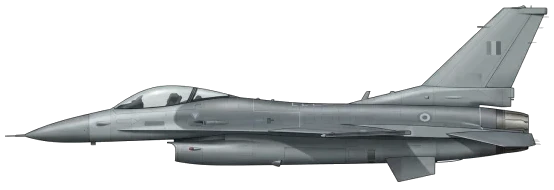
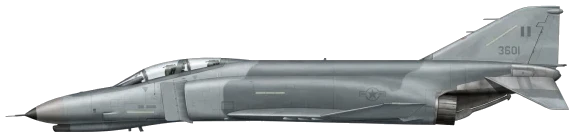
| F-16 Fighting Falcon | F-4 Phantom II | |
|---|---|---|
| Origin country | 🇺🇸 United States | 🇺🇸 United States |
| Category | Combat Aircraft | Combat Aircraft |
| Manufacturer | General Dynamics | McDonnell |
| First flight | 2 February 1974 | 27 May 1958 |
| Year introduced | 1978 | 1962 |
| Number produced | 4604 units | 5195 units |
| Average unit price | $18.8 million | $2.4 million |
| Wing area | 27.9 m² | 49.2 m² |
| Wingspan | 10.0 m | 11.7 m |
| Height | 4.9 m | 5.0 m |
| Length | 15.1 m | 19.0 m |
| Maximum speed | 2178 km/h | 2370 km/h |
| Operational range | 4,217 km | 2,699 km |
| Service ceiling | 15,240 m | 18,288 m |
| Max. takeoff weight | 19,200 kg | 28,030 kg |
| Empty weight | 8,570 kg | 13,757 kg |
| Total thrust | 1 x 12,701 kgf | 2 x 8,094 kgf |
Detailed Comparison
The McDonnell Douglas F-4 Phantom II relies on raw thrust and a second crew member to manage radar intercepts, weighing 28,030 kg fully loaded to push its twin J79 engines to 2,370 km/h. The General Dynamics F-16 Fighting Falcon operates at a fraction of that mass—19,200 kg maximum takeoff weight—using a single F110 engine, fly-by-wire controls, and an inherently unstable aerodynamic profile to allow a single pilot to sustain 9G maneuvers.
Development and Design
The F-4 emerged from a 1953 US Navy requirement for a fleet defense interceptor. McDonnell prioritized speed and missile carriage over agility. Early models omitted an internal gun, reflecting the era's reliance on AIM-7 Sparrow missiles for beyond-visual-range engagements. The F-16 originated from the USAF Lightweight Fighter Program, heavily influenced by combat data from the Vietnam War. The Phantom's high wing loading and poor turn rates against agile MiGs drove the YF-16's design parameters. Designers implemented a frameless bubble canopy for 360-degree visibility, a 30-degree reclined seat for G-tolerance, and relaxed static stability managed by fly-by-wire.
Specifications and Performances
The F-4 produces 16,186 kgf of thrust to move its 13,757 kg empty airframe, yielding a thrust-to-weight ratio below 1:1 when fully loaded. Its 49.2 m² wing area and resulting high wing drag caused rapid energy bleed during turning engagements. The single-engine F-16 uses 7,777 kgf to push an 8,570 kg empty weight, enabling energy retention in sustained turns. While the F-4 requires 1,370 m of takeoff distance, the F-16's high power-to-weight ratio yields a climb rate of 254.0 m/s compared to the F-4's 210.0 m/s. Both airframes accommodate payloads around 8,400 kg across their hardpoints.
Deployment and usage
The F-4 recorded the bulk of US air-to-air kills in the Vietnam War but suffered losses to MiG-17s and MiG-21s in visual-range dogfights. This forced the integration of an internal M61 Vulcan in the F-4E. The F-16 entered service in 1978 and validated the energy maneuverability concept in combat. Israeli F-16s destroyed Syrian MiG-21s and MiG-23s over the Bekaa Valley in 1982 without losses. During Operation Desert Storm in 1991, the division of labor was clear:
- F-16s executed high-volume SEAD, close air support, and strike missions.
- F-4Gs flew specialized Wild Weasel profiles before retiring shortly after.
The F-16 outcompeted export rivals via lower unit costs and continuous radar upgrades, resulting in 4,604 units built versus the F-4's 5,195.
Conclusion
The F-4 Phantom II has the edge in historical fleet defense and heavy payload projection prior to 1980. It served as a brute-force platform hauling heavy nuclear and conventional loads across contested airspaces. However, the F-16 Fighting Falcon wins in modern multirole combat and sustained air superiority. Its energy maneuverability, lower radar cross-section, and native integration of targeting pods and AIM-120 AMRAAMs make it lethal in environments where the F-4's massive heat signature and poor turn rate guarantee its destruction. The F-16 survives today because its aerodynamic baseline balances acquisition cost, payload, and kinetic performance better than mid-century twin-engine interceptors.
-
 United States
846
United States
846
-
 Turkey
235
Turkey
235
-
 Egypt
220
Egypt
220
- All 24 operators →

