F-22 Raptor vs F-35 Lightning II
F-22 Raptor vs F-35 Lightning II at a glance — top speed 2,414 vs 1,960 km/h, range 3,000 vs 2,800 km, max takeoff weight 38,000 vs 27,216 kg, built 195 vs 965 units.
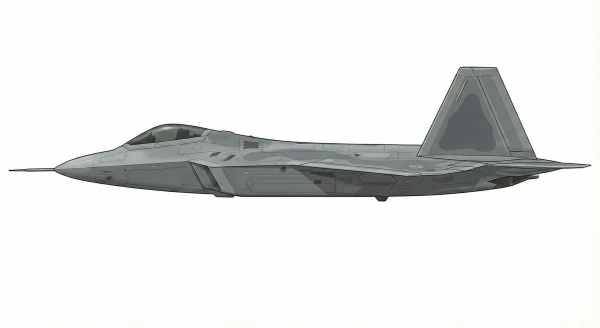
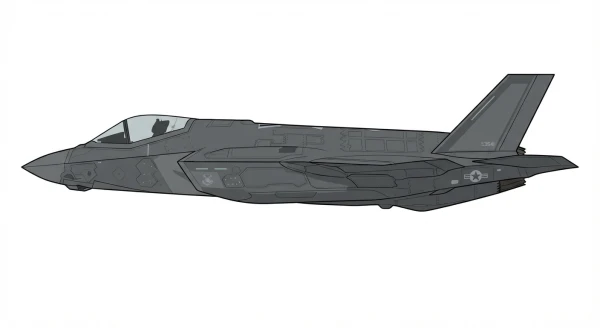
| F-22 Raptor | F-35 Lightning II | |
|---|---|---|
| Origin country | 🇺🇸 United States | 🇺🇸 United States |
| Category | Combat Aircraft | Combat Aircraft |
| Manufacturer | Lockheed Martin | Lockheed Martin |
| First flight | 7 September 1997 | 15 December 2006 |
| Year introduced | 2005 | 2013 |
| Number produced | 195 units | 965 units |
| Average unit price | $150 million | $103 million |
| Wing area | 78.0 m² | 43.0 m² |
| Wingspan | 13.6 m | 11.0 m |
| Height | 5.1 m | 4.4 m |
| Length | 18.9 m | 15.6 m |
| Maximum speed | 2414 km/h | 1960 km/h |
| Operational range | 3,000 km | 2,800 km |
| Service ceiling | 19,812 m | 15,000 m |
| Max. takeoff weight | 38,000 kg | 27,216 kg |
| Empty weight | 19,700 kg | 14,651 kg |
| Total thrust | 2 x 15,876 kgf | 1 x 19,500 kgf |
Detailed Comparison
The F-22 Raptor is a twin-engine air superiority fighter developed to counter advanced Soviet threats, whereas the F-35 Lightning II is a single-engine multirole aircraft designed as a versatile, cost-effective platform for the U.S. and allied nations. The F-22 is a specialized asset built in limited numbers (195 units) and is not for export, while the F-35 program has produced over 965 aircraft for a wide international user base, reflecting its role as a scalable, next-generation workhorse.
Development and Design
The F-22 originated from the Advanced Tactical Fighter (ATF) program, a Cold War initiative prioritizing kinematic performance and air-to-air dominance. Its design incorporates thrust vectoring and supercruise (supersonic flight without afterburner), enabled by its two powerful Pratt & Whitney F119 engines. Its primary innovation was combining unprecedented agility and speed with a very-low-observable stealth airframe.
Conversely, the F-35 emerged from the Joint Strike Fighter (JSF) program, which aimed to create a common airframe for the Air Force, Navy, and Marine Corps to reduce lifecycle costs. Its design prioritizes sensor fusion and network-centric warfare. The Distributed Aperture System (DAS) and Electro-Optical Targeting System (EOTS) provide the pilot with unparalleled situational awareness. The F-35’s three variants (A, B, and C) share commonality but offer distinct basing flexibility—conventional, short takeoff/vertical landing (STOVL), and carrier-based—a level of versatility the F-22 was never designed for.
Specifications and Performances
A comparison of performance data underscores their distinct roles. The F-22 possesses superior flight characteristics for air combat, with a higher maximum speed (2414 km/h vs. the F-35's 1930 km/h) and service ceiling (19,812 m vs. 15,000 m). Its larger wing area (78.04 m²) and twin-engine power contribute to superior agility at high altitudes and speeds.
The F-35's specifications reflect its multirole design. While it lacks the F-22's raw kinematic performance, its single F135 engine is the most powerful fighter engine ever produced, providing significant thrust. Its primary advantages are not in speed or ceiling but in its advanced avionics and stealth, which allow it to penetrate contested airspace to engage air and ground targets. The F-35B variant's STOVL capability, for example, allows it to operate from austere locations and amphibious assault ships, a unique operational advantage.
Deployment and usage
The F-22 is a strategic asset used by the U.S. Air Force to establish and maintain air superiority. It saw its first combat use in 2014 over Syria, primarily in a strike and command-and-control role. Due to its specialized nature and high operating costs, its deployments are deliberate and targeted.
The F-35 has seen much wider and more varied operational use. Its three variants are operated by every U.S. air combat service branch and numerous allied nations. Israel first used its F-35s in combat in 2018. The aircraft's versatility has been demonstrated in roles including:
- Air-to-ground strikes
- Suppression of Enemy Air Defenses (SEAD)
- Close Air Support (CAS)
- Intelligence, Surveillance, and Reconnaissance (ISR)
The F-35's proliferation among allies makes it a cornerstone of coalition air operations, a role the F-22 cannot fill.
Conclusion
The F-22 Raptor is an exceptional air dominance fighter, unmatched in its intended role of clearing the skies of high-end threats. Its design is a product of a "cost-is-no-object" Cold War requirement, resulting in a limited-production, highly potent but specialized asset. The F-35 Lightning II, while a capable fighter, is fundamentally a different tool. It is a flying sensor node and a versatile strike platform, designed for mass production, allied interoperability, and long-term sustainability across a spectrum of missions. The F-22 was built to win the air war; the F-35 was built to be the backbone of 21st-century air power for the U.S. and its partners.