F-35 Lightning II vs F/A-18 E/F Super Hornet
F-35 Lightning II vs F/A-18 E/F Super Hornet at a glance — top speed 1,960 vs 1,915 km/h, range 2,800 vs 2,346 km, max takeoff weight 27,216 vs 29,900 kg, built 1,375 vs 632 units.
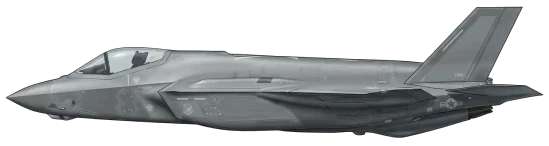
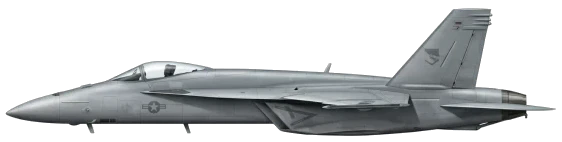
| F-35 Lightning II | F/A-18 E/F Super Hornet | |
|---|---|---|
| Origin country | 🇺🇸 United States | 🇺🇸 United States |
| Category | Combat Aircraft | Combat Aircraft |
| Manufacturer | Lockheed Martin | Boeing |
| First flight | 15 December 2006 | 29 November 1995 |
| Year introduced | 2011 | 2001 |
| Number produced | 1375 units | 632 units |
| Average unit price | $103 million | $70 million |
| Wing area | 43.0 m² | 46.5 m² |
| Wingspan | 10.7 m | 13.6 m |
| Height | 4.4 m | 4.9 m |
| Length | 15.7 m | 18.3 m |
| Maximum speed | 1960 km/h | 1915 km/h |
| Operational range | 2,800 km | 2,346 km |
| Service ceiling | 15,240 m | 15,940 m |
| Max. takeoff weight | 27,216 kg | 29,900 kg |
| Empty weight | 14,651 kg | 14,550 kg |
| Total thrust | 1 x 19,500 kgf | 2 x 9,979 kgf |
Detailed Comparison
The F-35 Lightning II is a single-engine, fifth-generation combat aircraft defined by its very low observable (stealth) characteristics and advanced sensor fusion. In contrast, the F/A-18 E/F Super Hornet is a twin-engine, 4.5-generation evolution of an earlier design, prioritizing payload, operational flexibility, and a lower unit cost of $57.0 million compared to the F-35's $85.0 million. While the F-35 was conceived as a common, next-generation platform for multiple services, the Super Hornet was developed as a more immediate, cost-effective replacement for the F-14 Tomcat, building on a proven airframe.
Development and Design
The F-35's design stems from the Joint Strike Fighter initiative, which mandated a versatile airframe with three distinct variants (A, B, and C) sharing high component commonality. Its philosophy is built around stealth, evident in its composite construction, internal weapons bay, and shaping designed to deflect radar signals. A key innovation is its integrated sensor suite (AESA radar, DAS, EOTS), which fuses data to provide the pilot with comprehensive situational awareness. The Super Hornet's lineage is evolutionary, developed to enhance the original F/A-18's range and payload. It is a larger aircraft with 25% more wing area, but it incorporates radar cross-section reduction features rather than being a true stealth design. Its twin-engine configuration remains a critical feature for naval operations, providing crucial redundancy.
Specifications and Performances
While both aircraft have similar maximum speeds around Mach 1.6, their core performance characteristics diverge. The Super Hornet's two General Electric F414 engines provide the safety of redundancy, a key consideration for carrier operations. The F-35 relies on a single, more powerful Pratt & Whitney F135 engine. The Super Hornet has a higher maximum takeoff weight (29,900 kg vs. 27,216 kg) and a larger external weapons payload of 8,050 kg. The F-35 prioritizes its internal weapons bay to maintain its stealth profile, which is essential for penetrating contested airspace where the Super Hornet would be more vulnerable. The F-35A variant has a greater combat radius (833 km) than the Super Hornet (730 km).
Deployment and usage
The F/A-18 E/F has served as the backbone of the U.S. Navy's carrier air wing since 2002, with extensive combat use in the Middle East. It is a proven workhorse for air superiority and strike missions, with its versatility enhanced by the two-seat F model and the specialized EA-18G Growler electronic attack variant. The F-35 is a more recent system, reaching initial operational capability with U.S. forces between 2015 and 2019. It is designed to act as a force multiplier, penetrating advanced air defenses to gather intelligence and engage high-value targets. Its growing adoption by allied nations is establishing it as a key component of multinational air power.
Conclusion
The F-35 and F/A-18 E/F are complementary assets reflecting different strategic priorities. The F-35 Lightning II is a forward-looking investment in fifth-generation capabilities, where stealth and information dominance are paramount for survivability in high-threat environments. Its high costs are a trade-off for its advanced sensor and networking capabilities. The F/A-18 E/F Super Hornet is a mature and reliable 4.5-generation platform offering significant payload flexibility, proven performance, and lower acquisition costs. The two aircraft are expected to operate in tandem, with the F-35 leveraging its stealth and sensors to support heavily-armed Super Hornets.
-
 United States
724
United States
724
-
 Australia
72
Australia
72
-
 Italy
57
Italy
57
- All 20 operators →