Hawk vs Yak-130 Mitten
Hawk vs Yak-130 Mitten at a glance — top speed 1,028 vs 1,060 km/h, range 2,520 vs 2,100 km, max takeoff weight 8,340 vs 10,290 kg, built 1,000 vs 186 units.
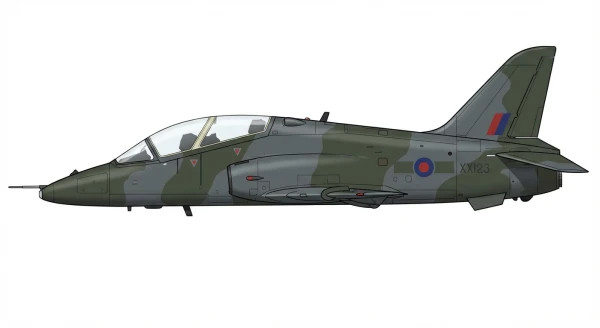
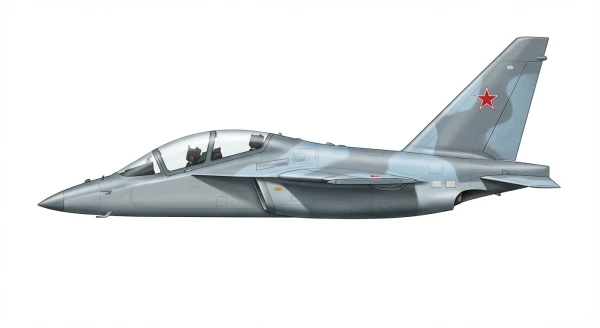
| Hawk | Yak-130 Mitten | |
|---|---|---|
| Origin country | 🇬🇧 United Kingdom | 🇷🇺 Russia |
| Category | Military Training Aircraft | Military Training Aircraft |
| Manufacturer | British Aerospace | Yakovlev |
| First flight | 21 August 1974 | 26 May 1996 |
| Year introduced | 1976 | 2010 |
| Number produced | 1000 units | 186 units |
| Average unit price | $18 million | $18 million |
| Wing area | 16.7 m² | 23.5 m² |
| Wingspan | 9.4 m | 9.8 m |
| Height | 4.1 m | 4.8 m |
| Length | 11.9 m | 11.5 m |
| Maximum speed | 1028 km/h | 1060 km/h |
| Operational range | 2,520 km | 2,100 km |
| Service ceiling | 15,000 m | 12,500 m |
| Max. takeoff weight | 8,340 kg | 10,290 kg |
| Empty weight | 3,635 kg | 4,600 kg |
| Total thrust | 1 x 2,420 kgf | 2 x 2,500 kgf |
Detailed Comparison
The BAE Systems Hawk is a single-engine airframe utilizing 1970s aerodynamics, while the Yakovlev Yak-130 is a fly-by-wire, twin-engine platform from the 1990s. The Hawk relies on iterative digital retrofits to train modern pilots, whereas the Yak-130 uses native programmable flight controls to replicate the handling characteristics of multirole fighters.
Development and Design
The UK Ministry of Defence issued Air Staff Target 397 in 1970 for a fast jet trainer, leading to the Hawk's selection. Hawker Siddeley optimized the design for low acquisition and operating costs, selecting a single Rolls-Royce Turbomeca Adour turbofan and conventional mechanical flight controls. The elevated rear instructor seat maximized forward visibility, setting a standard for tandem trainers.
Yakovlev initiated the Yak-130 post-Soviet collapse, originally partnering with Italy's Aermacchi before the joint venture dissolved. The Yak-130 integrates a quadruplex fly-by-wire system programmed to alter its aerodynamic stability, artificially inducing the high angle-of-attack dynamics of Sukhoi Su-30 and Su-35 fighters. Its twin Ivchenko-Progress AI-222-25 engines provide redundancy entirely absent in the Hawk architecture.
Specifications and Performances
The Yak-130 outpaces the legacy Hawk in payload and kinetic performance, primarily due to its twin-engine configuration generating 5,000 kgf combined thrust versus the Hawk’s 2,420 kgf. This structural divergence creates distinct kinetic profiles:
- The Yak-130 carries up to 3,000 kg of ordnance across nine hardpoints, whereas the base Hawk T1 is limited to 680 kg.
- Yakovlev's airframe climbs at 65 m/s and operates from 335-meter unpaved strips, satisfying Russian austere-basing doctrine.
- The Hawk trades raw power for lower fuel consumption, yielding a 2,520 km range against the Yak-130's 2,100 km.
Both airframes top out at Mach 0.85, but the Yak-130 operates at a higher maximum takeoff weight (10,290 kg vs 8,340 kg), translating directly to heavier weapons integration.
Deployment and usage
BAE Systems built 1,000 Hawks, establishing a massive footprint across NATO and allied air forces. The Hawk transitions pilots to Eurofighter Typhoons and F-35s, though its mechanical baseline requires heavy simulator supplementation to teach fly-by-wire concepts. In combat, Malaysian Hawk 208s conducted airstrikes during the 2013 Lahad Datu standoff, and Zimbabwean Hawks bombed positions in the Second Congo War.
Yakovlev produced 186 Yak-130s, operating as the primary trainer for the Russian Aerospace Forces. Myanmar employs the Yak-130 in an active counter-insurgency role, executing low-altitude bombing runs against rebel factions. Yak-130 exports face heavy friction from CAATSA sanctions, limiting adoption to states like Belarus, Algeria, and Iran.
Conclusion
The Yak-130 holds a definitive edge in modern lead-in fighter training and light ground attack. The Hawk’s 1970s aerodynamic baseline cannot physically replicate the unstable flight dynamics of modern fighters, regardless of glass cockpit retrofits in the Hawk 128/T2. The Yak-130’s reprogrammable fly-by-wire system, twin-engine redundancy, and 3,000 kg payload capacity make it a dual-role asset capable of teaching fifth-generation energy management while executing close air support. The Hawk commands historical market share and secure Western supply chains, but the Yak-130 provides a more capable technical foundation for twenty-first-century air forces.